The discovery of comet C/2013 A1 (SIDING SPRING) was announced on Cbet nr. 3368 & M.P.E.C.
2013-A14, issued on 2013, January 05. The comet was discovered on CCD images obtained by notable Australian observer R. H. McNaught with the 0.5-m Uppsala Schmidt telescope a few days earlier on Jan. 03 (with a discovery magnitude 18.6). Precovery images of the comet *(images taken but not known/recorded of the comet) by the Catalina Sky Survey from 8 December 2012 and Pan-STARRS from 4 October 2012 were subsequently found and then used in an attempt to determine the orbit.
It has been noted that C/2013 A1 will have a very close approach with planet Mars on October 19, 2014. With an observation arc thus far of 148 days, JPL/NASA give a nominal closest approach of ~0.0003578 A.U. which is around 53,500 km on 2014 Oct. 19 at approximately 19:28UT +/- 1:03. The comet will pass Mars at a relative velocity of 56 km/s. Early estimates for the diameter of the nucleus have varied from 5 up to 50 km.
Due to the uncertainty within the orbital calculations, there is also a very small possibility that the comet may impact Mars (~ from 0.1% to 0.01% according to how you handle the observations thus far. See
here for more info about this).
By comparison below you can find a table of the the closest known approaches to the Earth by comets published on
Minor Planet Center website. This list is intended to be complete for comets discovered after 1700
that approached the earth to within 0.1020 AU. It also includes a number
of well-documented earlier approaches by periodic comets. C/1491 B1
allegedly came to within 0.0094 AU on 1491 Feb. 20.0 TT, but the orbit
of this comet is very uncertain.

The plots below made by
Aldo Vitagliano with his software
Solex through a MonteCarlo generation of clones,
"shows a picture of the current prediction taken about half an hour before the possible impact. The generation of clones was made assuming equal weights on all observations (one discarded) and an esd of. 0.5 arcsecs. In total, 2000 clones are represented.......The blue dot represents the "old" nominal solution. The white dot is the new nominal solution and the magenta dot is an impactor. One grid square is 100,000 km and the XY axes are in the plane of the Mars' orbit." (click on the image below for a bigger version)
In the second plot the plane is rotated by 90°, so the axes are now X and Z (Z perpendicular to the Mars' orbital plane). The origin is not longer fixed on Mars, but is fixed on the nominal solution, and the plot shows how Mars moves with respect to the cloud. (click on the image below for a bigger version)
We performed follow-up measurements of this object remotely from the
Faulkes Telescope South (mpc code E10) on 2013, March 04.5 through a 2.0-m f/10.0 Ritchey-Chretien + CCD. (Faulkes Telescope is operated by
Las Cumbres Observatory Global Telescope Network)
Below you can see an image of comet C/2013 A1 (single 80-second exposure. Click on the image for a bigger version). Our team will be closely monitoring this comet and feeding our observations to the minor planet centre to hopefully assist in resolving the orbit, and helping determine whether or not this comet will impact Mars.
More info about this close approach
here &
here.
UPDATE - March 05, 2013
A plot published on
NASA/JPL website shows how comet C/2013 A1 will appear as seen from Mars. The "best observing" occurs when the comet's total brightness is at least magnitude 12 and its elongation from the Sun is 30° or larger.
"During the close Mars approach, the comet will likely achieve a total visual magnitude of zero or brighter as seen from Mars-based assets. The attached illustration shows the comet's approximate, apparent visual magnitude and its solar elongation angle as a function of time as seen from Mars. Because the comet's apparent magnitude is so uncertain, the brightness curve was cut off at apparent visual magnitude zero. However, the comet may get brighter than magnitude zero as seen from Mars. From Earth, the comet will not likely reach naked eye brightness but it could brighten to visual magnitude 8 as seen from the southern hemisphere in mid-September 2014." "Our current estimate for the impact probability is less than one in six hundred and we expect that future observations will allow us to completely rule out a Mars impact." (click on the plot below for a bigger version)
.
 |
| Credit: Jon Giorgini / NASA / JPL |
According to the S&T article (see link above in the post):
Three craft are circling the Red Planet right now (Mars Reconnaissance Orbiter, Mars Odyssey, and ESA's Mars Express), and both Curiosity and Opportunity are roving its surface. Potentially any of them might be commanded to take some comet pictures.
"For example, one of Curiosity's Mast Cameras has a 100-mm focal length and color capability. If the comet performs as expected, says Michael Ravine of Malin Space Science Systems, which built the cameras, some imaging will definitely be planned".
UPDATE - March 07, 2013
In the attempt to extende the observational arc of comet C/2013 A1, we perfomed some follow-up remotely from the Faulkes Telescope South (mpc code E10) on 2013, March 07.5 through a 2.0-m f/10.0 Ritchey-Chretien + CCD. Below you can see our image, stack of 11x80-seconds R-Filtered exposures
. The galaxy just below the comet in the image is
PGC177709. Click on it for a bigger version.
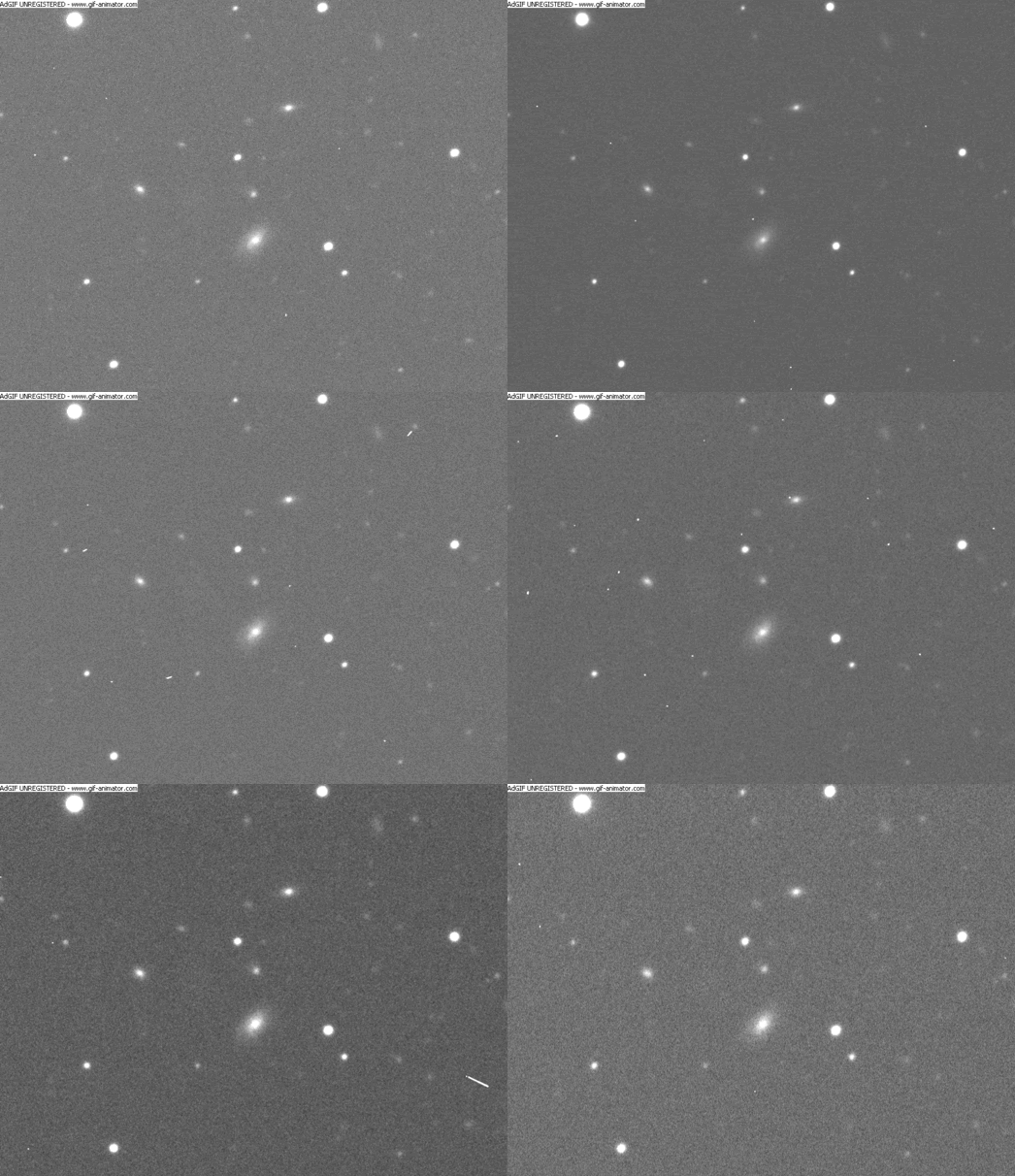
Below you can see an animation (spanning 25 minutes and composed of 11 exposures, 80 seconds each) showing the movement of comet C/2013 A1. Click on the thumbnail below for a bigger version.
Images of taken in collaboration with the Faulkes Project and Horbury Academy. Faulkes Telescope is operated by Las Cumbres Observatory Global Telescope Network.
UPDATE - March 10, 2013
The MPC recently
issued a new batch of comet astrometry (included our Faulkes South observations, see previous update) , and JPL/NASA has just updated their forecast of the upcoming close approach. Now the nominal closest approach is of ~0.0007357 A.U. which is around 110,060 km on 2014 Oct. 19 at approximately 18:50UT +/- 00:57. Probability of impact is now of 1 in 2300.
UPDATE - March 26, 2013
After the latest observations, the probability of impact according to JPL is of 1 in 10000.
Aldo Vitagliano, author of the software
Solex, created a video showing how the comet should miss Mars. In the video Mars is the red disk at the center of the video. The line-of-sight is in the plane of Mars' orbit, and the vertical axis of the plot is perpendicular to the Mars' orbital plane. The movie shows 2000 MonteCarlo clones of the comet, created assuming a standard error of 0.5 arcsecs for the observations. The (retrograd) cloud comes from below the orbital plane and crosses it before Mars arrives. See the video below.
While assuming a standard error of 1 arcsecs for the observations, this results in a more "expanded" cloud of possible comets, and gives a small residual impact probability. See second video below.
UPDATE - October 24, 2014
Please
click here for a selection of some of the most significant results and images obtained from the observation of this flyby on 2014, October 19.
by Ernesto Guido & Nick Howes


_FT_April_15_2013.JPG)


_FTN_04_April_2013.bmp)
.JPG)
.JPG)
_T30_March_14_2013.gif)
_H06_March_15_2013.JPG)


_March_04_2013_FTS.jpg)

_March_07_2013_FTS.JPG)