Showing posts with label Close Approach. Show all posts

Wednesday, October 11, 2017

New Close Approach by Asteroid 2012 TC4

Asteroid 2012 TC4 was discovered by F51 Pan-STARRS 1, Haleakala on images taken on 2012, Oct. 04.4 with a 1.8-m Ritchey-Chretien + CCD. Just eight days after its discovery, on 2012 Oct. 12, this object passed at about 0.25 LD from Earth

After exactly 5 years, 2012 TC4 will have a new close approach with our planet that will provide astronomers with a valuable opportunity to learn more about its orbit and composition and to test the network of observatories and scientists who work with planetary defense. This asteroid was not observed since the week it was discovered in October 2012 and it has been recovered by astronomers using one of the European Southern Observatory's 8.2-meter telescopes at the Very Large Telescope (VLT) on July 27, 2017 at an apparent magnitude of 26.8 (making it the faintest Near Earth Asteroid so far measured).

Credit: ESO/ESA NEOCC/Hainaut (ESO), Micheli (ESA) & Koschny (ESA)

2012 TC4 has an estimated size of 12 m - 27 m (H=26.7) and it will have a close approach with Earth at about 0.13 LD (Lunar Distances = ~384,000 kilometers) or 0.00034 AU (1 AU = ~150 million kilometers) at 0542 UT on 12 Oct. 2017 and it will reach the peak magnitude ~13. (For comparison, the asteroid that hit Earth’s atmosphere near Chelyabinsk, Russia, in February 2013 was roughly 20 meters across). The rapid rotation and lightcurve amplitude (rotation period of 0.2038 hours with a brightness variation of 0.93 magnitude) suggest that the 2012 TC4 is an elongated, monolithic body (a rubble pile would have spun itself apart). Non-principal axis rotation suggests that it probably has a complex (non-ellipsoidal) shape. 2012 TC4 should be detectable at Goldstone from about Oct. 9 - 16, but not at the moment of closest approach, when it will be too far south for Goldstone to track.

Below you can see my image (single 120-second exposure) of 2012 TC4 obtained on 2017, Oct. 11.35, few hours before its close approach. At the moment of the shot, the asteroid was of magnitude ~15.9 and moving at ~24"/min. The asteroid is trailed in the image due to its fast speed. Click on the image below to see a bigger version. (North is up, East is to the left). 


The short animation below is showing the movement of 2012 TC4 (two consecutive 120-second exposure). Click on the thumbnail below to see the animation (North is up, East is to the left).


Thanks to the new observations following its 2017 recovery, it became clear that new orbit solution precludes a possible impact in 2050: "2012 TC4 would miss the keyhole that would lead to an impact with Earth in 2050. This plot shows the b-plane—the asymptotic location of TC4 relative to the Earth before the Earth's gravity starts bending the trajectory of TC4. The b-plane intersections for progressive orbit solutions is shown by the ellipses (dashed lines show 1-σ uncertainties, solid lines show 3-σ uncertainties), while the red dots show the b-plane coordinates that lead to an impact in 2050. Starting with the Sept 28 solution, the 3-σ uncertainites fall well clear of the red dots, indicating that the asteroid will miss the Earth in 2050. Future impacts beyond that date have not been ruled out."

Credit: The 2012 TC4 Observing Campaign


by Ernesto Guido

Wednesday, September 7, 2016

Close Approach of Asteroid 2016 RB1

The asteroid 2016 RB1 was discovered  (at ~ magnitude +19) on 2016, September 05 by Mt. Lemmon Survey (MPC code G96) with a 1.5-m reflector + 10K CCD. 

Asteroid 2016 RB1 has an estimated size of 7.3 m - 16 m (based on the object's absolute magnitude H=27.8) and it will have a close approach with Earth at about 0.1 LD (Lunar Distances = ~384,000 kilometers) or 0.0003 AU (1 AU = ~150 million  kilometers) on 2016, September 7 at 17:20UT and it will reach a peak magnitude of about +12.3. Radio astronomers will try to  observe it as 2016 RB1 could be a really strong radar target during its close approach.

I performed some follow-up measurements of this object on 2016, September 07.6, remotely from the Q62 iTelescope network (Siding Spring, Australia) through a 0.4-m f/3.5 reflector + CCD. Below you can see our image taken with the asteroid at about magnitude +13 and moving at ~ 503 "/min. At the moment of its close approach on Sep 07, around 17UT, 2016 RB1 will move at ~ 2716 "/min (or about  45.2 deg/hour). The asteroid is trailed in the image due to its fast speed. Click on the image below to see a bigger version. (North is up, East is to the left). 


by Ernesto Guido

Monday, October 26, 2015

Close Approach of Asteroid 2015 TB145

The asteroid 2015 TB145 was discovered  (at ~ magnitude +20) on 2015, October 10 by  Pan-STARRS I survey (MPC code F51) with a 1.8-m Ritchey-Chretien + CCD. 

Asteroid 2015 TB145 has an estimated size of 290 m - 650 m (based on the object's absolute magnitude H=19.8) and it will have a close approach with Earth at about 1.3 LD (Lunar Distances = ~384,000 kilometers) or 0.0033 AU (1 AU = ~150 million kilometers) on 2015, October 31 at 17:01UT. This asteroid will reach the peak magnitude about +10 between on October 31. Radio astronomers will try to  observe it as the radar signal-to-noise ratios will be very strong "so this should be one of the best radar targets of the year.  We hope to obtain images with a range resolution as high as 2 m/pixel using DSS-13 to transmit and Green Bank (and possibly Arecibo) to receive. The flyby presents a truly outstanding scientific opportunity to study the physical properties of this object."

Moreover 2015 TB145 is in an extremely eccentric (~0.86) and high inclination (~40 deg) orbit.  It has a Tisserand parameter of 2.937 hinting that it may be cometary in nature. If so, then this would be the first time that the Goldstone radar has imaged a comet from such a close distance. The encounter velocity is 35 km/s, which is unusually high.  

The graphic below depicts the orbit of asteroid 2015 TB145 (click on the image for a bigger version). 

Credit: (NASA/JPL - Caltech)

The graphic below depicts the passage of asteroid 2015 TB145 past Earth on October 31, 2015 (click on the image for a bigger version). 

Credit: P. Chodas (NASA/JPL - Caltech)


This flyby of 2015 TB145 will be the closest by any known space rock this large until asteroid (137108) 1999 AN10 (absolute magnitude H=17.9) flies past Earth in 2027 within one lunar distance. On April 2017, another asteroid "2014 JO25" (absolute magnitude H=18.1) will pass at about 4.8 LD from Earth. 


I performed some follow-up measurements of this object on 2015, October 26.5, remotely from the Q62 iTelescope network (Siding Spring, Australia) through a 0.50-m f/6.8 astrograph + CCD + focal reducer). Below you can see our image taken with the asteroid at about magnitude +16 and moving at ~ 0.78 "/min (full moon was only 48 degree away from the asteroid). At the moment of its close approach on Oct 31, around 17UT, 2015 TB145 will move at ~ 880 "/min (or about  14.7 deg/hour). Click on the image below to see a bigger version. (North is up, East is to the left).


The chart below shows the path of asteroid 2015 TB145 as it sweeps past Earth at 35 km per second. "During this 20-hour-long period the asteroid's magnitude varies from 10.1 to 12.2, and its proximity to Earth will create a parallax shift of ½° or more. So you won't be able to point your telescope based on this track; instead, you will need to consult another source (for example the MPC website) to generate positions specific to your location" (click on the image for a bigger version). 


UPDATE - November 02, 2015

The radar images from Arecibo indicate the object is spherical in shape and approximately 600 meters (2,000 feet) in diameter and completes a rotation about once every five hours.


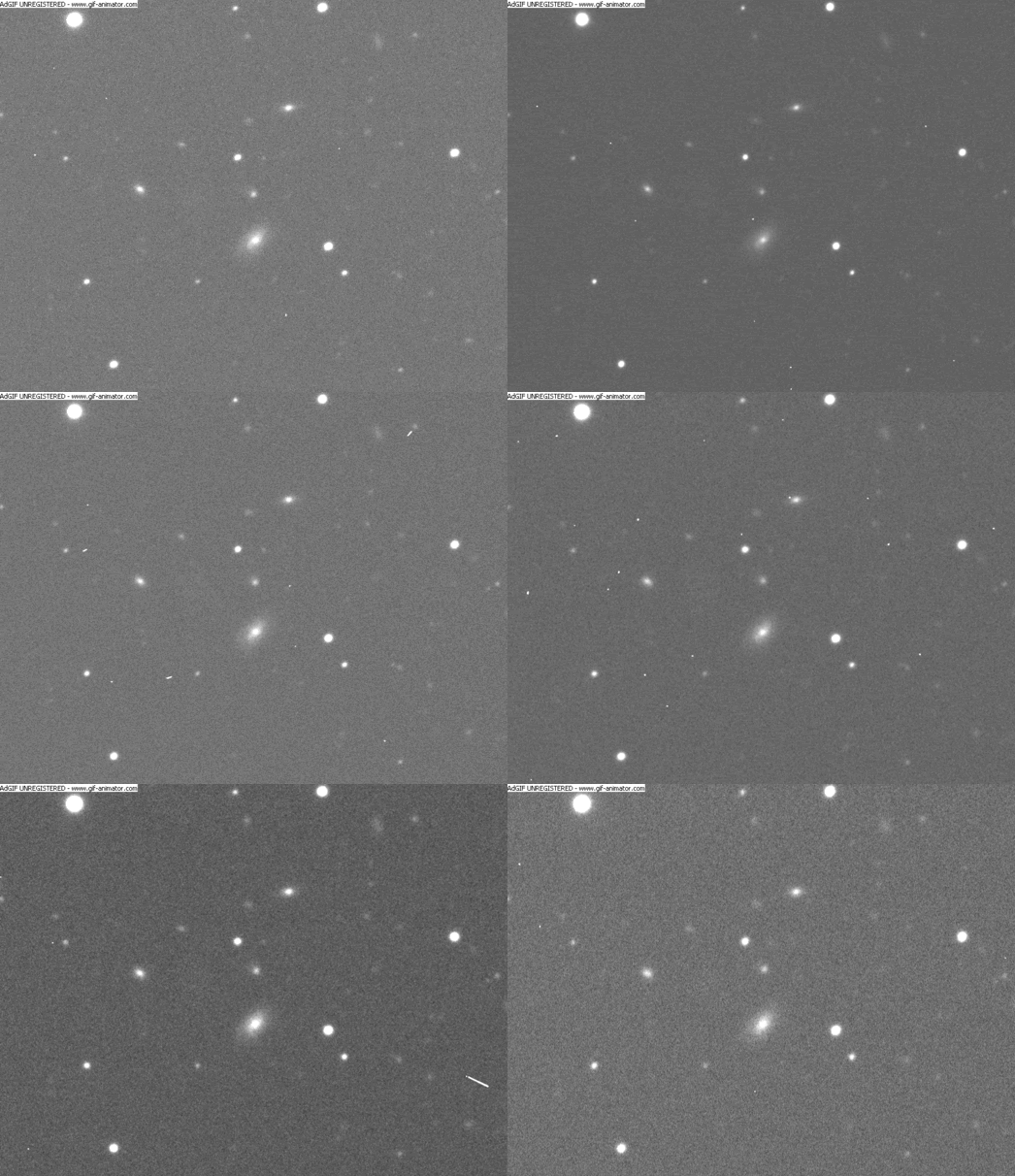
Credits: NAIC-Arecibo/NSF

The animated GIF above was generated using radar data collected by the National Science Foundation's 305-meter (1,000-foot) Arecibo Observatory in Puerto Rico. The six radar images used in the animation were taken on Oct. 30, 2015, and the image resolution is 7.5 meters (25 feet) per pixel.

Radar images obtained at the Arecibo Observatory appear to rotate clockwise, which is noticeable by the movement of bright features. “The bright and dark features are indication of surface irregularities. For example, the central dark feature may be a large circular depression, possibly an impact crater”, commented Dr. James Richardson, USRA Scientist in the Planetary Radar Group. 

Scientists observing asteroid 2015 TB145 with NASA's Infrared Telescope Facility (IRTF) on Mauna Kea, Hawaii, have determined that the celestial object is more than likely a dead comet that has shed its volatiles after numerous passes around the sun. Indeed researchers now estimate that its surface reflects only about 6% of the sunlight that strikes it (most comets have a reflectivity in the range of 3% to 5%, but asteroids are usually considerably higher, around 15% to 20%).

UPDATE - November 03, 2015

Below the new radar animation of asteroid 2015 TB145 obtained by the radar team of Arecibo Observatory on Nov 1, 2015.

Credits: Arecibo Obs/NASA/NSF

by Ernesto Guido

Friday, October 24, 2014

Close Approach of Asteroid 2014 SC324

The asteroid 2014 SC324 was discovered (at ~ magnitude +21.4) on 2014, September 30.2 by Mt. Lemmon Survey (MPC code G96) with a 1.5-m reflector + CCD. 

2014 SC324 has an estimated size of 40 m - 90 m (based on the object's absolute magnitude H=24.1) and it will have a close approach with Earth at about 1.5 LD (Lunar Distances = ~384,000 kilometers) or 0.0038 AU (1 AU = ~150 million kilometers) at 1921 UT on 2014, October 24. This asteroid will reach the peak magnitude about +13.6 at close approach.

We performed some follow-up measurements of this object on 2014, October 24.3 remotely from the H06 iTelescope network (New Mexico, Mayhill) through a 0.25-m f/3.4 astrograph + CCD and a 0.1-m f/5.0 astrograph + CCD. Below you can see our image taken with the asteroid at about magnitude +13.6 and moving at ~ 135 "/min (the asteroid is trailed in the image due to its fast speed). At the moment of its close approach on Oct 24 at 1921 UT, 2014 SC324 will move at ~ 221 "/min. Click on the image below to see a bigger version. North is up, East is to the left. 


Below you can see a short animation showing the movement of 2014 SC324 (five consecutive 60-second exposure). Click on the thumbnail below to see the animation (North is up, East is to the left):


UPDATE - October 30, 2014

Below you can see the Goldstone Radar Images of asteroid 2014 SC324 obtained on October 25, 2014 at 11:46UT. Click on the image below to see a bigger version. While for more info click here


Credit: Goldstone/California Institute of Technology

by Ernesto Guido, Nick Howes & Martino Nicolini

Wednesday, May 7, 2014

Close Approach of Asteroid 2014 JR24

The asteroid 2014 JR24 was discovered (at magnitude ~17.2) on 2014, May 06.3 by Catalina Sky Survey (MPC code 703) with a 0.68-m Schmidt + CCD. 

2014 JR24 has an estimated size of 3.7 m - 8.2 m (based on the object's absolute magnitude H=29.3) and it had a close approach with Earth at about 0.3 LD (Lunar Distances = ~384,000 kilometers) or 0.0007 AU (1 AU = ~150 million kilometers) at 1045 UT on 2014, May 07. This asteroid reached the peak magnitude ~15.6 on May 07, 2014.

We performed some follow-up measurements of this object on 2014, May 07.3, remotely from the H06 iTelescope network (New Mexico) through a 0.43-m f/6.8 astrograph + CCD. Below you can see our image taken with the asteroid at magnitude ~15.7 and moving at ~466.77 "/min. At the moment of its close approach at 1045 UT, 2014 JR24 was moving at ~526 "/min. Click on the image below to see a bigger version. North is up, East is to the left (the asteroid is trailed in the image due to its fast speed).


Below you can see a short animation showing the movement of 2014 JR24 (two consecutive 60-second exposure). Click on the thumbnail for a bigger version:


by Ernesto Guido, Nick Howes & Martino Nicolini

Monday, May 5, 2014

Close Approach of Asteroid 2014 HO132

The asteroid 2014 HO132 was discovered (at magnitude ~19.6) on 2014, April 28.4 by F51 Pan-STARRS 1, Haleakala survey.

2014 HO132 has an estimated size of 19 m - 42 m (based on the object's absolute magnitude H=25.7) and it had a close approach with Earth at about 2.1 LD (Lunar Distances = ~384,000 kilometers) or 0.0055 AU (1 AU = ~150 million kilometers) at 0810 UT on 2014, May 05. This asteroid reached the peak magnitude ~15.6 on May 04, 2014.

We performed some follow-up measurements of this object on 2014, May 05.5, remotely from the Q62 iTelescope network (Siding Spring) through a 0.50-m f/6.8 astrograph + CCD + f/4.5 focal reducer.

Below you can see our image taken with the asteroid at magnitude ~16.4 and moving at ~135.47 "/min. At the moment of its close approach at 0810 UT, 2014 HO132 was moving at ~141 "/min. Click on the image below to see a bigger version. North is up, East is to the left (the asteroid is trailed in the image due to its fast speed).


Below you can see a short animation showing the movement of 2014 HO132 (three consecutive 90-second exposure). Click on the thumbnail for a bigger version:


UPDATE - May 08, 2014

Asteroid 2014 HO132 was observed on May 03, 2014 by radar at Goldstone. Below you can find the radar images, sums of fifteen consecutive runs at a resolution of 3.75 m x 0.11 Hz resolution (click on it for a bigger version).

Credit: NASA/JPL-Caltech/GSSR

by Ernesto Guido, Nick Howes & Martino Nicolini

Wednesday, March 5, 2014

Close Approach of Asteroid 2014 DX110

The asteroid 2014 DX110 was discovered (at magnitude ~20) on 2014, February 28 by F51 Pan-STARRS 1 , Haleakala survey.

2014 DX110 has an estimated size of 19 m - 43 m (based on the object's absolute magnitude H=25.7) and it will have a close approach with Earth at about 0.9 LD (Lunar Distances = ~384,000 kilometers) or 0.0023 AU (1 AU = ~150 million kilometers) at 2100 UT on 2014, March 05. This asteroid will reach the peak magnitude ~14.8 on March 05, 2014.

We performed some follow-up measurements of this object on 2014, March 05.6, remotely from the Q62 iTelescope network (Siding Spring) through a 0.32-m f/9.0 Ritchey-Chretien + CCD + f/6.1 focal reducer.

Below you can see our image taken with the asteroid at magnitude ~15.2 and moving at ~145.84 "/min. At the moment of its close approach in the next few hours, 2014 DX110 will move at ~509"/min. Click on the image below to see a bigger version. North is up, East is to the left (the asteroid is trailed in the image due to its fast speed).


According to a preliminary light-curve published on MPML mailing list by B. Warner, this asteroid is a fast rotator with a period of 0.1204 h (7.2 min) and amplitude 0.36 mag.  Click on the image below to see a bigger version.


Credit: Brian Warner

by Ernesto Guido, Nick Howes & Martino Nicolini

Tuesday, February 11, 2014

Close Approach of Asteroid 2006 DP14

The Potentially Hazardous Asteroid (PHA) 2006 DP14 was discovered on 2006, February 23 by the Massachusetts Institute of Technology Lincoln Near Earth Asteroid  Research (LINEAR) program. PHAs are space rocks larger than approximately 100m that can come closer to Earth than 0.05 AU. None of the known PHAs is on a collision course with our planet, although astronomers are finding new ones all the time.

2006 DP14 has an estimated size of 460 m - 1.0 km (based on the object's absolute magnitude H=18.8) and it had a close approach with Earth at about 6.2 LD (Lunar Distances = ~384,000 kilometers) or 0.0160 AU (1 AU = ~150 million kilometers) at 1905 UT on 2014, February 10. This asteroid reached the peak magnitude ~12.8 on February 11, 2014. Shortly before and after the closest approach, this asteroid will be far enough north for Goldstone to track, and it is expecting to be a strong imaging target. Goldstone tracks are scheduled on February 8, 12, and 13.

We performed some follow-up measurements of this object on 2014, February 11.6, remotely from the Q62 iTelescope network (Siding Spring) through a 0.32-m f/9.0 Ritchey-Chretien + CCD + f/6.1 focal reducer.

Below you can see our image taken with the asteroid at magnitude ~12.8 and moving at ~82.0 "/min. At the moment of the close approach 2006 DP14 was moving at ~142"/min. Click on the image below to see a bigger version. North is up, East is to the left (the asteroid is trailed in the image due to its fast speed).


Below you can see a short animation showing the movement of 2006 DP14 (two consecutive 120-second exposure). Click on the thumbnail for a bigger version:


UPDATE - February 22, 2014

Goldostone has been able to obtain radar images of asteroid 2006 DP14 on February 12, 2014. See image below (click on it for a bigger version).

Credit: NASA

According to this JPL/NASA press release: "Delay-Doppler radar imaging revealed that the asteroid is about 1,300 feet (400 meters) long, 660 feet (200 meters) wide, and shaped somewhat like a big peanut. The asteroid's period of rotation is about six hours. The asteroid is of a type known as a "contact binary" because it has two large lobes on either end that appear to be in contact. Previous radar data from Goldstone and the Arecibo Observatory in Puerto Rico has shown that at least 10 percent of near-Earth asteroids larger than about 650 feet (200 meters) have contact binary shapes like that of 2006 DP14. The data were obtained over an interval of 2.5 hours as the asteroid completed about half a revolution. The resolution is about 60 feet (19 meters) per pixel."


by Ernesto Guido, Nick Howes & Martino Nicolini

Tuesday, December 10, 2013

Close Approach of Asteroid 2013 XY8

M.P.E.C. 2013-X44, issued on 2013, December 08, reports the discovery of the asteroid 2013 XY8 (discovery magnitude 17.7) by Catalina Sky Survey (MPC code 703 ) on images taken on December 07.1 with a 0.68-m Schmidt + CCD.

2013 XY8 has an estimated size of 31 m - 68 m (based on the object's absolute magnitude H=24.7) and it will have a close approach with Earth at about 2 LD (Lunar Distances = ~384,000 kilometers) or 0.0051 AU (1 AU = ~150 million kilometers) at 1117 UT on 2013, December 11. This asteroid will reach the peak magnitude ~14.4 between December 10 & 11.

We performed some follow-up measurements of this object on 2013, December 10.6, remotely from the Faulkes Telescope South (MPC code E10), through a 2.0-m f/10.0 Ritchey-Chretien + CCD (Faulkes Telescope is operated by Las Cumbres Observatory Global Telescope Network).

Below you can see our image taken with the asteroid at magnitude ~15 and moving at ~78.0 "/min. At the moment of the close approach 2013 XY8 will move at ~151"/min. Click on the image below to see a bigger version. North is up, East is to the left (the asteroid is trailed in the image due to its fast speed).


Below you can see a short animation showing the movement of 2013 XY8 (four consecutive 30-second exposure). Click on the thumbnail for a bigger version:
 

by Ernesto Guido, Nick Howes & Martino Nicolini

Wednesday, August 7, 2013

Close Approach of Asteroid 2013 PJ10

M.P.E.C. 2013-P39, issued on 2013 August 06, reports the discovery of the asteroid 2013 PJ10 (discovery magnitude 14.8) by La Sagra Sky Survey (MPC code J75) on images taken on August 04.9 with a 0.45-m f/2.8 reflector + CCD.

2013 PJ10 has an estimated size of 31 m - 70 m (based on the object's absolute magnitude H=24.6) and it had a close approach with Earth at about 1 LD (Lunar Distances = ~384,000 kilometers) or 0.0025 AU (1 AU = ~150 million kilometers) at 0218 UT on 2013, August 04. This asteroid reached the peak magnitude ~13.0 on August 04.

We performed some follow-up measurements of this object on 2013, August 06.3, while it was still on the neocp, remotely from the H06 iTelescope network (New Mexico, Mayhill), through a 0.25-m f/3.4 reflector + CCD. Below you can see our image, stack of 6X15-second exposures, taken with the asteroid at magnitude ~15.3 and moving at ~ 19.0 "/min. At the moment of the close approach 2013 PJ10 was moving at ~ 218"/min. Click on the image below to see a bigger version. North is up, East is to the left


by Ernesto Guido & Nick Howes

Sunday, July 28, 2013

Close Approach of Asteroid 2003 DZ15

M.P.E.C. 2013-O29, issued on 2013 July 20, reports the recovery of the Apollo asteroid 2003 DZ15 (magnitude 18) by F51 Pan-STARRS 1, Haleakala, on images taken on July 19.4 with a 1.8-m Ritchey-Chretien + CCD.

2003 DZ15 was discovered on February 2003 by 608 Haleakala-NEAT/MSSS and it has an estimated size of 95 m - 210 m (based on the object's absolute magnitude H=22.2) and it will have a close approach with Earth at about 9.1 LD (Lunar Distances = ~384,000 kilometers) or 0.0233 AU (1 AU = ~150 million kilometers) at 0037 UT on 2013 July 30. This asteroid will reach the peak magnitude ~16.5 on 29 and 30 July 2013. This is its closest approach to the Earth for this century, although it will make a pass nearly as close to the Earth in 2057 on February 12th.

We performed some follow-up measurements of this object, from the Q62 ITelescope network (Siding Spring, AU) on  2013, July 28.6, through a 0.50-m f/6.8 astrograph + CCD + focal reducer. Below you can see our image, single 120-second exposure, taken with the asteroid at magnitude ~16.6 and moving at ~40.80 "/min. At the moment of the close approach 2003 DZ15 will move at ~52 "/min. Click on the image below to see a bigger version (the asteroid is trailed in the image due to its fast speed).


Below you can see a short animation showing the movement of 2003 DZ15 (three consecutive 120-second exposure). Click on the thumbnail for a bigger version:


by Ernesto Guido & Nick Howes

Friday, May 17, 2013

Close Approach of Asteroid (285263) 1998 QE2

Asteroid (285263) 1998 QE2 was discovered on Aug. 19, 1998, by the Massachusetts Institute of Technology Lincoln Near Earth Asteroid  Research (LINEAR) program.

1998 QE2 has an estimated size of 1.3 km - 2.9 km (based on the object's absolute magnitude H=16.6). It was observed by the Spitzer Space Telescope by Trilling et al. (2010), who estimated that it has a diameter of 2.7 km and a dark optical albedo of  0.06. This asteroid will have a close  approach with Earth at about 15.2 LD (Lunar Distances = ~384,000 kilometers) or 0.0392 AU (1 AU = ~150 million kilometers) at  2059 UT on 2013 May 31 and it will reach the peak magnitude ~10.8 on May 31 around 2300 UT.

(285263) 1998 QE2 will be a great Goldstone radar target May 30 through June 9. This is going to be one of the best radar targets of the year. Radar images from the Goldstone antenna could achieve resolutions as fine as 3.75 meters.

We performed some follow-up measurements of this object, from the Q62 iTelescope network (Siding Spring) on  2013, May 17.36, through a 0.50-m f/6.8 astrograph + CCD + f/4.5 focal reducer. Below you can see our image, stack of 15x10-second exposure, taken with the asteroid at magnitude ~14.5 and moving at ~3.13 "/min. At the moment of the close approach 1998 QE2 will move at ~23 "/min. Click on the image below to see a bigger version. North is up, East is to the left.


Below you can see a short animation showing the movement of 1998 QE2 (15x10-second exposures). Click on the thumbnail for a bigger version:


UPDATE - May 30, 2013

Radar images of asteroid 1998 QE2 obtained on the evening of May 29, 2013, by NASA scientists (led by scientist Marina Brozovic) using the 70-meter Deep Space Network antenna at Goldstone, Calif., show that it is a binary system.

Credit: NASA/JPL-Caltech/GSSR

According to the JPL press release: "Radar images suggest that the main body, or primary, is approximately 2.7 kilometers in diameter and has a rotation period of less than four hours. Also revealed in the radar imagery of 1998 QE2 are several dark surface features that suggest large concavities. The preliminary estimate for the size of the asteroid's satellite, or moon, is approximately 2,000 feet (600 meters) wide. The radar collage covers a little bit more than two hours. In the near-Earth population, about 16 percent of asteroids that are about 200 meters or larger are binary or triple systems."


UPDATE - May 31, 2013

We performed some follow-up measurements of this object on 2013, May 31.3 (few hours before its close approach), remotely from the iTelescope Observatory (H06 Mpc code), through a 0.25-m f/3.4 reflector + CCD. Below you can see our image, 1 single exposure of 180 seconds, taken with the asteroid at magnitude ~11.0 and moving at ~ 21.72 "/min. The asteroid is trailed in the image due to its fast speed. Click on the image below to see a bigger version. North is up, East is to the left.


Below you can see a short animation showing the movement of 1998 QE2 (20 consecutive 10-second exposures). North is up, East is to the left. Click on the thumbnail for a bigger version:


by Ernesto Guido & Nick Howes

Monday, March 4, 2013

Comet C/2013 A1 and its close approach to Mars

The discovery of comet C/2013 A1 (SIDING SPRING) was announced on Cbet nr. 3368 & M.P.E.C. 2013-A14, issued on 2013, January 05. The comet was discovered on CCD images obtained by notable Australian observer R. H. McNaught with the 0.5-m Uppsala Schmidt telescope a few days earlier on Jan. 03 (with a discovery magnitude 18.6). Precovery images of the comet *(images taken but not known/recorded of the comet) by the Catalina Sky Survey from 8 December 2012 and Pan-STARRS from 4 October 2012 were subsequently found and then used in an attempt to determine the orbit.

It has been noted that C/2013 A1 will have a very close approach with planet Mars on October 19, 2014.  With an observation arc thus far of 148 days, JPL/NASA give  a nominal closest approach of ~0.0003578 A.U. which is around 53,500 km on 2014 Oct. 19 at approximately 19:28UT +/- 1:03. The comet will pass Mars at a relative velocity of 56 km/s. Early estimates for the diameter of the nucleus have varied from 5 up to 50 km.

Due to the uncertainty within the orbital calculations, there is also a very small possibility that the comet may impact Mars (~ from 0.1% to 0.01% according to how you handle the observations thus far. See here for more info about this). 

By comparison below you can find a table of the the closest known approaches to the Earth by comets published on Minor Planet Center website. This list is intended to be complete for comets discovered after 1700 that approached the earth to within 0.1020 AU. It also includes a number of well-documented earlier approaches by periodic comets. C/1491 B1 allegedly came to within 0.0094 AU on 1491 Feb. 20.0 TT, but the orbit of this comet is very uncertain.


The plots below made by Aldo Vitagliano with his software Solex through a MonteCarlo generation of clones, "shows a picture of the current prediction taken about half an hour before the possible impact. The generation of clones was made assuming equal weights on all observations (one discarded) and an esd of. 0.5 arcsecs. In total, 2000 clones are represented.......The blue dot represents the "old" nominal solution. The white dot is the new nominal solution and the magenta dot is an impactor. One grid square is 100,000 km and the XY axes are in the plane of the Mars' orbit." (click on the image below for a bigger version)


In the second plot the plane is rotated by 90°, so the axes are now X and Z (Z perpendicular to the Mars' orbital plane). The origin is not longer fixed on Mars, but is fixed on the nominal solution, and the plot shows how Mars moves with respect to the cloud. (click on the image below for a bigger version)


We performed follow-up measurements of this object remotely from the Faulkes Telescope South (mpc code E10) on 2013, March 04.5 through a 2.0-m f/10.0 Ritchey-Chretien + CCD. (Faulkes Telescope is operated by Las Cumbres Observatory Global Telescope Network)

Below you can see an image of comet C/2013 A1 (single 80-second exposure. Click on the image for a bigger version).  Our team will be closely monitoring this comet and feeding our observations to the minor planet centre to hopefully assist in resolving the orbit, and helping determine whether or not this comet will impact Mars.


More info about this close approach here & here.

UPDATE - March 05, 2013

A plot published on NASA/JPL website shows how comet C/2013 A1 will appear as seen from Mars. The "best observing" occurs when the comet's total brightness is at least magnitude 12 and its elongation from the Sun is 30° or larger.

"During the close Mars approach, the comet will likely achieve a total visual magnitude of zero or brighter as seen from Mars-based assets. The attached illustration shows the comet's approximate, apparent visual magnitude and its solar elongation angle as a function of time as seen from Mars. Because the comet's apparent magnitude is so uncertain, the brightness curve was cut off at apparent visual magnitude zero. However, the comet may get brighter than magnitude zero as seen from Mars. From Earth, the comet will not likely reach naked eye brightness but it could brighten to visual magnitude 8 as seen from the southern hemisphere in mid-September 2014." "Our current estimate for the impact probability is less than one in six hundred and we expect that future observations will allow us to completely rule out a Mars impact." (click on the plot below for a bigger version).


Credit: Jon Giorgini / NASA / JPL

According to the S&T article (see link above in the post):

Three craft are circling the Red Planet right now (Mars Reconnaissance Orbiter, Mars Odyssey, and ESA's Mars Express), and both Curiosity and Opportunity are roving its surface. Potentially any of them might be commanded to take some comet pictures.

"For example, one of Curiosity's Mast Cameras has a 100-mm focal length and color capability. If the comet performs as expected, says Michael Ravine of Malin Space Science Systems, which built the cameras, some imaging will definitely be planned".


UPDATE - March 07, 2013

In the attempt to extende the observational arc of comet C/2013 A1, we perfomed some follow-up remotely from the Faulkes Telescope South (mpc code E10) on 2013, March 07.5 through a 2.0-m f/10.0 Ritchey-Chretien + CCD. Below you can see our image, stack of 11x80-seconds R-Filtered exposures. The galaxy just below the comet in the image is PGC177709. Click on it for a bigger version.


Below you can see an animation (spanning 25 minutes and composed of 11 exposures, 80 seconds each) showing the movement of comet C/2013 A1. Click on the thumbnail below for a bigger version.


Images of taken in collaboration with the Faulkes Project and Horbury Academy. Faulkes Telescope is operated by Las Cumbres Observatory Global Telescope Network.

UPDATE - March 10, 2013

The MPC recently issued a new batch of comet astrometry (included our Faulkes South observations, see previous update) , and JPL/NASA has just updated their forecast of the upcoming close approach. Now the nominal closest approach is of ~0.0007357 A.U. which is around 110,060 km on 2014 Oct. 19 at approximately 18:50UT +/- 00:57. Probability of impact is now of 1 in 2300.


UPDATE - March 26, 2013

After the latest observations, the probability of impact according to JPL is of 1 in 10000. Aldo Vitagliano, author of the software Solex, created a video showing how the comet should miss Mars.  In the video Mars is the red disk at the center of the video. The line-of-sight is in the plane of Mars' orbit, and the vertical axis of the plot is perpendicular to the Mars' orbital plane. The movie shows 2000 MonteCarlo clones of the comet, created assuming a standard error of 0.5 arcsecs for the observations. The (retrograd) cloud comes from below the orbital plane and crosses it before Mars arrives. See the video below.


While assuming a standard error of 1 arcsecs for the observations, this results in a more "expanded" cloud of possible comets, and gives a small residual impact probability. See second video below.


UPDATE - October 24, 2014

Please click here for a selection of some of the most significant results and images obtained from the observation of this flyby on 2014, October 19.

by Ernesto Guido & Nick Howes

Close approach of Asteroid 2013 ET

M.P.E.C. 2013-E14, issued on 2013 March 04, reports the discovery of the asteroid 2013 ET (discovery magnitude 16.9) by Catalina Sky Survey (mpc code 703) on images taken on March 03.3 with a 0.68-m Schmidt + CCD.

2013 ET has an estimated size of 64 m - 140 m (based on the object's absolute magnitude H=23.1) and it will have a close approach with Earth at about 2.54 LD (Lunar Distances = ~384,000 kilometers) or 0.0065 AU (1 AU = ~150 million kilometers) at 1207 UT on March 09 2013. This asteroid will reach the peak magnitude ~15.0 on the first hours of March 09.

We performed some follow-up measurements of this object on 2013, March 04.4, while it was still on the neocp, remotely from the Haleakala-Faulkes Telescope North, through a 2.0-m f/10.0 Ritchey-Chretien + CCD (Faulkes Telescope is operated by Las Cumbres Observatory Global Telescope Network). Below you can see our image, stack of 5X10-second exposures, taken with the asteroid at magnitude ~16.9 and moving at ~6.15"/min. At the moment of the close approach 2013 ET will move at ~ 153"/min. Click on the image below to see a bigger version. North is up, East is to the left.


Below you can see a short animation showing the movement of 2013 ET (three consecutive stacks of 5X10-second exposures each). North is up, East is to the left. Click on the thumbnail for a bigger version:


UPDATE - March 10, 2013

Due to its close approach, 2013 ET was a strong radar target at Goldstone. On a message on mpml, JPL Radar Team confirmed  they were able to detect radar echoes from 2013 ET at Goldstone on March 07.

"The radar signal-to-noise ratios were stronger than expected and we obtained images with a range resolution as fine as 7.5 meters/pixel, but even so, the images barely resolve the object into a few range rows because 2013 ET is so small.  The Doppler broadening (aka the bandwidth) of the echoes varies as the asteroid spins, so clearly it's somewhat elongated, and there are hints of irregularity in the shape in the images. We're planning to release some images after the track on March 10 when we should see more detail if things go well."

UPDATE - March 19, 2013

As announced on the previous update of this post, asteroid 2013 ET was successfully targeted by the 70-meter Deep Space Network antenna at Goldstone, Calif. A sequence of radar images was obtained on March 10, 2013 by NASA scientists when the asteroid was about 1.1 million kilometers from Earth, which is 2.9 lunar distances.

"The radar imagery suggests the irregularly shaped object is at least 130 feet (40 meters) wide. The 18 radar images were taken over a span of 1.3 hours. During that interval, the asteroid completed only a fraction of one rotation, suggesting that it rotates once every few hours."

Credit: NASA/JPL-Caltech/GSSR

by Ernesto Guido, Kris Rochowicz & Nick Howes

Tuesday, February 12, 2013

Close Approach of Asteroid 2012 DA14

Asteroid 2012 DA14 was discovered by J75 OAM Observatory, La Sagra on images taken on February 23.03, 2012 with a 0.45-m f/2.8 reflector + CCD. 

2012 DA14 has an estimated size of 40 m - 90 m (based on the object's absolute magnitude H=24.09) and it will have a close approach with Earth at about 0.09 LD (Lunar Distances = ~384,000 kilometers) or 0.0002 AU (1 AU = ~150 million kilometers) at 1925 UT on 2013 Feb. 15.

2012 DA14 will pass only ~ 27,700 km (17,200 mi) above the Earth's surface, that is only 0.09 lunar distances or 5.4 Earth radii from the center of the Earth. So close that it will pass inside the ring of geosynchronous weather and communications satellites (located about 35,800 kilometers (22,200 miles) above the equator, but still well above the vast majority of satellites, including the International Space Station). Due to the extremely close approach, this object will be a very strong radar target at Goldstone where observations are scheduled on 2013 Feb. 16, 18, 19, and 20. Radar images should provide constraints on the size, shape, and rotation state of the object.

Credit: NASA/JPL Near-Earth Object Program Office

This asteroid will reach the peak magnitude ~7 on February 15 around 1930 UT and it will be  brighter than 9th magnitude for approximately 3 hours (18h00-21h30 UTC).  At the moment of the close approach 2012 DA14 will move at ~ 2800"/min (slightly less that 1 degree per minute).  This means it will need only 40 seconds to move the apparent diameter of the Moon. While it will be too faint to be seen with the naked eye, 2012 DA14 will be easily visible with a good set of binoculars or a small telescope. It will rise above the horizon in the constellation Virgo, after that it will move in the direction of the north celestial pole, reaching about 10th magnitude approximately two hours later in the Little Dipper. In the morning hours of February 16, it will have crossed half of the sky, moving slowly close to the Pole Star at a magnitude of 13.

Below you can see an animation (10-minute steps) showing the path of 2012 DA14 from 21:00 UT of Feb. 15 to 02:00 UT of Feb. 16 (calculated for Rome, Italy). Next to the asteroid designation, you can see the expected magnitude value. Click on the animation for a bigger version.


The animated gif below made by Geert Barentsen indicate (green areas) parts of the world where the asteroid will be above (and the Sun below) the horizon during the period of its maximum brigthness (18h00-21h30 UTC of Feb. 15). Observers in Australia, Asia and Europe will be best placed. Click on the animation for a bigger version.


While there is no cause for concern ( 2012 DA14 will NOT impact Earth), this is one of the closest approaches recorded and the record close approach for a known object of this size. The table below shows the top 20 closest approaches by NEOs (Near-Earth Objects) sorted by nominal distance (click on the image for a bigger version).

Credit: NASA/JPL

While the table below shows the top 20 closest approaches by NEOs (Near-Earth Objects) sorted  by nominal distance + absolute magnitude H < =26.  (click on the image for a bigger version).

Credit: NASA/JPL

According to JPL website "on average, we expect an object of this size to get this close to the Earth about once every 40 years. An actual Earth collision by an object of this size would be expected much less frequently, about once every 1200 years on average".

We plan to image 2012 DA14 during its close approach so stay tuned!


UPDATE - February 14, 2013 

Below you can see a short animation showing the motion of asteroid 2012 DA14 on Feb. 14, 2013 at around 11:06UT. The asteroid was moving at ~1.15 "/min and its magnitude was ~17. The animation has been assembled using 3 images taken with Faulkes Telescope South  2.0-m f/10.0 Ritchey-Chretien + CCD operated by Las Cumbres Observatory Global Telescope Network by E. Gomez. Animation by Remanzacco Observatory. Click here or on the animation for a bigger version.


(Credit LCOGT/Faulkes)


UPDATE - February 15, 2013 - 11:00UT

Apparently, at about 09:30 local time, a very big meteor burned up over Chelyabinsk, a city in Russia just east of the Ural mountains, and about 1500 kilometers east of Moscow. A pretty big sonic boom from the fireball, which set off car alarms and shattered windows. There are reports of many people injured (by shattered glass blown out by the shock wave).

According to ESA experts there is NO link between Russia event & asteroid 2012 DA14 close approach.


Here you can see preliminary calculations showing how the 2 events are unrelated.


UPDATE - February 15, 2013 - 20:00UT
We have been able to image 2012 DA14 remotely from Australia on February 15, 2013 at 17:40UT. Exposure time 5 seconds with a 0.50-m f/6.8 astrograph + CCD + f/4.5 focal reducer from Q62 (iTelescope Observatory, Siding Spring). The asteroid was then of magnitude ~9.5 and  moving at ~1140 "/min and less than 2 hours before its close approach of 19:25UT. Click on the image for a bigger version.


Credit: E. Guido & N. Howes

Below you can see a short animation made by using 3x5-second exposures. Click on the thumbnail for a bigger version.


UPDATE - February 15, 2013 - 22:00UT

New image we have obtained remotely from Australia on February 15, 2013 at 18:45UT, just 40 minutes before the close approach. Exposure time 60 seconds with a 0.1m f/5.0 Astrograph + CCD from Q62 (iTelescope Observatory, Siding Spring). The asteroid was then of magnitude ~7.6 and  moving at ~2665 "/min.

Credit: E. Guido & N. Howes

UPDATE - February 16, 2013 - 13:00UT

You can find here a selection (in chronological order) of our images & animations taken before, during and after the close approach.


UPDATE - February 19, 2013 - 19:00UT

An initial sequence of radar images of asteroid 2012 DA14 was obtained on the night of Feb. 15/16, 2013, by NASA scientists using the 230-foot (70-meter) Deep Space Network antenna at Goldstone, Calif. Each of the 72 frames required 320 seconds of data collection by the Goldstone radar.


The observations were made as the asteroid was moving away from Earth. The asteroid's distance from the radar dish increased from 74,000 miles (120,000 kilometers) to 195,000 miles (314,000 kilometers). The resolution is 13 feet (four meters) per pixel. The images span close to eight hours and clearly show an elongated object undergoing roughly one full rotation.

Credit: NASA/JPL-Caltech

by Ernesto Guido & Nick Howes