Showing posts with label asteroids. Show all posts

Saturday, November 30, 2019

Comets & Asteroids - Summary for Sept & Oct 2019

During the 2-month period September through October 2019, 9 new comets were discovered, cometary activity was detected for 1 previously discovered object (earlier designated as asteroids) and there were 6 comet recoveries. "Current comet magnitudes" & "Daily updated asteroid flybys" pages are available at the top of this blog (or just click on the underline text here). See below for the "Other news" section.

The dates below refer to the date of issuance of CBET (Central Bureau Electronic Telegram) which reported the official news & designations.

- Comet Discoveries

Sep 10 Discovery of C/2019 Q3 (PANSTARRS)            (CBET 4665)
Sep 12 Discovery of C/2019 Q4 (BORISOV)                 (CBET 4666)
Oct 05 Discovery of P/2019 S2 (PANSTARRS)             (CBET 4673)
Oct 05 Discovery of P/2019 S3 (PANSTARRS)             (CBET 4674)
Oct 16 Discovery of C/2019 T3 (ATLAS)                       (CBET 4678)
Oct 23 Discovery of C/2019 T4 (ATLAS)                       (CBET 4681)
Oct 23 Discovery of C/2019 T5 (ATLAS)                       (CBET 4682)
Oct 24 Discovery of P/2019 T6 (PANSTARRS)             (CBET 4684)
Oct 28 Discovery of P/2019 U4 (PANSTARRS)             (CBET 4688)


- Cometary activity detected

Oct 06 Cometary activity detected in 2018 DO4 =  C/2018 DO_4 (LEMMON)  (CBET 4675)

- Comet Recoveries

Sep 08 Recovery of P/2007 T4 (GIBBS) as P/2019 R2                   (CBET 4662)
Sep 09 Recovery of P/2008 Y1 (BOATTINI) as P/2019 R1            (CBET 4663)
Sep 27 Recovery of P/2006 R1 (SIDING SPRING) as P/2019 S1  (CBET 4671)
Oct 25 Recovery of P/2006 W1 (GIBBS) as P/2019 U1                 (CBET 4685)
Oct 28 Recovery of P/2006 F1 (KOWALSKI) as P/2019 U2          (CBET 4686)
Oct 28 Recovery of P/2004 WR_9 (LINEAR) as P/2019 U3          (CBET 4687)

- Other news

Sep 04 New paper on Arxiv by D. Jewitt & J. Luu: "Disintegrating In-Bound Long-Period Comet C/2019 J2".

Credit: Jewitt & Luu

Sep 16 Analysis of a bright flash in Jupiter’s atmosphere observed by an amateur astronomer in August 2019 has revealed that the likely cause was a small asteroid with a density typical of stony-iron meteors. The impact is estimated to have released energy equivalent to an explosion of 240 kilotons of TNT – around half the energy released in the 2013 Chelyabinsk event at Earth.

Credit: E. Chappel/R. Hueso


Oct 07 Saturn Surpasses Jupiter After The Discovery Of 20 New Moons. A team led by Carnegie's Scott S. Sheppard has found 20 new moons orbiting Saturn.  This brings the ringed planet’s total number of moons to 82, surpassing Jupiter, which has 79. 

Credit: NASA/JPL-Caltech/Space Science Institute/Sartorio/Shutterstock

Oct 08 The 2019 #NobelPrize in Physics has been awarded with one half to James Peebles “for theoretical discoveries in physical cosmology” and the other half jointly to Michel Mayor and Didier Queloz “for the discovery of an exoplanet orbiting a solar-type star”.

Credit: Mayor & Queloz

Oct 28 Beautiful images from VLT/SPHERE of the fourth biggest asteroid, Hygiea, found a big surprise: an almost spherical shape. It was hit in the past by a big impact which shattered and reassembled it while still fluid.

Credit: Vernazza et al.


by Ernesto Guido

Saturday, August 31, 2019

Comets & Asteroids - Summary for July & August 2019

During the 2-month period July through August 2019, 7 new comets were discovered and there were 4 comet recoveries. "Current comet magnitudes" & "Daily updated asteroid flybys" pages are available at the top of this blog (or just click on the underline text here). See below for the "Other news" section.

The dates below refer to the date of issuance of CBET (Central Bureau Electronic Telegram)  which reported the official news & designations.

- Comet Discoveries

Jul 01 Discovery of C/2019 L3 (ATLAS)                  (CBET 4644)
Jul 02 Discovery of C/2019 K7 (SMITH)                  (CBET 4645)
Jul 02 Discovery of C/2019 K8 (ATLAS)                  (CBET 4646)
Jul 03 Discovery of C/2019 LB_7 (KLEYNA)           (CBET 4647)*
Jul 15 Discovery of C/2019 N1 (ATLAS)                  (CBET 4650)
Jul 17 Discovery of P/2019 M2 (ATLAS)                  (CBET 4651)**
Jul 18 Discovery of C/2019 M3 (ATLAS)                  (CBET 4653)


*The available astrometry for this very faint object was published on MPEC 2019-N20, where it was inadvertently given the minor-planet designation 2019 LB_7 by the Minor Planet Center.

**Following a private remark by the D. Green that the orbital elements of comets D/1884 O1 (Barnard) and P/2019 M2 are similar, Nakano has attempted an investigation into the possibility that the two designations might refer to the same comet. Nakano remarks that he is unable to link the two orbits, suggesting that (while possibly related) the two comets seem to be different objects. Additional astrometry for P/2019 M2 is urgently needed to extend the arc of observations at this return, before the comet fades rapidly in the coming weeks.(CBET 4657)

- Comet Recoveries

Jul 06 Recovery of P/2006 S1 (CHRISTENSEN) as P/2019 M1     (CBET 4649)
Jul 17 Recovery of 39P/OTERMA                                                   (CBET 4652)*
Jul 28 Recovery of P/2014 U2 (KOWALSKI) as P/2019 O1          (CBET 4654)
Aug 09 Recovery of P/2010 U2 (HILL) as P/2019 P1                    (CBET 4658)

*Recovery of comet 39P/Oterma (magnitude 24) on CCD images taken on July 3 UT with the 8.1-m "Gemini South" telescope, with confirmatory follow-up images being obtained on July 5 using both the 8.1-m "Gemini South" and the 6.5-m Magellan-Clay telescopes.  A point-source object was located within 1" of an ephemeris generated by the orbit given on MPC 75716.An upper bound of the nucleus radius -- based on photometry of the July 3 and 5 individual 100-s r' images and assuming a 4-percent albedo -- is between 2.1 and 2.5 km.  This upper bound is lower than what would be derived from 2001 photometry reported on MPCs 43260 and 43446 (2.5-3.5 km), suggesting that there might have been a compact coma in those observations and/or that 39P has an elongated nucleus.The comet was last seen in 2001 (cf. IAUC 7689). Comet 39P is currently inbound with perihelion in 2023. The comet was missed at its 1983 return.

- Other news


Jul 08 Zwicky Transient Facility (ZTF) spotted an unusual asteroid with the shortest "year" known for any asteroid. The rocky body, dubbed 2019 LF6, is about a kilometer in size and circles the sun roughly every 151 days. In its orbit, the asteroid swings out beyond Venus and, at times, comes closer in than Mercury, which circles the sun every 88 days. 2019 LF6 is one of only 20 known "Atira" asteroids, whose orbits fall entirely within Earth's. In the images below you can see an animation showing the asteroid as captured by ZTF on June 10 and how the orbit of 2019 LF6 (white) falls entirely within the orbit of Earth (blue).


Credit: ZTF/Caltech Optical Observatories


Credit: NASA/JPL-Caltech

Jul 12 ATel #12931 Disintegration of Comet C/2019 J2 (Palomar) - Quanzhi Ye et al. report the apparent disintegration of comet C/2019 J2 (Palomar), first detected by Soulier and Sárneczky on images taken on UT 2019 July 6-7. After receiving the reports from Soulier and Sárneczky, Ye examined the images taken with the Zwicky Transient Facility (ZTF) operated on the 1.2-m Oschin Schmidt telescope at Palomar Observatory. The ZTF image on July 9 shows that the comet has lost its central condensation. Although the disintegration only becomes apparent at some time between the ZTF observation on July 2 and the Maisoncelles/Konkoly observation on July 6, ZTF photometry suggests that the process likely started much earlier, possibly in early May. The brightness of the comet increased by ~0.6 mag from Apr. 27 to May 9, then decreased by an equal amount from May 9 to Jul. 2, while a typical comet would have brightened by 1.0 mag from Apr. 27 to Jul. 2.

Jul 29 Austrian filmmaker Christian Stangl combined some of the more than 400,000 images taken by @ESA's Rosetta mission into a stunning short film: "the Comet". Together the images show details of Comet 67P, which Rosetta followed and researched for 2 years.


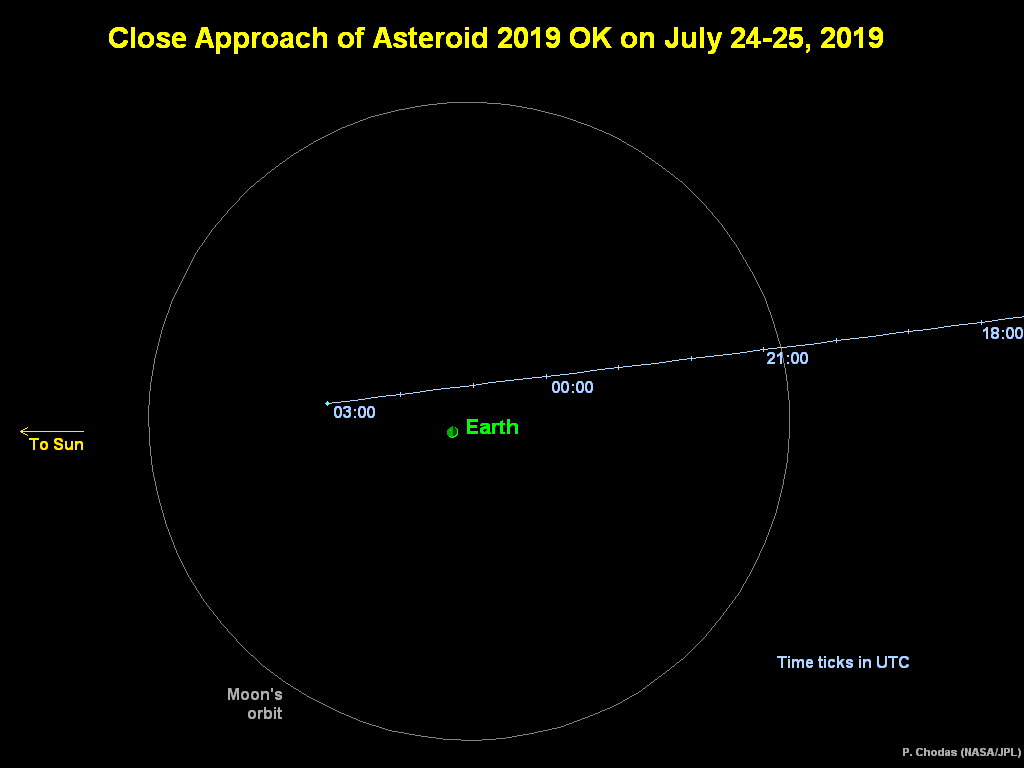
Aug 07 On July 24, asteroid 2019 OK (60-130 meters in size; discovered by SONEAR team @CrisJacques)  approached Earth at about 65,000 km above the surface, one fifth the distance to the Moon. Largest Asteroid To Pass This Close To Earth in a Century

Credits: P. Chodas (NASA/JPL)

Aug 08 A possible impact on Jupiter recorded on 07 August 2019 at 04:07 UTC by E. Chappel. This is not the first time that we have seen something slam into Jupiter. It's actually the seventh event of its kind in recent years. More info about past recent events are available here

Credits: E. Chappel


Credits: E. Chappel

Aug 17 Fireball over Sardinia, Italy on the evening of August 16, 2019 via @ClaudioPorcu - More video available here  #meteor #meteora #astronomy #astronomia #Sardegna

Credits: C. Porcu

Below you can see a map showing the trajectory in the atmosphere projected to the ground of this bolide. The triangulation was done using 6 visual observations selected among the more than 80 arrived at the IMO.

(Credits: A. Carbognani)


by Ernesto Guido

Wednesday, July 31, 2019

Comets & Asteroids - Summary for May & June 2019

During the 2-month period May through June 2019, 11 new comets were discovered and there were 2 comet recoveries. "Current comet magnitudes" & "Daily updated asteroid flybys" pages are available at the top of this blog (or just click on the underline text here). See below for the "Other news" section.

The dates below refer to the date of issuance of CBET (Central Bureau Electronic Telegram)  which reported the official news & designations.

- Comet Discoveries

May 04 Discovery of C/2019 H1 (NEOWISE)                  (CBET 4623)
May 12 Discovery of C/2019 J1 (LEMMON)                   (CBET 4625)
May 13 Discovery of C/2019 J2 (PALOMAR)                  (CBET 4626)
May 23 Discovery of C/2019 K1 (ATLAS)                    (CBET 4629)
May 23 Discovery of C/2019 J3 (ATLAS)                    (CBET 4630)
May 24 Discovery of C/2019 JU_6 (ATLAS)                  (CBET 4631)*
Jun 24 Discovery of C/2019 K4 (YE)                       (CBET 4636)
Jun 28 Discovery of C/2019 K5 (YOUNG)                    (CBET 4637)
Jun 28 Discovery of C/2019 L1 (PANSTARRS)                (CBET 4640)
Jun 28 Discovery of C/2019 L2 (NEOWISE)                  (CBET 4641)
Jun 30 Discovery of C/2019 K1 (ATLAS)                    (CBET 4643)

* Apparently asteroidal object that was discovered on CCD images obtained on 2019 May 12.5 with a 0.5-m reflector at Haleakala in the course of the "Asteroid Terrestrial-Impact Last Alert System" (ATLAS) search program), and given the minor-planet designation 2019 JU_6 by the Minor Planet Center (cf. MPS 996641; orbit on MPEC 2019-J141 from a two-day arc), has been found to show cometary appearance by CCD astrometrists elsewhere.


- Comet Recoveries

Jun 03 Recovery of P/2000 S4 (LINEAR-SPACEWATCH) as P/2019 K2     (CBET 4633)
Jun 04 Recovery of P/2007 R1 (LARSON)            as P/2019 K3     (CBET 4635)

- Other news


May 01 Miklós Lovas, most successful Hungarian discoverer, has passed away at the age of 88 years on April 18th. He discovered 42 supernovae, 5 comets (including 93P & 184P) and 2 unusual minor planets at the Konkoly Obs. between 1964 and 1995 via K. Sárneczky


May 10 (CBET 4624) OUTBURST OF 15-BOOTIDS METEOR SHOWER - P. Jenniskens, SETI Institute and NASA Ames Research Center, and E. Lyytinen, Finland, report activity of the 15-Bootid meteors (IAU shower 923, code FBO) between 2019 Apr. 21d22h01m and 22d00h13m UTC, corresponding to solar longitude 31.24-31.34 degrees (equinox J2000.0). Six 15-Bootids were detected between 22h01m and 00h12m UTC by the low-light video cameras of the CAMS BeNeLux network (coordinated by C. Johannink) during routine observations that were made during 19h50m-03h15m UTC that night. The orbital elements bear some resemblance to those of the bright comet C/539 W1 (parabolic orbital elements q = 0.16 +/- 0.15 AU, i = 19 +/- 6 deg, Argument of Perihelion = 246 +/- 40 deg, Node = 33 +/- 20 deg; cf. Hasegawa 1979, PASJ 31, 257).  The broad 2-hr duration of the shower, presumably requiring somewhat higher ejection velocities, is consistent with a relatively large comet.

May 17 (CBET 4627) NEW SATELLITE AROUND (31) EUPHROSYNE - P. Vernazza, B. Carry, F. Vachier, J. Hanus, J. Berthier, B. Yang, F. Marchis and the HARISSA team report the discovery of a satellite around minor planet (31) Euphrosyne.  They observed (31) Euphrosyne with the Very Large Telescope (+ SPHERE/ZIMPOL) at six different epochs between 2019 Mar. 15 and Apr. 10.  On Mar. 15.301 UT, the satellite was at a separation of 0".398 arcsec (projected separation 651 km) in p.a. 268.49 degrees; on Apr. 10.109, the satellite was found at a separation of 0".384 in p.a. 87.0 degrees. Based on these detections, the mean magnitude difference through an N_R filter (central wavelength 645.9 nm; bandwidth 56.7 nm) between (31) and its companion is 8.0 +/- 0.8, implying a diameter of about 6 km.  Preliminary orbit computation indicates an orbital period of about 1.2 days for the satellite, with a semi-major axis of 677 km.

May 17 CBET 4628, CBET 4632 (May 29), CBET 4634 (Jun 03) report that the following minor planets are binaries systems: (2873) BINZEL, (72036) 2000 XM44 & (1344) CAUBETA

May 23 "From Centaurs to comets - 40 years" - Review chapter to be published in the book "The Transneptunian Solar System" #astronomy #comets #centaurs

Credit: Peixinho et al.


Jun 04 The #VLT instrument #SPHERE observed the double asteroid (66391) 1999 KW4 as it flew by Earth on 25 May #astronomy #asteroids

Credit: ESO

Jun 06 HiPOD: A new impact crater on Mars, formed between Sept 2016 and Feb 2019. What makes this stand out is the darker material exposed beneath the reddish dust.

: NASA/JPL/University of Arizona

Jun 19 ‘Comet Interceptorhas been selected as ESA’s new fast-class mission in its Cosmic Vision Programme. Comprising three spacecraft, it will be the first to visit a truly pristine comet or other interstellar object that is only just starting its journey into the inner Solar System.


Jun 28 (CBET 4638) 2019 MO - An 18th-magnitude fast-moving asteroidal object, detected on June 22.3 and 22.4 UT with the Pan-STARRS2 1.8-m Ritchey-Chretien reflector at Haleakala and the ATLAS 0.5-m reflector at Mauna Loa and designated 2019 MO by the Minor Planet Center on MPEC 2019-M72 (which contains astrometry and orbital elements), impacted the earth's atmosphere around June 22.896 UT.  It was evidently detected in daylight satellite imagery over the Caribbean Sea. The absolute magnitude of 29.3 suggests a size prior to entry on the order of 3-4 meters. This is fourth known object to hit the earth's atmosphere after detection in space prior to impact (cf. CBET 4519).

Jun 29 (CBET 4642) JUNE EPSILON OPHIUCHID METEORS - P. Jenniskens, SETI Institute and NASA Ames Research Center, reports unusual activity of the June epsilon Ophiuchids shower (IAU shower 459, code JEO) between 2019 June 19d08h and 26d05h UTC, corresponding to the solar longitude range 87.5-94.1 degrees, with most activity between solar longitude 89.3 and 93.3 degrees, centered on 92.11 degrees (equinox J2000.0).  Eighty-eight June epsilon Ophiuchids were detected by CAMS camera network on June 19-26. The orbital elements resemble those of the Jupiter-family comet 300P/Catalina (q = 0.826 AU, a = 2.695 AU, i = 5.69 degrees, Peri. = 222.75 degrees, Node = 95.81 degrees, and longitude of perihelion 318.56 degrees. The outburst confirms the existence of this otherwise minor shower (cf. Rudawska and Jenniskens 2014, Meteoroids 2013, p. 217) and offers evidence of past activity of its parent body.

Bright June epsilon Ophiuchid shower meteor captured on 2019, June 24

Credit: Rancho Mirage Observatory (Eric McLaughlin)


by Ernesto Guido

Tuesday, April 30, 2019

Comets & Asteroids - Summary for March & April 2019

During the 2-month period March through April 2019, 6 new comets were discovered and there were 3 comet recoveries. "Current comet magnitudes" & "Daily updated asteroid flybys" pages are available at the top of this blog (or just click on the underline text here). See below for the "Other news" section.

The dates below refer to the date of issuance of CBET (Central Bureau Electronic Telegram)  which reported the official news & designations.

- Comet Discoveries

Mar 21 Discovery of C/2019 D1 (FLEWELLING)                  (CBET 4614)
Mar 21 Discovery of C/2019 E3 (ATLAS)                                (CBET 4615)
Apr 10 Discovery of P/2019 G1 = P/2011 O2 (PANSTARRS) (CBET 4618)* 
Apr 10 Discovery of C/2019 F1 (ATLAS-AFRICANO)           (CBET 4619) 
Apr 22 Discovery of C/2019 F2 (ATLAS)                                (CBET 4620) 
Apr 23 Discovery of P/2019 GG_21 (PANSTARRS)               (CBET 4621)** 

* G. V. Williams, Minor Planet Center, then identified additional pre-discovery (apparently stellar) observations obtained at Kitt Peak by T. H. Bressi with the 1.8-m Spacewatch II on 2009 Feb. 26 and at the XuYi Station of  Purple Mountain Observatory with a 1.04-m Schmidt telescope on 2009 Mar. 25.

**  Initially designated as minor planet 2019 GG21, there was one prior report of cometary activity in this object. R. Weryk and R. Wainscoat (F51, Apr. 4) reported a ~1".9 FWHM ("seemingly" larger than the 1".4 +/- 0".2 FWHM of nearby stars) and a slight asymmetry to the northwest.  No other credible cometary reports were received.  A  report received today of a "new comet" (remarking that 2019 GG21 was predicted to be "nearby") from S. Sheppard  (807,Apr. 4 and 5) noted that the object had a 21" tail in P.A. 310.  The object is therefore being redesignated P/2019 GG21.

- Comet Recoveries

Mar 10 Recovery of P/2003 L1 (SCOTTI) as P/2019 E1     (CBET 4612)
Mar 18 Recovery of P/2005 Y2 (McNAUGHT) as P/2019 E2   (CBET 4613)
Apr 03 Recovery of P/2006 F4 (SPACEWATCH) as P/2019 D2 (CBET 4616)

- Other news

Mar 06 Image sequence captured by CAM-H during the touchdown of @haya2e_jaxa @haya2_jaxa spacecraft with  asteroid (162173) Ryugu last month. Also on youtube http://bit.ly/2VFTpfy  #astronomy #asteroids #ryugu

Credits: JAXA

Mar 12 New paper on Arxiv by D. Seligman, G. Laughlin & K. Batygin: "Implications of the Small Spin Changes Measured for Large Jupiter-Family Comet Nuclei". Long-form blog post up on http://oklo.org/2019/03/12/on-oumuamua/

Mar 19 OSIRIS-REx caught asteroid Bennu ejecting particles from its surface. NavCam 1 imager captured the first-ever close-up observations of material being released from an “active asteroid.” 

Credits: NASA/Goddard/University of Arizona/Lockheed Martin

Mar 27 The gigantic 170 ft (52 m) boulder on asteroid Bennu #Bennu #OSIRISREx #Asteroid via Roman Tkachenko

Credits: NASA/Goddard/University of Arizona/Lockheed Martin

Mar 28 Active asteroid (6478) Gault imaged by Hubble Space Telescope. Images from Hubble show two narrow, comet-like tails of dusty debris streaming from the asteroid (6478) Gault. Each tail represents an episode in which the asteroid gently shed its material.

Credits: NASA, ESA, Meech & Kleyna (University of Hawaii) and Hainaut (ESO)

Apr 05 The Hayabusa2 deployable camera, DCAM3, successfully photographed the ejector from when the SCI  (Small Carry-on Impactor) collided with Ryugu’s surface"This is the world’s first collision experiment with an asteroid! In the future, we will examine the crater formed and how the ejector dispersed".  (see image below. Image credits: JAXA, Kobe University, Chiba Institute of Technology, The University of Occupational and Environmental Health, Kochi University, Aichi Toho University, The University of Aizu, and Tokyo University of Science)


UPDATE Apr 25 Crater formation where the Small Carry-on Impactor collided with Ryugu has been confirmed! These images compare the surface before and after the SCI collision.

Credit: Hayabusa2 JAXA


Apr 05 (CBET 4617) P. Jenniskens, SETI Institute and NASA Ames Research Center; and J. W. Baggaley, University of Canterbury, Christchurch, report that an outburst of delta Pavonid meteors (IAU shower 120; code DPA) has been detected by the CAMS New Zealand stations operated by P. Aldous (Geraldine) and I. Crumpton (West Melton).The parent comet is presumed to be C/1907 G1 (Grigg-Mellish), which was poorly observed in 1907, with parabolic orbital elements q = 0.924 AU, i = 110.06 deg, Peri. = 328.76 deg, and Node = 190.417 deg (equinox 2000.0) -- in good agreement when allowing for the motion of the node due to planetary perturbations.

Credits: NASA Meteor Shower Portal; CAMS SETI


Apr 15 New paper on Arxiv by D. Jewitt et al.: "Episodically Active Asteroid 6478 Gault".

Credit: Jewitt et al.


Apr 23 New paper on Arxiv by Chandler et al.: "Six Years of Sustained Activity from Active Asteroid (6478) Gault".

Credits: Chandler et al.


Apr 24 Three months of surface temperature maps of #67P nucleus from Rosetta suggest that only the upper layers are affected by temporal effects, keeping the immediate interior pristine.

Credits: F. Tosi et al - Nature Astronomy 2019


by Ernesto Guido

Sunday, March 31, 2019

Comets & Asteroids - Summary for Jan & Feb 2019

During the 2-month period January through February 2019, 14 new comets were discovered. Moreover inner main-belt minor planet (6478) GAULT developed a lengthening tail or trail. "Current comet magnitudes" & "Daily updated asteroid flybys" pages are available at the top of this blog (or just click on the underline text here). See below for the "Other news" section.

The dates below refer to the date of issuance of CBET (Central Bureau Electronic Telegram)  which reported the official news & designations.


- Comet Discoveries

Jan 02 Discovery of P/2018 Y2 (AFRICANO)      (CBET 4590)
Jan 07 Discovery of P/2019 A1 (PANSTARRS)   (CBET 4591)
Jan 08 Discovery of P/2019 A2 (ATLAS)            (CBET 4595)
Jan 10 Discovery of P/2019 A3 (PANSTARRS)   (CBET 4598)
Jan 17 Discovery of P/2019 A4 (PANSTARRS)   (CBET 4600)
Jan 17 Discovery of C/2019 A5 (PANSTARRS)   (CBET 4601)
Jan 17 Discovery of P/2019 A6 (LEMMON-PANSTARRS)   (CBET 4602)
Jan 23 Discovery of C/2019 B1 (AFRICANO)    (CBET 4604)
Jan 23 Discovery of P/2019 A7 (PANSTARRS)   (CBET 4605)
Feb 04 Discovery of P/2018 V5 (TRUJILLO-SHEPPARD)   (CBET 4607)*
Feb 04 Discovery of P/2019 A8 (PANSTARRS)   (CBET 4608)
Feb 04 Discovery of P/2019 B2 (GROELLER)    (CBET 4609)
Feb 07 Discovery of C/2019 A9 (PANSTARRS)   (CBET 4610)
Feb 27 Discovery of C/2019 B3 (PANSTARRS)   (CBET 4611)

* S. Sheppard reported that this object showed a ~9" tail in P.A. 276 on 2018 Nov. 7 and a 19" tail in P.A. 277 on 2019 Jan. 8.  The comet was detected by C. Trujillo on images taken by Sheppard.  R. Weryk reported prediscovery images that showed the object with a  1".3 FWHM (compared to 1".10 +/- 0".05 for nearby stars) on 2017 Oct. 28.


- Other news

Jan 07 CBET 4592, CBET 4593 (Jan 08), CBET 4596 (Jan 09), CBET 4599 (Jan 16) report that the following minor planets are binaries systems: (2337) BOUBIN, 2016 AZ_8, (7393) LUGINBUHL & (2070) HUMASON
 
Jan 08 CBET 4594 (issued on 2019, January 08) announces the serendipitous discovery by the "Asteroid Terrestrial-Impact Last Alert System" (ATLAS) team of unusual activity associated with the inner main-belt minor planet (6478) which appears to have developed a lengthening tail or trail. 


by Ernesto Guido

Thursday, February 28, 2019

Comets & Asteroids - Summary for Nov & Dec 2018

During the 2-month period November through December 2018, 10 new comets were discovered, cometary activity was detected for 1 previously discovered object (earlier designated as asteroids) and there was 1 comet recovery. Moreover an apparently asteroidal object with nearly-parabolic orbital elements was discovered. No cometary activity has yet been confirmed, but it has been given a cometary style A/ designation. "Current comet magnitudes" & "Daily updated asteroid flybys" pages are available at the top of this blog (or just click on the underline text here). See below for the "Other news" section.

The dates below refer to the date of issuance of CBET (Central Bureau Electronic Telegram)  which reported the official news & designations.

 - Comet Discoveries

Nov 08 Discovery of C/2018 V1 (MACHHOLZ-FUJIKAWA-IWAMOTO)     (CBET 4569 & 4572)
Nov 18 Discovery of P/2018 VN_2 (LEONARD)            (CBET 4573)*
Nov 20 Discovery of C/2018 U1 (LEMMON)                 (CBET 4574)
Dec 01 Discovery of C/2018 V2 (ATLAS)                       (CBET 4578)
Dec 01 Discovery of C/2018 V4 (AFRICANO)               (CBET 4579)
Dec 03 Discovery of C/2018 W1 (CATALINA)               (CBET 4580 & 4582)**
Dec 03 Discovery of C/2018 W2 (AFRICANO)              (CBET 4580)***
Dec 16 Discovery of C/2018 X2 (FITZSIMMONS)        (CBET 4583)
Dec 17 Discovery of C/2018 X3 (PANSTARRS)             (CBET 4584)
Dec 20 Discovery of C/2018 Y1 (IWAMOTO)                (CBET 4588)


* MPC inadvertently assigned it the minor-planet designation 2018 VN_2 by mistake.

** No cometary activity was detected at discovery, but it was given a cometary style A/ designation. On December 16, CBET 4582 reported that a faint coma had been detected in images taken with the CFHT at Mauna Kea on December 8.

*** Nearly simultaneous independent discoveries of a comet were reported on Nov. 27 via CCD images taken by H. Groeller (with the Catalina Sky Survey 0.68-m Schmidt telescope) and by B. M. Africano (with the Mount Lemmon 1.5-m reflector). G. V. Williams notes that Africano reported the object first, and that the object was posted on the Minor Planet Center's NEOCP webpage before Groeller's report arrived.  The Central Bureau received Africano's report at around Nov. 27.55 UT, or 21 minutes before Groeller's report was received.


- Cometary activity detected

Nov 29 Cometary activity detected in 2017 TW_13 =  P/2017 TW_13 (LEMMON)  (CBET 4576)

- Comet Recoveries

Dec 06  Recovery of P/2005 GF_8 (LONEOS) as C/2018 X1 (CBET 4581)

According to CBET 4579 (Dec. 01, 2018), an apparently asteroidal object designated A/2018 V3 with nearly-parabolic orbital elements (T = 2019 Sept. 8.66 TT, e = 0.990, q = 1.34 AU; at mag 21 and about 4 AU from the sun) was discovered. No cometary activity has yet been confirmed, but it has been given a cometary style A/ designation.

NEW NUMBERINGS OF SHORT-PERIOD COMETS (CBET 4589)

Further to CBET 4442, the following permanent numbers have been assigned to short-period comets based upon their being securely observed at multiple returns to perihelion.
                                                      
Designation/Name         Provisional Designations                Reference
363P/Lemmon               P/2011 VJ_5 = P/2017 W1               CBET 4455
364P/PANSTARRS        P/2013 CU_129 = P/2018 A2           CBET 4475
365P/PANSTARRS        P/2011 WG_113 = P/2017 U6          CBET 4490
366P/Spacewatch          P/2005 JN = P/2018 F2                    CBET 4497
367P/Catalina                P/2011 CR_42 = P/2018 H1             CBET 4510

368P/NEAT                   P/2005 R1 = P/2018 L3                      CBET 4526
369P/Hill                       P/2010 A1 = P/2018 P1                      CBET 4538
370P/NEAT                   P/2001 T3 = P/2018 P2                      CBET 4539
371P/LINEAR-Skiff         P/2001 R6 = P/2018 R1                      CBET 4552
372P/McNaught             P/2008 O2 = P/2018 P6                      CBET 4554

373P/Rinner                  P/2011 W2 = P/2018 R2                     CBET 4555
374P/Larson                  P/2007 V1 = P/2018 S1                      CBET 4558
375P/Hill                       P/2006 D1 = P/2018 T1                     CBET 4560


- Other news
 
Nov 08 CBET 4570, CBET 4575 (Nov 27), CBET 4586 (Nov 18) report that the following minor planets are binaries systems: (20882) 2000 VH57 & (6245) IKUFUMI & (250162) 2002 TY_57

Nov 20 On this day, 5 years ago: "Asteroids named after Thomas Pynchon & Stabia"  #astronomy #pynchon #stabia #asteroids


Dec 03 Dec 03 NASA’s Origins, Spectral Interpretation, Resource Identification, Security-Regolith Explorer (OSIRIS-REx) spacecraft completed its 2 billion-kilometer journey to arrive at the asteroid Bennu Monday. The spacecraft executed a maneuver that transitioned it from flying toward (101955) Bennu to operating around the asteroid. This series of images below, taken by the OSIRIS-REx spacecraft, shows Bennu in one full rotation from a distance of around 580 km. The spacecraft’s PolyCam camera obtained the 36 2.2-millisecond frames over a period of four hours and 18 minutes.

Credits: NASA/Goddard/University of Arizona

Dec 17 Comet 46P/Wirtanen imaged by E. Guido on 2018-12-17 at 11:45:26UT remotely from Bathurst Observatory Australia (MPC Q67). Single 20-second frame by 0.28-m f/2.2 reflector + CCD (ZWO 1600 Color) #astronomy #comets


Dec 18 Discovery by Sheppard, Tholen & Trujillo of new Solar System object 2018 VG18 ( nicknamed “Farout”) around 120 AU, making it the first Solar System object observed beyond 100 AU http://bit.ly/2S2thtI  & http://bit.ly/2S2thKe  #astronomy

Credits:  R. Molar Candanosa, S. Sheppard, Carnegie Institution for Science

Dec 20 Comet 46P/Wirtanen imaged on Dec. 13, 2018 by @NASAHubble space telescope https://go.nasa.gov/2QGAjIb  #astronomy #comets #Comet46pwirtanen #CometWirtanen

Credits: NASA, ESA, D. Bodewits and J.-Y. Li

Dec 21 Comet 46P/Wirtanen observed on Dec. 15, 2018 by astronomers at @AreciboRadar @NAICobservatory. The new radar observations provided the first definitive measurements of 46P/Wirtanen’s diameter, which is approximately 1.4 km (0.9 miles). http://bit.ly/2A9n48q  #astronomy #comets

Credits: Arecibo Observatory, NASA, NSF

Dec 26 Radar images of near-Earth asteroid 2003 SD220 obtained on Dec. 15-17 #astronomy #asteroids

Credits: NASA/Arecibo/USRA/UCF/GBO/NSF


by Ernesto Guido

Wednesday, October 31, 2018

Comets & Asteroids - Summary for Sept & Oct 2018

During the 2-month period September through October 2018, 3 new comets were discovered and there  were 5 comet recoveries. "Current comet magnitudes" & "Daily updated asteroid flybys" pages are available at the top of this blog (or just click on the underline text here). See below for the "Other news" section.

The dates below refer to the date of issuance of CBET (Central Bureau Electronic Telegram)  which reported the official news & designations.

- Comet Discoveries

Sep 16 Discovery of C/2018 R3 (LEMMON)     (CBET 4556)
Sep 16 Discovery of C/2018 R4 (FULS)            (CBET 4557)
Sep 18 Discovery of C/2018 R5 (LEMMON)     (CBET 4559)


- Comet Recoveries

Sep 08  Recovery of P/2001 R6 (LINEAR-SKIFF) as P/2018 R1 (CBET 4552)
Sep 16  Recovery of P/2008 O2 (McNAUGHT) as P/2018 P6      (CBET 4554)
Sep 16  Recovery of P/2011 W2 (RINNER) as P/2018 R2           (CBET 4555)
Sep 18  Recovery of P/2007 V1 (LARSON) as P/2018 S1           (CBET 4558)
Oct 06  Recovery of P/2006 D1 (HILL) as P/2018 T1                   (CBET 4560)


- Other news

Sep 14 CBET 4553, CBET 4561 (Oct 07), CBET 4562 (Oct 14), CBET 4563 (Oct 18), CBET 4565 (Oct 23), CBET 4566 (Oct 23) & CBET 4567 (Oct 26) report that the following minor planets are binaries systems: (25015) 1998 QN2 & (5402) KEJOSMITH & (18527) 1996 VJ30 & (2178) KAZAKHSTANIA & (100015) 1989 SR7 & (6100) KUNITOMOIKKANSAI & 2018 TF3.

Sep 25 Third most energetic meteor of the year (1.9 kT) was observed, filmed and recorded South of Reunion & Mauritius islands, on September 25, 14h10m UT.

Image of the September 25, 2018, 14h 10m UT fireball extracted from a Youtube video of the event.

Oct 02 New Extremely Distant Solar System Object Found During Hunt for PLANET X. The newly found object, called 2015 TG387, was discovered about 80 astronomical units (AU) from the Sun. 

2015 TG387 as it moves across the sky, as seen through the Subaru telescope - Credit: S. Sheppard


Oct 23 An outburst of October Draconids was widely observed between Oct. 8d17h55m and 9d06h05m UTC (solar longitude 195.146-195.647 degrees, equinox J2000). Visual observations gathered by the International Meteor Organization suggest a peak Zenith Hourly Rate (ZHR) of 122 +/- 5 meteors/hr at 23.6 +/- 0.1 hr UTC on Oct. 8, and a full-width-at-half-maximum (FWHM) duration of 4.0 +/- 0.4 hr.  (CBET 4564)

Composite picture of 2018 Draconid outburst - Credit: Juraj Toth

by Ernesto Guido

Wednesday, September 26, 2018

Comets & Asteroids - Summary for August 2018

During the month of August 2018, 4 new comets were discovered, cometary activity was detected for 1 previously discovered object (earlier designated as asteroids) and there  were 2 comet recoveries. "Current comet magnitudes" & "Daily updated asteroid flybys" pages are available at the top of this blog (or just click on the underline text here). See below for the "Other news" section.

The dates below refer to the date of issuance of CBET (Central Bureau Electronic Telegram)  which reported the official news & designations.


- Comet Discoveries

Aug 17 Discovery of C/2018 O1 (ATLAS)     (CBET 4543)
Aug 19 Discovery of P/2018 P3 (PANSTARRS) (CBET 4548)
Aug 19 Discovery of P/2018 P4 (PANSTARRS) (CBET 4549)
Aug 19 Discovery of C/2018 P5 (PANSTARRS) (CBET 4550)

- Cometary activity detected

Aug 14 Cometary activity detected in 2018 KJ3 = C/2018 KJ3 (LEMMON)

- Comet Recoveries

Aug 13  Recovery of P/2010 A1 (HILL) as P/2018 P1 (CBET 4538)
Aug 13  Recovery of P/2001 T3 (NEAT) as P/2018 P2 (CBET 4539)

- Other news

Aug 07  Asteroid (162173) Ryugu imaged on August 07, 2018 from a distance of about 1 km by @haya2e_jaxa - For more info see http://bit.ly/2M3KKCr  #astronomy #asteroids


Credit: JAXA

Aug 10 S. S. Sheppard, Carnegie Institution for Science, reports the discovery of a satellite to the trans-Neptunian object 2013 FY27.  The satellite was detected about 0".17 at a position angle of 135 degrees from the primary in four 545-s images taken with the WFPC3/UVIS instrument with the Hubble Space Telescope during 2018 Jan. 15.058-15.104 UT.  The satellite is about 3 magnitudes fainter than the primary in the F350LP filter.  The projected separation of the satellite is about 9800 km from the primary (CBET 4537)

Aug 17 M. S. P. Kelley and D. Bodewits, University of Maryland; and Q.-Z. Ye, Infrared Processing and Analysis Center, California Institute of Technology, on behalf of the Zwicky Transient Facility (ZTF) Solar System Working Group, report an outburst of comet 64P/Swift-Gehrels in ZTF images taken with the Oschin 1.2-m Schmidt telescope at Palomar. The post-outburst brightness (7"-radius aperture) is r' = 13.88 +/- 0.02, indicating an outburst strength of at least 2.7 mag (CBET 4544)

Aug 20 A Better Look At Asteroid 216 Kleopatra (based on the findings described in the article entitled A revised shape model of asteroid (216) Kleopatra, recently published in the journal Icarus).

Credit: Shepard et al.

Aug 22 Has Anyone Found a Lost Comet?! (based on the papaer "Finding Long Lost Lexell's Comet: The Fate of the First Discovered Near-Earth Object")

Aug 28 NASA's New Horizons spacecraft has made its first detection of its next flyby target, the Kuiper Belt object 2014 MU69 nicknamed Ultima Thule, more than four months ahead of its New Year's 2019 close encounter.  

Credits: NASA/JHUAPL/SwRI

by Ernesto Guido