Tuesday, March 31, 2020

Comets & Asteroids - Summary for Jan & Feb 2020

During the 2-month period January through February 2020, 9 new comets were discovered and cometary activity was detected for 1 previously discovered object (earlier designated with the prefix A/, see MPEC 2018-H54). "Current comet magnitudes" & "Daily updated asteroid flybys" pages are available at the top of this blog (or just click on the underline text here). See below for the "Other news" section.

The dates below refer to the date of issuance of CBET (Central Bureau Electronic Telegram) which reported the official news & designations.

(This post has been written during the covid-19 lockdown in Italy. I hope everyone is staying safe out there)

- Comet Discoveries

Jan 06 Discovery of C/2019 Y1 (ATLAS)              (CBET 4708)
Jan 08 Discovery of P/2019 Y2 (FULS)                 (CBET 4709)
Jan 09 Discovery of P/2019 Y3 (CATALINA)        (CBET 4711)
Jan 11 Discovery of C/2019 Y4 (ATLAS)               (CBET 4712)
Jan 13 Discovery of P/2019 X2 (PANSTARRS)      (CBET 4713)
Jan 15 Discovery of C/2020 A2 (IWAMOTO)         (CBET 4715)
Jan 21 Discovery of C/2020 A3 (ATLAS)                (CBET 4716)
Feb 06 Discovery of C/2020 B2 (LEMMON)          (CBET 4723)
Feb 07 Discovery of C/2020 B3 (RANKIN)            (CBET 4724)


- Cometary activity detected

Feb 05 Cometary activity detected in A/2019 C1 =  C/2019 C1 (ATLAS)  (CBET 4721)*

*The object was given the designation "A/2019 C1" when announced on MPEC 2019-D42, due evidently to its comet-like orbit.


- Other news

Jan 01 On the first evening of 2020, at 18h 26min UT, a -10 fireball was observed and recorded by PRISMA video network over Northern Italy. After careful trajectory analysis and having make the public aware of potential meteorite fall in the region of Cavezzo (Province of Modena), two pieces (55 g) of the fresh meteorite fall were recovered on January 4th.


Credit : PRISMA/FRIPON
Credit : PRISMA

Jan 09 NASA’s Lucy mission team is seeing double after discovering that Eurybates, the asteroid the spacecraft has targeted for flyby in 2027, has a small satellite. This “bonus” science exploration opportunity for the project was discovered using images taken by the Hubble Space Telescope’s Wide Field Camera 3 in September 2018, December 2019, and January 2020.

Credit: Lucy/HST

Jan 17 At 2130UTC of 2020-01-17, a #fireball was detected just north of Puerto Rico (5:31pm local time). Satellite image available here #puertorico #meteor #fireball #meteoro #astronomy

Credit: @LouisVtweeter

Jan 23 CBET 4717 & CBET 4722 (Feb 05) report that the following minor planets are binaries systems: (9474) CASSADRURY & (2883) BARABASHOV.

Feb 07 CBET 4725 reports that Arecibo S-band (2380-MHz, 12.6-cm) range-Doppler radar images obtained on 2020 Feb. 4.8417-4.9215 and Feb. 5.8029-5.8611 UT reveal that the potentially hazardous, near-earth minor planet 2020 BX_12 (cf. MPEC 2020-B281) is a binary system. Preliminary measurements of visible range extents in radar images with 7.5 m/pixel resolution suggest a round primary at least 165 m in diameter and a secondary at least 70 m in diameter. 

Credit: Arecibo/NASA/NSF

Feb 12 #IAUnews What will be the impact of the planned mega-constellations of communication satellites on astronomical observations and on the pristine appearance of the night sky? Some preliminary findings. See also this paper by J. C. McDowell (published online on March 16, 2020).

Feb 13 The farthest, most primitive object in the #SolarSystem ever to be visited by a spacecraft—a #KuiperBelt Object known as Arrokoth (2014 #MU69) is described in detail in three new Science reports: https://fcld.ly/r10fbzb  & https://fcld.ly/3gz4pq2 & https://fcld.ly/varrccj  

Feb 15 2020 CD3 is a tiny near-Earth asteroid and temporary satellite of Earth. It was discovered at the Mount Lemmon Observatory by astronomers Theodore Pruyne and Kacper Wierzchoś on 15 February 2020, as part of the Mount Lemmon Survey or Catalina Sky Survey. The asteroid's discovery was announced by the Minor Planet Center on 25 February 2020, after subsequent observations have confirmed that it is orbiting around Earth. It is the second temporary satellite of Earth discovered in situ, after 2006 RH120, which was discovered in 2006. Based on its nominal trajectory, 2020 CD3 was captured by Earth between 2015–2016, and is expected to remain in a geocentric orbit around Earth until May 2020.

Credit: Gemini Observatory


Feb 28 A bright daylight bolide spotted at around 10:30am of February 28, 2020 over north-east of Italy, Croatia and Slovenia.  A piece of this fall was recovered on March 04, 2020 by G. Kos

Credit:  Tomislav Čar

by Ernesto Guido

Thursday, February 6, 2020

New Comet C/2020 B3 (Rankin)

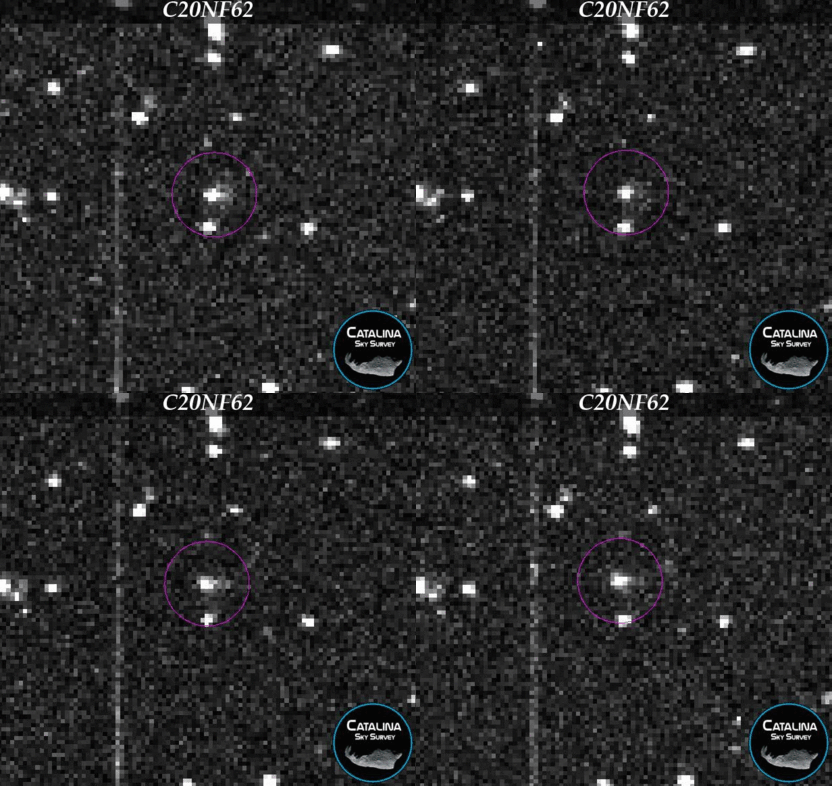
MPEC 2020-C111, issued on 2020, February 06, announces the discovery of a comet (magnitude ~20) by D. Rankin in the course of the Mt. Lemmon Survey (G96), in images taken on 2020, Jan 29 with a 1.5-m reflector + 10K CCD. The new comet has been designated C/2020 B3 (Rankin).  

I performed follow-up measurements of this object while it was still on the PCCP webpage. Stacking of 16 unfiltered exposures, 120 seconds each, obtained remotely on 2020, February 03.2 from X02 Telescope Live (El Sauce, Chile) through a 0.6-m f/6.5 astrograph + CCD, shows that this object is a comet   with a compact coma about 5" in diameter slightly elongated toward PA 250.

My confirmation image (click on it for a bigger version)


MPEC 2020-C111, assigns the following preliminary orbital elements to comet  C/2020 B3: T 2019 Oct. 22.8; e= 0.98; Peri. =  325.92; q = 3.35;  Incl.= 20.75

Below you can see the discovery animation:

Credits: D. Rankin; Catalina Sky Survey

Congrats to David Rankin for this discovery!!

by Ernesto Guido

Monday, January 6, 2020

New Comet C/2019 Y1 (ATLAS)

CBET 4708 & MPEC 2020-A72, issued on 2020, January 05,  announce the discovery of a comet (magnitude ~18) in the course of the "Asteroid Terrestrial-Impact Last Alert System" (ATLAS) search program, in images taken on 2019, Dec 16 with a 0.5-m reflector + CCD. The new comet has been designated C/2019 Y1 (ATLAS).  

I performed follow-up measurements of this object while it was still on the PCCP webpage. Stacking of 28 unfiltered exposures, 30 seconds each, obtained remotely on 2019, December 20.15 from X02 Telescope Live network (El Sauce, Chile) through a 0.6-m f/6.5 reflector + CCD, shows that this object is a comet with a sharp central condensation and a diffuse irregular coma about 15 arcsec in diameter elongated in PA 90.

My confirmation image (click on it for a bigger version)


M.P.E.C. 2020-A72, assigns the following preliminary orbital elements to comet  C/2019 Y1: T 2020 Mar. 15.54; e= 1.0; Peri. =  57.20; q = 0.84;  Incl.= 73.40

Neither the MPEC nor the CBET mention the relationship that has been pointed out by R. J. Bouma in comets-ml mailing list about this comet and the "LILLER" group (comets C/1988 A1 Liller, C/1996 Q1 Tabur, C/2015 F3 SWAN).


by Ernesto Guido

Tuesday, December 31, 2019

Comets & Asteroids - Summary for Nov & Dec 2019

During the 2-month period November through December 2019, 4 new comets were discovered and there was 1 comet recovery. "Current comet magnitudes" & "Daily updated asteroid flybys" pages are available at the top of this blog (or just click on the underline text here). See below for the "Other news" section.

The dates below refer to the date of issuance of CBET (Central Bureau Electronic Telegram) which reported the official news & designations.

- Comet Discoveries

- Cometary activity detected

- Comet Recoveries

- Other news

UNDER CONSTRUCTION

Saturday, November 30, 2019

Comets & Asteroids - Summary for Sept & Oct 2019

During the 2-month period September through October 2019, 9 new comets were discovered, cometary activity was detected for 1 previously discovered object (earlier designated as asteroids) and there were 6 comet recoveries. "Current comet magnitudes" & "Daily updated asteroid flybys" pages are available at the top of this blog (or just click on the underline text here). See below for the "Other news" section.

The dates below refer to the date of issuance of CBET (Central Bureau Electronic Telegram) which reported the official news & designations.

- Comet Discoveries

Sep 10 Discovery of C/2019 Q3 (PANSTARRS)            (CBET 4665)
Sep 12 Discovery of C/2019 Q4 (BORISOV)                 (CBET 4666)
Oct 05 Discovery of P/2019 S2 (PANSTARRS)             (CBET 4673)
Oct 05 Discovery of P/2019 S3 (PANSTARRS)             (CBET 4674)
Oct 16 Discovery of C/2019 T3 (ATLAS)                       (CBET 4678)
Oct 23 Discovery of C/2019 T4 (ATLAS)                       (CBET 4681)
Oct 23 Discovery of C/2019 T5 (ATLAS)                       (CBET 4682)
Oct 24 Discovery of P/2019 T6 (PANSTARRS)             (CBET 4684)
Oct 28 Discovery of P/2019 U4 (PANSTARRS)             (CBET 4688)


- Cometary activity detected

Oct 06 Cometary activity detected in 2018 DO4 =  C/2018 DO_4 (LEMMON)  (CBET 4675)

- Comet Recoveries

Sep 08 Recovery of P/2007 T4 (GIBBS) as P/2019 R2                   (CBET 4662)
Sep 09 Recovery of P/2008 Y1 (BOATTINI) as P/2019 R1            (CBET 4663)
Sep 27 Recovery of P/2006 R1 (SIDING SPRING) as P/2019 S1  (CBET 4671)
Oct 25 Recovery of P/2006 W1 (GIBBS) as P/2019 U1                 (CBET 4685)
Oct 28 Recovery of P/2006 F1 (KOWALSKI) as P/2019 U2          (CBET 4686)
Oct 28 Recovery of P/2004 WR_9 (LINEAR) as P/2019 U3          (CBET 4687)

- Other news

Sep 04 New paper on Arxiv by D. Jewitt & J. Luu: "Disintegrating In-Bound Long-Period Comet C/2019 J2".

Credit: Jewitt & Luu

Sep 16 Analysis of a bright flash in Jupiter’s atmosphere observed by an amateur astronomer in August 2019 has revealed that the likely cause was a small asteroid with a density typical of stony-iron meteors. The impact is estimated to have released energy equivalent to an explosion of 240 kilotons of TNT – around half the energy released in the 2013 Chelyabinsk event at Earth.

Credit: E. Chappel/R. Hueso


Oct 07 Saturn Surpasses Jupiter After The Discovery Of 20 New Moons. A team led by Carnegie's Scott S. Sheppard has found 20 new moons orbiting Saturn.  This brings the ringed planet’s total number of moons to 82, surpassing Jupiter, which has 79. 

Credit: NASA/JPL-Caltech/Space Science Institute/Sartorio/Shutterstock

Oct 08 The 2019 #NobelPrize in Physics has been awarded with one half to James Peebles “for theoretical discoveries in physical cosmology” and the other half jointly to Michel Mayor and Didier Queloz “for the discovery of an exoplanet orbiting a solar-type star”.

Credit: Mayor & Queloz

Oct 28 Beautiful images from VLT/SPHERE of the fourth biggest asteroid, Hygiea, found a big surprise: an almost spherical shape. It was hit in the past by a big impact which shattered and reassembled it while still fluid.

Credit: Vernazza et al.


by Ernesto Guido

Thursday, October 31, 2019

V659 SCUTI = NOVA SCUTI 2019

Following the posting on the Central Bureau's Transient Object Confirmation Page about a possible Nova in Scutum (TOCP Designation: PNV J18395972-1025415) I performed some follow-up of this object through a TEL 0.6-m f/6.5 astrograph + CCD located in the El Sauce Observatory in Chile and operated by Telescope Live network.  

On images taken on October 31.01, 2019 I can confirm the presence of an optical counterpart with R-filtered CCD magnitude about +8.4 (saturated in a 10-second exposure) at coordinates:

R.A. = 18 39 59.71, Decl.= -10 25 41.9

(equinox 2000.0; Gaia DR2 catalogue reference stars for the astrometry).

This transient was discovered (discovered magnitude 11.5 g-Sloan Filter) by the All-Sky Automated Survey for Supernovae (ASAS-SN) on 2019 Oct. 29 at 01:12UT and reported to Transient Name Server (TNS) on Oct. 29 at 02:07:49 UTC as ASASSN-19aad = AT 2019tpb. According to CBET 4690, several independents discoveries have been reported to the Central Bureau of a nova in Scutum: Koichi Nishiyama (unfiltered magnitude 9.4 on Oct. 29.397), Hideo Nishimura (unfiltered magnitude 9.8 on Oct. 29.421), Shizuo Kaneko (unfiltered magnitude 9.8 on Oct. 29.462) (on AAVSO VSX is reported also Fujio Kabashima as independent discoverer). 

Spectroscopy by S. C. Williams et al. (see ATel #13241) & by  M. Pavana et al. (see ATel #13245) show that AT 2019tpb/ASASSN-19aad is a Galactic nova in the early stages of eruption.

N. Samus writes that the permanent GCVS designation V659 Sct has been assigned to this nova.

Below my confirmation image (sum of two unfiltered 30-sec exposure through a 0.6-m f/6.5 astrograph + CCD; El Sauce Observatory, Chile). Click on the image for a bigger version: 


An animation showing a comparison between my image and the archive POSS1 Blue plate (1951-07-30).


Below the same animation with a larger field of view. At the bottom left of V659 Sct you will notice a star occupying a different position in the new image with respect to the 1951 archive image. This star (Gaia designation DR2 4155146598548456064) is a high proper  motion star. Most stars are so distant that their apparent motion even over hundreds of years is all but negligible to naked eye observers. Some stars have very significant movements compared to the background stars (Click on it for a bigger version:


Below an image that is the difference between the new image and the archive image useful to highlight the "new" objects. There you can easily see the new galactic nova V659 Sct and the  high proper motion star.


by Ernesto Guido

Monday, September 30, 2019

Comet Images from the Dark Sky Of Chile

Below you can find a selection of some of the comets we imaged in the last few days using remotely a Planewave Telescope CDK24 a 0.61-m f/6.5 reflector + CCD located in the El Sauce Observatory in Chile. The telescope is owned by "TELESCOPE LIVE" network and we would like to thank them for allowing us to use their telescope for these images free of charge. Click on each image for a bigger version.


68P/Klemola  - 2019, September 27


29P/Schwassmann–Wachmann -  2019, September 27


101P/Chernykh - 2019, September 30


C/2017 U7 - 2019, September 30


C/2016 M1 (PANSTARRS) - 2019, October 06


by Ernesto Guido