Friday, April 15, 2011

T PYXIDIS OUTBURST

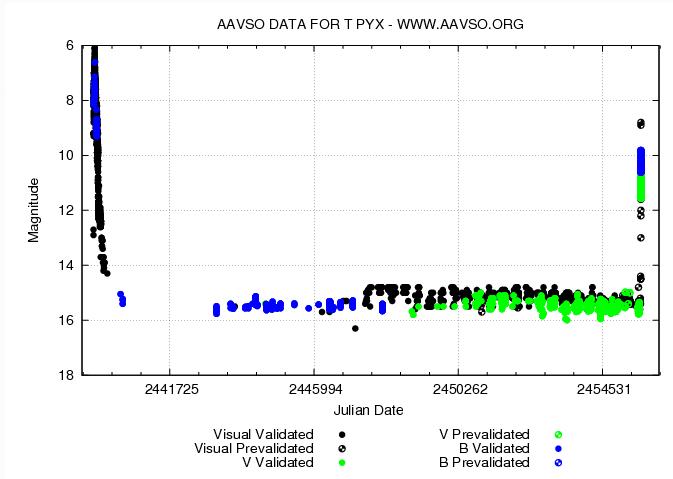
CBET No. 2700 issued on April 15, 2011 reports that the recurrent nova T Pyxidis has been discovered in outburst. It was detected by by Mike Linnolt at visual magnitude 13.0 on 2011 April 14.2931 and the outburst has been visually confirmed by several observers.

This is the first outburst of T Pyx since December 7, 1966 (discovered then by Albert Jones), nearly 45 years ago, when it reached visual magnitude 6.5 from fainter than 15th magnitude; it was brighter than magnitude 8 for two months. Previous outbursts occurred in 1890, 1902, 1920, and 1944. There are only ten known galactic recurrent novae.

Below you can see the five maxima of the recurrent nova T Pyx from 1890 to 1967.


(Credit: AAVSO)


AAVSO Light-Curve for the period 1966 to present.


(Credit: AAVSO)


T Pyxidis is 6,000 light-years away in the dim southern constellation Pyxis, the Mariner's Compass. In September 1997, astronomers released an image of T Pyxidis taken using the Hubble Space Telescope. The Hubble's image shows that the shells of gas around the star that were blown off during several eruptions, are actually more than 2,000 gaseous blobs packed into an area that is 1 light-year across.


(Credits: Mike Shara, Bob Williams, and David Zurek (Space Telescope Science Institute); Roberto Gilmozzi (European Southern Observatory); Dina Prialnik (Tel Aviv University); and NASA)


T Pyx is located at the following coordinates:

RA 09h 04m 41.5s DEC -32 22' 47.4" (2000)


On April 15.41 we have been able to image T Pyx remotely through Gras network from Officer, Australia (MPC Code - E03) using a RCOS 12.5" - FL 1950 @ f/6.3. The object has reached the unfiltered magnitude ~8.5. Click on the image for a bigger version.


Below you can find an animation showing a comparison between our image and the archive DSS plate (R Filter - 1992) - Click on the thumbnail for a bigger version:


Below you can see a a spectrum of T Pyx in its rising phase reported by Arai-san at Koyama Astron. Obs. (Kyoto Sangyo U.) :


Follow-up observations are strongly encouraged!!

by Ernesto Guido & Giovanni Sostero

Wednesday, April 13, 2011

2011 GP59 - Close Approach

The Mpec circular 2011-G60 issued on April 09, 2011 announced the discovery of a new Aten asteroid officially designated 2011 GP59. This asteroid (~ magnitude 17.5) was discovered by La Sagra Survey through their 0.45-m f/2.8 reflector + CCD, on images obtained on April 08.9, 2011. After posting on the Minor Planet Center's 'NEOCP' webpage, other CCD astrometrists have been able to follow-up the new object to define its orbit.

According to the preliminay orbit, 2011 GP59 is an Aten type asteroid. This class of asteroids are defined by having semi-major axes of less than one astronomical unit (the distance from the Earth to the Sun). 2011 GP59 will have a close approach with Earth on April 15, 2011 at 1909 UTC at rougly 0.003567AU or 1.39 LD (Lunar Distance) reaching the magnitude ~13. Its absolute magnitude H=24.30 correspond to an approximate diameter of 50 meters.

2011 GP59 shows evident magnitude fluctuations. Below you can see a light-curve made by Brian Skiff (Lowell Observatory): 6-hours of observations using the Lowell 0.55-m Schmidt with 45-second exposures showing an amplitude in excess of 2 full magnitudes over a period of roughly 7.5 minutes.


(Credit: Brian Skiff - Lowell Observatory)

We have been able to follow 2011 GP59 on April 12.35 remotely from the GRAS Observatory (near Mayhill, NM) through a 0.25-m, f/3.4 reflector + CCD. Below you can see an animation showing the fast movement (the object was moving at 10.5 "/min) of 2011 GP59 on the sky on April 12, 2011. Each frame is a stack of 2x20-second exposure. The asteroid is moving from the top left corner to the bottom right corner. In the animation you can easily see the rapid brightness fluctuations of this object.

Click on the thumbnail below to see the animation:


UPDATE - April 14, 2011 - 13:30UT


We imaged 2011 GP59 on April 14.36, 2011 remotely from the GRAS Observatory (near Mayhill, NM) through a 0.51-m, f/6.9 reflector + CCD.

It's a single unfiltered exposure of 600 seconds, showing 2011 GP59 as trail with brightness fluctuations clearly evident (click on the image for a bigger version) :


by Ernesto Guido & Giovanni Sostero

Wednesday, April 6, 2011

New Comet: C/2011 G1 (MCNAUGHT)

IAUC nr.9204, issued on 2011, Apr. 06, announced the discovery of a new comet (discovery magnitude 17.3) by R. H. McNaught on CCD images obtained on Apr. 05, 2011 with the 0.5-m Uppsala Schmidt telescope at Siding Spring . The new comet has been designated C/2011 G1 (MCNAUGHT).

After posting on the Minor Planet Center's 'NEOCP' webpage, this object has been found by several CCD astrometrists to show cometary appearance. We performed some follow-up measurements of this object while it was still listed in the NEO-CP, on 2011 Apr. 06.5, remotely from the Tzec Maun Observatory (near Moorook, Australia) through a 0.15-m, f/7.3 refractor + CCD.

Stacking of 40 unfiltered exposures, 60-sec each, shows that this object a coma nearly 8-arcsec in diameter with a sharp central condensation, short tail about 15-arcsec long toward PA 15.

Our confirming image (click for a bigger version):


MPEC 2011-G49 assignes the following preliminary parabolic orbital elements to comet C/2011 G1: T = 2011 Sep. 24.39; Peri. = 13.234; q = 1.81 AU; Incl. = 161.45; Node = 158.43


According to COCD webpage, this is the 59th comet discovery for LINEAR Survey.

by Giovanni Sostero & Ernesto Guido

New discovered PHA: 2011 GM44

The Mpec circular 2011-G45 issued on April 06, 2011 announced the discovery of a new PHA asteroid officially designated 2011 GM44. This asteroid (~ magnitude 16) was discovered by R. H. McNaught through the 0.5-m Uppsala Schmidt telescope at Siding Spring, on images obtained on April 05.4, 2011. After posting on the Minor Planet Center's 'NEOCP' webpage, other CCD astrometrists have been able to follow-up the new object to define its orbit.

According to the preliminay orbit, 2011 GM44 is an Aten type asteroid. This class of asteroids are defined by having semi-major axes of less than one astronomical unit (the distance from the Earth to the Sun). It is also flagged as a "Potentially Hazardous Asteroid". PHA are asteroids larger than approximately 100m that might have threatening close approaches to the Earth (they can come closer to Earth than 0.05 AU)

2011 GM44 had a close approach with Earth on April 01, 2011 at rougly 0.0234AU.

We have been able to follow it while still on the neocp using a the Tzec Maun Foundation scope: the Takahashi TOA-150 f/7.3 refractor + CCD (located near Moorook, Australia).


Our confirming image (click on it for a bigger version):


Below you can see an animation showing the fast (the object was moving at 13.5 "/min) movement of 2011 GM44 on the sky on April 05, 2011. Each frame is a single 20-second exposure. Click on the thumbnail below to see the animation:


You can download the .avi file (~ 13 MB) here: http://ge.tt/5i4czE8

by Giovanni Sostero and Ernesto Guido

Monday, April 4, 2011

C/2011 C1 (McNaught) - Update

C/2011 C1 (McNaught) is at present the brightest comet in the sky (~m1=10) and it will reach the perihelion on April 18, 2011 at about 0.9 AU. This comet was discovered by R. H. McNaught through the 0.5-m Uppsala Schmidt telescope at Siding Spring, on images obtained on 2011, Feb. 10.7.

For more information about the discovery of this comet:

http://remanzacco.blogspot.com/2011/02/new-comet-c2011-c1-mcnaught.html


We have observed this comet again on April 03, 2011 remotely from the GRAS Observatory (near Mayhill, NM) through a 0.51-m, f/6.9 reflector + CCD. Below you can see the resulting image, stacking of 15 unfiltered exposures, 20 seconds each. Click on the image for a bigger version.


While this is an animation composed of 15 frames x 20 seconds, showing the movement of the comet in the sky. Click on the thumbnail below for a bigger version:


by Ernesto Guido & Giovanni Sostero

Thursday, March 31, 2011

Comet C/2010 X1 (Elenin)

According to the current ephemerides, comet C/2010 X1 (Elenin) promises to became a nice binocular object at the end of next summer. As for many new comets, there is still some discussion about the maximum brightness this comet might actually reach.

In order to provide further elements to the discussion, on 2011, March 14 we dedicated a few observing hours to C/2010 X1, using a couple of scopes kindly provided by the Tzec Maun Foundation: a RCOS 16" Ritchey-Chretien + CCD (located near Mayhill, NM) and a Takahashi TOA-150 f/7.3 refractor + CCD (located near Moorook, Australia).

We used V and R photometric filters, and a selection of different calibrated reference stars (Tycho catalogue). The first analysis indicate a compact coma about 15 arcsec in diameter; within such aperture, we measured the following magnitudes: V= 16.7, R= 16.5, with an uncertainty about 0.5 magn in each color (photometry of faint comets is always a tricky business, so this data must be taken anyway with a certain amount of caution).

The afrho parameter (proxy of the dust abundance within the coma) measured through an R-bessel filter, is close to a value 100 cm. Considering that the comet was about 3 Au from the Sun, this seems to indicate a relatively active object. It is always very risky to extrapolate the behavior of a newly discovered comet, expecially if it has a long period orbit, however we can say that, if its trend will continue this way, we might expect indeed a nice comet a few months from now. Probably a key factor will be the efficiency of water ice sublimation within the nucleus, that is expected to rise significantly in the next few weeks, when the comet will approach our star.


When the first visual estimations will be available, it would be possible to prepare a more reliable forecast about C/2010 X1 brightness peak.


Our image of C/2010 X1 (Elenin) (click for a bigger version):


by Giovanni Sostero and Ernesto Guido (CARA, AFAM)

Monday, March 21, 2011

New Comet: C/2011 F1 (LINEAR)

IAUC nr.9202, issued on 2011, Mar. 21, announced the discovery of a new comet (discovery magnitude 18.3) by the LINEAR survey through their 1.0-m f/2.15 reflector + CCD, on images obtained on 2011, Mar. 17.3. The new comet has been designated C/2011 F1 (LINEAR).

After posting on the Minor Planet Center's 'NEOCP' webpage, this object has been found by several CCD astrometrists to show cometary appearance. We performed some follow-up measurements of this object while it was still listed in the NEO-CP, on 2011 Mar. 18.45, remotely both from the GRAS Observatory (near Mayhill, NM) & from the Tzec Maun Observatory (near Mayhill, NM).

Twelve stacked 120-s images taken remotely on Mar. 18.46-18.47 UT with a GRAS 0.51-m f/6.9 reflector show a sharp coma nearly 8" in diameter, elongated toward the southwest. While twenty unfiltered 180-s images obtained remotely on Mar. 18.43-18.49 with a 0.18-m f/7.3 refractor at the Tzec Maun Observatory (Cloudcroft, NM, U.S.A.) to find an extremely sharp and condensed coma nearly 10" in diameter


Our confirming images (click for a bigger version):


MPEC 2011-F15 assignes the following preliminary parabolic orbital elements to comet C/2011 F1: T = 2013 Jan. 21.66; Peri. = 197.23; q = 1.62 AU; Incl. = 56.85

This comet may reach at least 9th magnitude at perihelion.

According to COCD webpage, this is the 202th comet discovery for LINEAR Survey.

by Ernesto Guido & Giovanni Sostero