
CBET No. 2700 issued on April 15, 2011 reports that the recurrent nova T Pyxidis has been discovered in outburst. It was detected by by Mike Linnolt at visual magnitude 13.0 on 2011 April 14.2931 and the outburst has been visually confirmed by several observers.
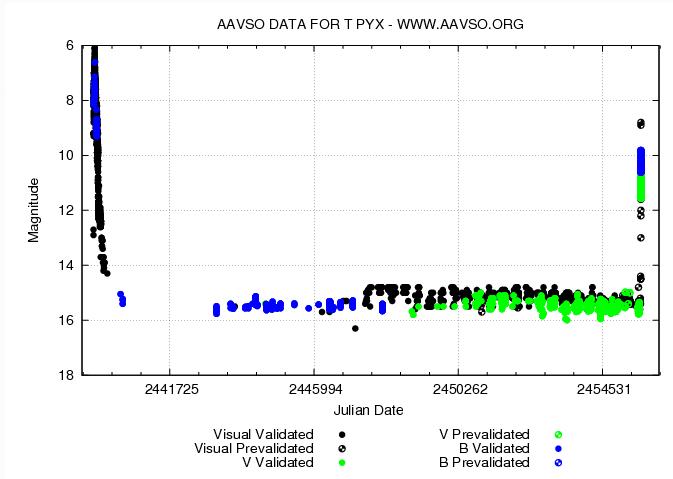
This is the first outburst of T Pyx since December 7, 1966 (discovered then by Albert Jones), nearly 45 years ago, when it reached visual magnitude 6.5 from fainter than 15th magnitude; it was brighter than magnitude 8 for two months. Previous outbursts occurred in 1890, 1902, 1920, and 1944. There are only ten known galactic recurrent novae.
Below you can see the five maxima of the recurrent nova T Pyx from 1890 to 1967.

(Credit: AAVSO)
AAVSO Light-Curve for the period 1966 to present.
T Pyxidis is 6,000 light-years away in the dim southern constellation Pyxis, the Mariner's Compass. In September 1997, astronomers released an image of T Pyxidis taken using the Hubble Space Telescope. The Hubble's image shows that the shells of gas around the star that were blown off during several eruptions, are actually more than 2,000 gaseous blobs packed into an area that is 1 light-year across.

(Credits: Mike Shara, Bob Williams, and David Zurek (Space Telescope Science Institute); Roberto Gilmozzi (European Southern Observatory); Dina Prialnik (Tel Aviv University); and NASA)
T Pyx is located at the following coordinates:
RA 09h 04m 41.5s DEC -32 22' 47.4" (2000)
On April 15.41 we have been able to image T Pyx remotely through Gras network from Officer, Australia (MPC Code - E03) using a RCOS 12.5" - FL 1950 @ f/6.3. The object has reached the unfiltered magnitude ~8.5. Click on the image for a bigger version.
RA 09h 04m 41.5s DEC -32 22' 47.4" (2000)
On April 15.41 we have been able to image T Pyx remotely through Gras network from Officer, Australia (MPC Code - E03) using a RCOS 12.5" - FL 1950 @ f/6.3. The object has reached the unfiltered magnitude ~8.5. Click on the image for a bigger version.

Below you can find an animation showing a comparison between our image and the archive DSS plate (R Filter - 1992) - Click on the thumbnail for a bigger version:

Below you can see a a spectrum of T Pyx in its rising phase reported by Arai-san at Koyama Astron. Obs. (Kyoto Sangyo U.) :

Follow-up observations are strongly encouraged!!
by Ernesto Guido & Giovanni Sostero


