Sunday, October 2, 2011

Bright Sungrazing Comet on October 01, 2011

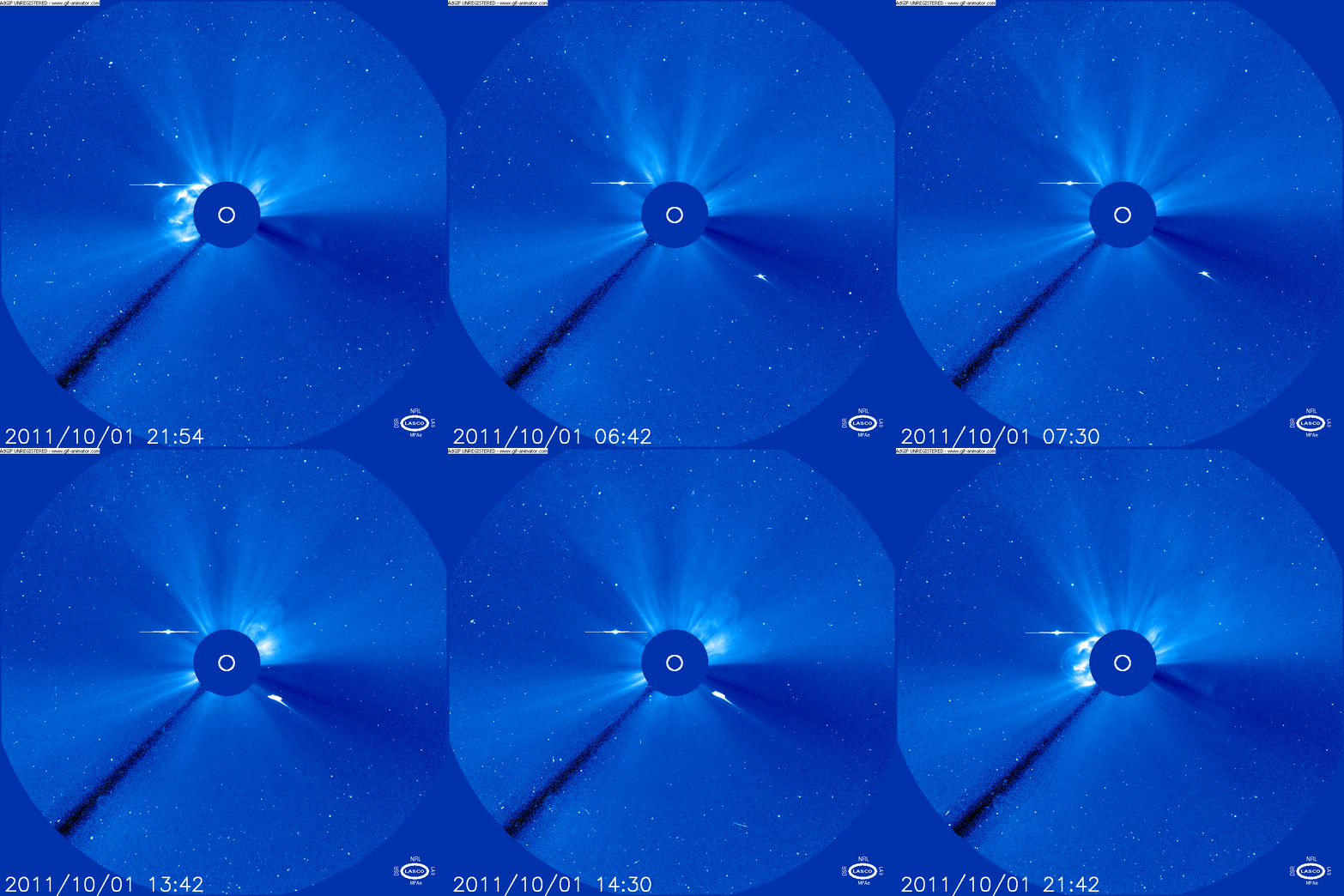
A new bright comet diving into the Sun is visible right now (October 01, 2011) in C3 and C2 images taken by SOHO spacecraft. This object belong to the famous Kreutz-group, a family of sungrazing comets that are named after German astronomer Heinrich Kreutz who first studied them in the details. These comet fragments passes extremely close to the Sun at perihelion and usually they completely evaporated during such a close approach. The comet (designated SOHO-2143) was discovered on Sept. 29th by a group of four independent SOHO comet hunters (M. Kusiak, S. Liwo, B. Zhou and Z. Xu), who reported it within 9-secs of each other! 

According to Karl Battams: "It's *very* rare for a comet to enter the fov as bright as this one. I think this is the brightest SOHO Kreutz we've ever seen!"

SOHO-2143 is strongly saturating C3 Images - (click to see a bigger version)


 (Credit : SOHO)


C2 Image - October 01, 2011 (click to see a bigger version)


(Credit : SOHO)


C3 & C2 Movies - (click on the thumbnails to see a bigger version)


You can read more details about latest bright SOHO comets here:

by Ernesto Guido

Thursday, September 29, 2011

Comet images + Amor Type asteroid

Below you can find a selection of some of the comets and asteroids we imaged in the month of September 2011 using the Faulkes (F65 & E10 MPC codes), New Mexico (H06 & H10 codes) and Malina River Observatory, Italy (B90 code) telescopes. 

Comet 45P/Honda–Mrkos–Pajdušáková (September 29, 2011)


Comet 45P/Honda–Mrkos–Pajdušáková (September 24, 2011)


 Comet 78P/Gehrels (September 07, 2011)


Comet C/2009 Y1 (Catalina) - September 07, 2011


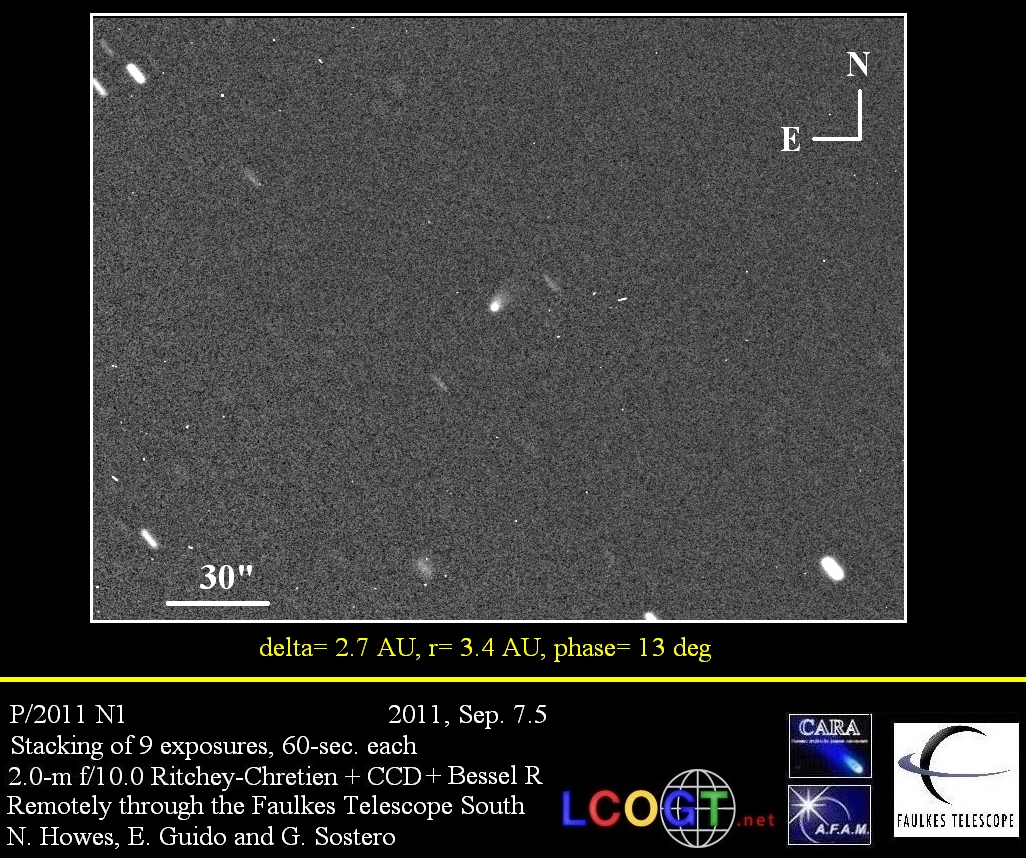
Comet P/2011 N1 (ASH) - September 07, 2011


AMOR Type Asteroid 2011 SQ32


By Ernesto Guido, Giovanni Sostero & Nick Howes

Thursday, September 22, 2011

Further fragmentation events in 213P/Van Ness

Stacking of 9 R-filtered exposures, 120-sec each, obtained remotely, from the Siding Spring-Faulkes Telescope South on 2011, September 20.6, through a 2.0-m f/10.0 Ritchey-Chretien + CCD, shows that fragment b of comet 213P is still visible, albeit very faint and diffuse (m2 about 21.5, coma diameter about 5-arcsec). Fragment b was located about 5.7 arcmin in PA 240 respect the main nuclear condensation of 213P/Van Ness.

During the same observing session, we noticed also the presence of a new fragment, not visible on our past images obtained with the same set-up (the last of which dates back 2011, Sep. 2.5): this additional fragment (that we called below "part-y") appears slightly brighter and compact than 0213Pb itself (m1 about 21.0, coma diameter about 4-arcsec elongated toward the southwest). "part-y" was located about 4.5 arcmin in PA 239 respect the main nuclear condensations of 213P/Van Ness.


Our image of Sept. 20.6 about these fragments is available here:


Click on the thumbnail below to see a short animation showing the fragment's motion:


We obtained additional follow-up through the same instrumentation on 2011, Sep. 21.6, confirming the existence of both fragments b and "part-y". Further inspection of our images, exclude the presence of other fragments brighter than magnitude R about 22, up to 12-arcmin tailward of 213P.

UPDATE - SEPTEMBER 23, 2011

Stacking of 11 R-filtered exposures, 120-sec each, obtained remotely, from the Siding Spring-Faulkes Telescope South on 2011, September 23.6, through a 2.0-m f/10.0 Ritchey-Chretien + CCD, shows that fragment b of comet 213P/Van Ness is now extremely weak and diffused (uncondensed coma about 7-arcsec in diameter) that hampers any astrometric measurement about it (however this might be a temporary disappearance, as sometimes happens with these small cometary fragments in rapid evolution).

On today's images we found again the fragment we reported first on 2011, Sep. 20.58846 (at that time we called it "part-y").


Click on the thumbnail below to see a short animation showing the fragment's motion:


by Giovanni Sostero, Ernesto Guido & Nick Howes

Wednesday, September 21, 2011

New Comet: C/2011 S1 (GIBBS)

Cbet nr.2822, issued on 2011, September 21, announces the discovery of a new comet (discovery magnitude 21.2) by A. R. Gibbs on CCD images obtained on September 18, 2011 by Gibbs and S. F. Tornero with the Mt. Lemmon 1.5-m reflector. The new comet has been designated C/2011 S1 (GIBBS).

We performed some follow-up measurements of this object, while it was still on the neocp, with "Faulkes-Telescope South" on September 21, 2011.

Stacking of 3 R-filtered exposures, 120-sec each, obtained remotely, from the Siding Spring-Faulkes Telescope South on 2011, September 21.6, through a 2.0-m f/10.0 Ritchey-Chretien + CCD, shows that this object is a comet: diffuse coma nearly 6-arcsec in diameter.

Our confirmation image (click on it for a bigger version):


M.P.E.C. 2011-S28 assignes the following preliminary orbital elements to comet C/2011 S1 (GIBBS): T 2013 Jan. 16.54; e= 1.0; Peri. =174.65; q = 4.99 AU; Incl.= 2.23

by Giovanni Sostero, Nick Howes and Ernesto Guido

Friday, September 9, 2011

New Comet: P/2011 R3 (NOVICHONOK-GERKE)

Cbet nr.2812, issued on 2011, September 09, announces the discovery of a new comet (discovery magnitude 18.9) by Artyom Novichonok on six images taken by Vladimir V. Gerke (Moscow) during Sept. 7.02-7.05 UT using a 0.4-m "Jigit" telescope at the TAU station of the Ka-Dar Observatory (located near Nizhniy Arkhyz, Russia). The new comet has been designated P/2011 R3 (NOVICHONOK-GERKE).

We performed some follow-up measurements of this object, while it was still on the neocp, with "Faulkes-Telescope North" on September 08, 2011.

Stacking of 6 R-filtered exposures, 60-sec each, obtained remotely, from the Haleakala-Faulkes Telescope North on 2011, September 8.4, through a 2.0-m f/10.0 Ritchey-Chretien + CCD, shows that this object is a comet: sharp central condensation, coma nearly 4-arcsec in diameter elongated toward southwest, broad tail at least 7-arcsec long toward PA 252.

Our confirmation image (click on it for a bigger version):


M.P.E.C. 2011-R34 assignes the following preliminary orbital elements to comet P/2011 R3: T 2011 Aug. 23.36; e= 0.26; Peri. =189.68; q = 3.56 AU; Incl.= 18.04

by Giovanni Sostero, Nick Howes and Ernesto Guido

Wednesday, September 7, 2011

NOVA SCORPII 2011 No. 2

Following the posting on the Central Bureau's Transient Object Confirmation Page about a possible transient in Sco  (TOCP Designation: PNV J16364300-4132460) and AAVSO Special Notice #251, we performed some follow-up of this object  remotely through the 2.0-m f/10.0 Ritchey-Chretien + CCD of "Faulkes Telescope South" (MPC Code - E10).

The two independent discoverers of this nova are: John Seach (Australia) and Yuji Nakamura (Japan).

On our images taken on September 07.50, 2011 we can confirm  the presence of an optical counterpart with filtered R-Bessel CCD magnitude 9.1 (USNO-B1.0 Catalogue reference stars) at coordinates:

R.A. = 16 36 44.29, Decl.= -41 32 37.7

(equinox 2000.0; USNO-B1.0 catalogue reference stars).

According to VIZIER there is a 15.08 R1 magnitude star at 0.060 arcseconds from the transient position (USNO-B1.0 0484-0459316).

Our BRV image (click on it for a bigger version):


Below you can see an animation showing a comparison between our confirmation image and the archive POSS2/UKSTU plate (R Filter - 1997). Click on the thumbnail for a bigger version: 


A. Arai, T. Kajikawa, C. Naka, Kyoto Sangyo University, reports on Cbet 2813 that they performed low-resolution optical spectroscopic observations (R about 580) of this object on Sept. 7.42 UT using the Araki telescope at Koyama Astronomical Observatory.  The spectrum exhibits broad Balmer emissions and Fe II multiplet emissions on a highly reddened continuum light.  The H-alpha emission line shows an asymmetric profile with FWZI about 6000 km/s. These features suggest that the object is an "Fe II"-type classical nova, highly reddened by the interstellar medium.

by Ernesto Guido, Nick Howes and Giovanni Sostero

New Comet: P/2011 R2 (PANSTARRS)

Cbet nr.2811, issued on 2011, September 07, announces the discovery of a new comet (discovery magnitude 18.7) by Larry Denneau and Richard Wainscoat on two i-band Pan-STARRS images taken with the 1.8-m "Pan-STARRS 1" telescope at Haleakala on September 4.5, 2011. The new comet has been designated P/2011 R2 (PANSTARRS).

We performed some follow-up measurements of this object with a "GRAS Telescope" and the "Faulkes-Telescope South" on September 06, 2011.

Stacking of 14 unfiltered exposures, 120-sec each, obtained remotely on 2011, September 9.3 from the GRAS Observatory (near Mayhill, NM) through a 0.25-m, f/3.4 reflector + CCD, shows that this object is a comet:  condensed coma about 8-arcsec in diameter, elongated, toward PA 250.

Stacking of 4 R-filtered exposures, 30-sec each, obtained remotely, from the Siding Spring-Faulkes Telescope South on 2011, September 6.5, through a 2.0-m f/10.0 Ritchey-Chretien + CCD, shows that this object is a comet: well condensed coma nearly 5-arcsec in diameter, and a broad tailabout 8-arcsec long in PA 251.

Our confirmation images (click for a bigger version): 


M.P.E.C. 2011-R24 assignes the following preliminary orbital elements to comet P/2011 R2: T 2011 Nov. 19.50; e= 0.40; Peri. =230.12; q = 2.02 AU; Incl.= 4.77

by Giovanni Sostero, Ernesto Guido and Nick Howes