Showing posts with label soho comets. Show all posts

Wednesday, December 28, 2016

Comets & Asteroids - Summary for November 2016

During the month of November 2016, 1 new comet has been discovered. "Current comet magnitudes" & "Daily updated asteroid flybys" pages are available at the top of this blog (or just click on the underline text here).  

The dates below refer to the date of issuance of CBET (Central Bureau Electronic  Telegram)  which reported the official news & designations.

- Comet Discoveries

Nov 03  Discovery of C/2016 U1 (NEOWISE)


- Other news

Nov 02 Newly discovered asteroid 2016 VA came to about 90.000 km from the Earth’s surface on the second day of November, reaching magnitude  12. It crossed the Earth shadow for a few minutes (between 23:24-23:35 UT on Nov 01, just 0.3 LD from Earth), challenging  astronomers to observe a peculiar “asteroidal eclipse”. Below you can see an animation showing this spectacular event as observed by G. Masi (Virtual Telescope Project). According to Masi: "Each frame comes from a 5-seconds integration. At the eclipse time, the asteroid was moving with an apparent motion of 1500"/minutes"


Nov 07 Roy Panther (1926 - 2016), British visual comet discoverer passed away. Obituary by N. James: "Roy was the discoverer of comet C/1980 Y2 (1980u). The discovery was made visually using a 0.20m, f/4 Newtonian at 1850 UT on Christmas day 1980 when the comet was a 9th magnitude object near M56. The discovery was confirmed that evening by Mike Hendrie and George Alcock and it was Roy's first success after 601 hours of searching.  Martin Mobberley has an interesting Sky at Night on his Youtube channel which includes an interview with Roy."

Roy Panther with his 8-inch 'old discoverer'

Nov 07 K. Battams & M. Knight published on Arxiv a summary paper of the more than 3,000 sungrazing and near-Sun comets discovered in coronagraph images returned by the Solar and Heliospheric Observatory (SOHO), since its launch in December 1995.

Credit: K. Battams & M. Knight


Nov 10 CBET 4336 reports that minor planet (5112) KUSAJI  is a binary system with an orbital period of 20.74 +/- 0.01 hr.  The primary shows a period of 2.7995 +/- 0.0001 hr and has a lightcurve amplitude of 0.12 mag at solar phases 4-8 degrees, suggesting a nearly spheroidal shape.


by Ernesto Guido

Thursday, October 6, 2016

Comets & Asteroids - Summary for August & September 2016

During the months of August & September 2016, 10 new comets were discovered, cometary activity was detected for 4 previously discovered object (earlier designated as an asteroid) and there were 3 comet recoveries. "Current comet magnitudes" & "Daily updated asteroid flybys" pages are available at the top of this blog (or just click on the underline text here). 

The dates below refer to the date of issuance of CBET (Central Bureau Electronic Telegram)  which reported the official news & designations.

- Comet Discoveries

Aug 14  Discovery of P/2016 P1 (PANSTARRS)
Aug 14  Discovery of P/2016 P2 (PANSTARRS)
Aug 29  Discovery of P/2016 N6 (PANSTARRS)
Aug 31  Discovery of C/2016 Q2 (PANSTARRS)
Sep 02   Discovery of C/2016 Q4 (KOWALSKI)
Sep 09   Discovery of C/2016 P4 (PANSTARRS)
Sep 09   Discovery of C/2016 R2 (PANSTARRS)
Sep 16   Discovery of C/2016 R3 (BORISOV)
Sep 29   Discovery of C/2016 S1 (PANSTARRS)
Sep 29   Discovery of P/2016 R4 (GIBBS)

- Cometary activity detected

Aug 10  Cometary activity detected in 2014 HU_195 = C/2014 HU_195
Aug 15  Cometary activity detected in 2015 TP_200  = P/2015 TP_200 (LINEAR)
Aug 31  Cometary activity detected in 2008 SH164   = P/2016 Q3 (LINEAR)
Sep 27   Cometary activity detected in P/2009 Q9       = P/2016 SV (PANSTARRS)

- Comet Recoveries

Aug 15  Recovery of P/2003 SQ_215 (NEAT-LONEOS) as P/2016 P3
Aug 31  Recovery of P/2005 S3 (READ) as P/2016 Q1
Sep 03   Recovery of P/2007 T6 (CATALINA) as P/2016 R1


- Other news

Aug 02 July Gamma Draconid meteor shower showed a little outburst between July 27d 23h56m and July 28d 00h23m UT as showed by IMO and CAMS meteor video camera networks and by Canadian Meteor Orbit Radar data. The observed rate translates to a peak zenith hourly rate for a visual observer (assuming a differential mass distribution index of 1.9) of about 50 meteors per hour for the period 0h-1h UT on July 28.


Credit: IMO


Aug 04 A bright sungrazer heading towards the Sun imaged by the ESA/NASA Solar & Heliospheric Observatory SOHO 03 & 04 August 2016.

Credit: SOHO


Sep 01 Comet 174P/ECHECLUS = (60558) ECHECLUS was found in outburst by P. Camilleri, brightening from magnitude r' = 17.8 to 15.2 between Aug 27.745 and 28.686 UT in a photometric aperture of radius 5".2. 


Sep 05 The search for @Philae2014 is OVER! Less than a month before the end of the mission, Rosetta’s high-resolution camera has revealed the Philae lander wedged into a dark crack on Comet 67P/Churyumov–Gerasimenko. The images were taken on 2 September by the OSIRIS narrow-angle camera as the orbiter came within 2.7 km of the surface and clearly show the main body of the lander, along with two of its three legs.

Credit: ESA/Rosetta

Sep 07 Close approach of asteroid 2016 RB1. Asteroid 2016 RB1 (estimated size of 7.3 m - 16 m) had a close approach with Earth at about 0.1 LD (Lunar Distances = ~384,000 kilometers) on 2016, September 7 at 17:20UT reaching a peak magnitude of about +12.3.


Sep 24 Time-resolved observations of the split comet 332P/Ikeya-Murakami were taken using the Hubble Space Telescope.

Credit: D. Jewitt et al.

Sep 30 ESA’s historic Rosetta mission has concluded as planned, with the controlled impact onto the comet it had been investigating for more than two years. Confirmation of the end of the mission arrived at ESA’s control centre in Darmstadt, Germany at 11:19 GMT (13:19 CEST) with the loss of Rosetta’s signal upon impact.

During the the spacecraft’s controlled descent, OSIRIS narrow-angle camera aboard Rosetta imaged comet 67P/Churyumov-Gerasimenko from an altitude of about 16 kilometers above the surface. Credit: ESA/Rosetta

A last image of comet 67P taken by Rosetta shortly before impact at an altitude of 20m above surface. The scale is 2 mm/pixel and the image measures about 96 cm across. Credit: ESA/Rosetta


by Ernesto Guido

Thursday, December 15, 2011

Comet C/2011 W3 (Lovejoy) approaches the Sun

Australian amateur astronomer Terry Lovejoy discovered on Nov. 27.7 his third comet, designated C/2011 W3 (Lovejoy). On our previous post about this comet you can see our follow-up image and animation.

C/2011 W3 is a Kreutz sungrazer, a family of sungrazing comets that are named after German astronomer Heinrich Kreutz who first studied them in the details. These comet fragments passes extremely close to the Sun at perihelion and usually they completely evaporated during such a close approach. 

Many Kreutz sungrazer comets are observed each year by SOHO Sun-observing satellite. SOHO provides a constant view of the immediate solar vicinity and it has now discovered more than 2000 of new sungrazing comets, some just a few metres across. About 83% of the sungrazers found by SOHO are members of the Kreutz group, with the other being referred to as 'non-Kreutz' or 'sporadic' sungrazers (Meyer, Marsden, and Kracht 1 & 2 families).

Comet C/2011 W3 will probably be the brightest Kreutz-group comet that SOHO has ever observed. It will reach the perihelion on 2011 Dec. 16.02 when it will be it within 880,000 km of the center of the Sun (the comet will pass just 180,000 km from the Sun’s surface).

According to Karl Battams, the new comet Lovejoy:

1. The comet should enter the STEREO/SECCHI HI-1B images on Dec 11, and HI-1A on Dec 12
2. The comet will enter the SOHO/LASCO C3 field of view early on Dec 14
3. The comet will enter the STEREO/SECCHI COR-2 A & B fields of view early on Dec 15 (UT time), and the COR-1 fields later that day.


We downloaded "Secchi" spacecraft FITS of the Dec. 11 & 12, 2011, and played a little bit with them. Using the image processing algorythms (developed for the CARA collaboration by our fellow collaborator Martino Nicolini). On those images, it's already possible to appreciate a narrow tail, in excess of about  1 deg. Below you can see our renditions (click on the images for a bigger version):


While below you can see an animation showing comet Lovejoy in SECCHI HI-1B on December 11 & 12, 2011 (click on the thumbnail for a bigger version).


According to Dr. Matthew Knight (Lowell Observatory/JHU-APL), Comet Lovejoy was at approximately magnitude 2.0 as on the LASCO C3 images of 16:32UT, Dec 14, 2011). While the peak magnitude is still uncertain, C/2011 W3 could reach the peak brightness at mag -3 or -4 and the comet will probably not survive perihelion. If Comet Lovejoy gets as bright as magnitude -4 or -5, there is a tiny but non-zero chance that it could become visible in the sky next to the sun. But extreme care is needed due to the comet's small solar elongation angle and close proximity to the Sun in the sky.

Below you can see the comet on latest LASCO C3 data available (08:30UT of December 15, 2011). Click on it for a bigger version:


(Credit: SOHO)

Stay tuned for more updates coming soon!!


UPDATE - December 15 at 12UT

Thanks to Karl, new STEREO-B, SECCHI fits dated back to December 13, 2011 are available. In spite of the fact that the image scale factor is a little small, it's possible to appreciate the growing of a slight asymmetry of the coma (toward the north-east):


Below an animation of Dec. 11, 12 and 13 stackings (or click here to see it):


Comet Lovejoy looks to be around mag -1 now and only has ~12hrs left. The comet will reach LASCO C2 around 1500 - 1600UT of today.  The animation below shows the comet in the SOHO C3 field (click on the thumbnail for a bigger version):


(Credit: SOHO)


UPDATE - December 15 at 20UT


New STEREO-B, SECCHI fits dated back to December 14, 2011 are available. Below you can see our new image processing on the STEREO/SECCHI HI-1A FITS for Dec 14.5 (click on the image for a bigger version):


In the meantime, new SOHO C3 image dated Dec, 15 at 16:30UT is available (click on the image for a bigger version):


A new narrow tail is visible in these images. This extremely narrow features recalls the Na or Fe tails already featured on a few extremely bright comets close to the Sun, e.g.:  http://tinyurl.com/cck9pbn  and http://tinyurl.com/ctun5cy

Matthew Knight of the Lowell Observatory and JHU-APL reports on Spaceweather website: "As of 16:30 UT on Dec. 15th, Comet Lovejoy has reached magnitude -3, possibly brighter. It is starting to saturate SOHO images even with narrow filters and shorter than normal exposure times." The comet is now brighter than Jupiter, but not quite as bright as Venus. If these developments continue apace, Comet Lovejoy could become visible to the naked eye in broad daylight before the end of Dec. 15th.

Again: extreme care is needed due to the comet's small solar elongation angle and close proximity to the Sun in the sky. Do not look at or near the sun through unfiltered optics; focused sunlight can seriously damage your eyes.

Comet Lovejoy's perihelion is roughly 5 hours from now, on Dec 16 at 00:30UT. Next SOHO images will be available after 22:20UT.

UPDATE - December 16 at 11UT

Surprisingly as it may seem, comet Lovejoy appears to have survived its close encounter with the sun. Video and images relased by the  NASA's Solar Dynamics Observatory (SDO) caught the comet reemerging on the other side of the Sun after its perihelion!!

SDO video showing the comet C/2011 W3 (LOVEJOY) flying towards the Sun:


While in the SDO video below you can see the comet incredibly emerging from perihelion:


Using the images taken from 04:39UT to 10:54UT by the SECCHI outer coronagraph (COR2) on the STEREO Ahead observatory on December 16, we have made this animation clearly showing what is left of the comet nucleus after the close approach with the Sun (at present no one can say how much of the comet's core remains intact). Click on the thumbnail for a bigger version:


Using images taken from SOHO C3 from 15:54 of December 15 to 09:30UT of December 16, we made this animation showing the comet on its course pre and after the perihelion. Click on the thumbnail for a bigger version:


Note how in the last frames the remnant of the pre-perihelion tail is still visible but completely disconnected from the comet:


(Credit: SOHO)

UPDATE - December 17 at 12UT

The missing SOHO C2 post-perihelion fits are now available. We just made this short animation showing the comet C/2011 W3 (Lovejoy) reemerging behind the solar disk after the perihelion on the first hours of December 16, 2011:


As we saw on the previous update, at first the emerging comet was missing its tail. Now on the latest C3 images, it is evident that tails are forming again (with the inclusion of the very narrow tail we saw just before the perihelion, possibly NA or Fe  related)  and that the comet is still very bright!!


In fact the comet has been succefully observed visually with a 10x50 binoculars by Alexandre Amorim from Brazil on Dec 17.34. He estimated the comet magnitude at -2.9. Here is its report:

C/2011 W3 (Lovejoy)
2011 Dec 17.34 UT: m1= -2.9*, Dia= <1', DC=9, tail= 0.2 in P.A. 240...10x50B...Alexandre Amorim(Florianopolis,Brazil)[comet alt. 4 deg, sun alt. -0.9 deg]


While below you can see a groud-based image taken at dawn by Jan Ebr with the FRAM remote telescope (0.3-m SCT) located in Argentina, Malargue:


UPDATE - December 19 at 15UT

Below you can see a beautiful image of the tail of comet C/2011 W3 (Lovejoy) taken on December 19, 2011 by FRAM team (Malargue, Argentina) with 200 mm telephoto lens piggybacked on the main telescope, using also a KAF-1603 camera (from FLI). Click on the image for a bigger version:


UPDATE - December 20 at 13UT

Thanks to Jakub Černý we had the chance to works on the FRAM team fits of December 17, 2011. We sorted and stacked the best V-filtered frames, and have done some image processing on it. Basically, it appears that, apart the two "tail branches", we have an asymmetric coma. In some treatement, there is the hint of a "curved jet" or "shell" (or whatever you would call it) in the inner coma, that appears to originate from the central condensation, developing in a "counterclockwise" direction. Obviously this stuff has to be confirmed in further images, to make sure it's not an artefact of my image processing. You can see below the result (click on the image for a bigger version):


On December 17, 2011 the comet has been imaged in daylight also by amateur astronomer Vincent Jacques of Breil-sur-Roya, France. Images and video below taken with an 80mm refractor at 80x + near IR filter and camera DMK21 from 09:00 UT to 13:00 UT.


(Credit: Vincent Jacques)


(Credit: Vincent Jacques)


Australian amateur astronomer Vello Tabur captured a 5-degree-long tail of comet Lovejoy on December 19.7 with a DSLR in the bright twilight.


(Credit: Vello Tabur)


Finally a new image by the FRAM team obtained on December 20, 2011 with a 30-cm Meade SCT F/10 (0.66x) located in Argentina, Malargue.


UPDATE - December 21 at 15UT

The comet has put on a great show for Southern observers. Amateur astronomer Colin Legg has been able to image (with a 5D2 digital camera) the beautiful tail of comet Lovejoy from the Mandurah Estuary on Western Australia around 3:30 WST of December 21, 2011. Below you can see his image and the stunning timelapse of his observing session.


While another observer (Grahame) from Australia  took the following image taken on December 21, 2011 at 0400 local time of Perth with canon 7D, 17-85mm lens, ISO 800 F4.5. Click on the image for a bigger version.


UPDATE - December 27 at 14UT

International Space Station Commander Dan Burbank captured spectacular images of Comet C/2011 W3 (Lovejoy) as seen from about 386 Km above the Earth’s horizon on Wednesday, Dec. 21.

(Credit : NASA)


Many beautiful images are arriving from observers in the Southern Hemisphere, you can find a very good selection here & here


Comet Lovejoy on 2011 Dec 23.7 UT, Michelago, NSW, Australia

(Credit: Vello Tabur)

by Ernesto Guido, Giovanni Sostero & Nick Howes

Sunday, October 2, 2011

Bright Sungrazing Comet on October 01, 2011

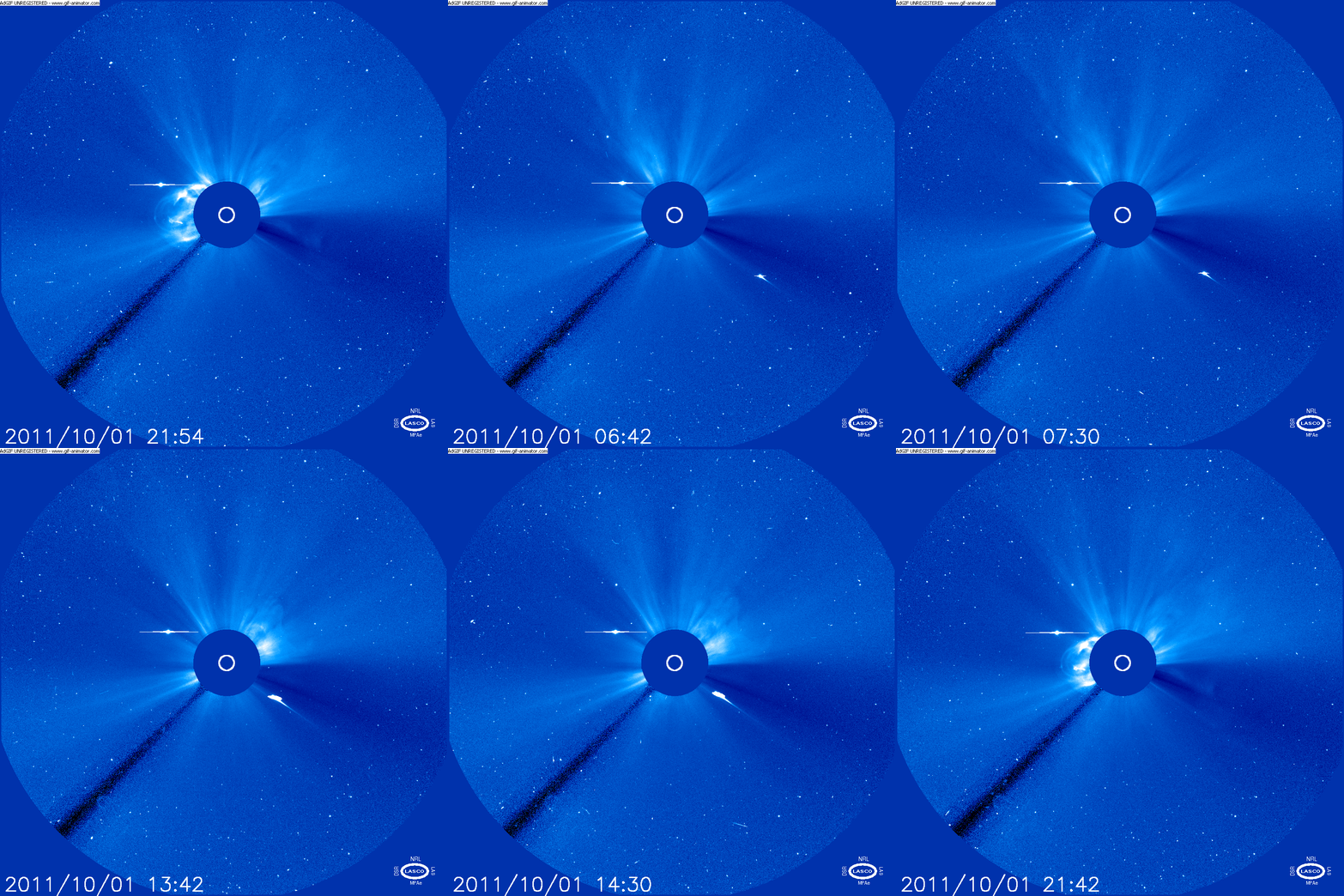
A new bright comet diving into the Sun is visible right now (October 01, 2011) in C3 and C2 images taken by SOHO spacecraft. This object belong to the famous Kreutz-group, a family of sungrazing comets that are named after German astronomer Heinrich Kreutz who first studied them in the details. These comet fragments passes extremely close to the Sun at perihelion and usually they completely evaporated during such a close approach. The comet (designated SOHO-2143) was discovered on Sept. 29th by a group of four independent SOHO comet hunters (M. Kusiak, S. Liwo, B. Zhou and Z. Xu), who reported it within 9-secs of each other! 

According to Karl Battams: "It's *very* rare for a comet to enter the fov as bright as this one. I think this is the brightest SOHO Kreutz we've ever seen!"

SOHO-2143 is strongly saturating C3 Images - (click to see a bigger version)


 (Credit : SOHO)


C2 Image - October 01, 2011 (click to see a bigger version)


(Credit : SOHO)


C3 & C2 Movies - (click on the thumbnails to see a bigger version)


You can read more details about latest bright SOHO comets here:

by Ernesto Guido

Wednesday, May 11, 2011

Bright Sungrazing Comet on May 10-11, 2011

A new bright comet diving into the Sun has been discovered on May. 09 by amateur astronomer Sergey Shurpakov using the images taken by SOHO spacecraft. This object belong to the famous Kreutz-group, a family of sungrazing comets that are named after German astronomer Heinrich Kreutz who first studied them in the details. These comet fragments passes extremely close to the Sun at perihelion and usually they completely evaporated during such a close approach.


C3 Image - May 10, 2011 (click to see a bigger version)


(Credit : SOHO)


Yesterday's now-evaporated bright Kreutz comet didn't die alone! This small companion was visible by its side on this C2 image:


(Credit: SOHO; @SungrazerComets):


C2 Movie - May 11, 2011 (click to see a bigger version)


(Credit : SOHO)

This Kreutz probably peaked near mag 2. (It was just starting to saturate in the LASCO cameras)

You can read more details about 2010 bright SOHO comets here:

http://remanzacco.blogspot.com/2010/11/bright-sungrazing-comet-on-november-17.html
http://remanzacco.blogspot.com/2010/11/bright-sungrazing-comet-on-1314.html
http://remanzacco.blogspot.com/2010/10/new-bright-sungrazing-comet.html
http://remanzacco.blogspot.com/2010/04/new-bright-sungrazing-comet.html
http://remanzacco.blogspot.com/2010/01/bright-sungrazing-comet.html
http://remanzacco.blogspot.com/2010/01/new-sungrazing-comet.html
http://remanzacco.blogspot.com/2010/03/new-sungrazing-comet.html


by Ernesto Guido

Saturday, November 20, 2010

Bright Sungrazing Comet on November 17-19, 2010

Only few days after the bright sungrazing comet of November 13/14, another new bright comet diving into the Sun has been discovered on Nov. 17 by Michal Kusiak using the images taken by SOHO spacecraft. This object too belong to the famous Kreutz-group, a family of sungrazing comets that are named after German astronomer Heinrich Kreutz who first studied them in the details. These comet fragments passes extremely close to the Sun at perihelion and usually they completely evaporated during such a close approach.


LASCO C2 Image - November 19, 2010


(Credit: SOHO)


C2 Movie (click on the thumbnail for a bigger version)


(Credit: SOHO)

We've had many bright Kreutz comets this year... A sign of a big one on its way?

Recently, different studies (Sekanina & Chodas 2007; Knight & Hearn 2008) have shown that the flow of Kreutz comets (correct of all systematic errors) increased. In the years since 1997 to 2002 for the Kreutz comet brighter that eighth magnitude has been calculated an average of about 83 new discoveries each year, while in the period 2003 - 2007 the average annual discovery rate risen to 125. This increase also applies to the findings of comets brighter than sixth magnitude where there was a increase in the flux of comets around 80%.

Sekanina and Chodas (2007) noted the increase in raw discoveries and suggested it may be “an early warning of another cluster of bright sungrazers approaching the Sun in coming decades.”


On November 18, 2010 the leading expert on Kreutz comets (reduced the observations of almost all of SOHO's ~1950 comets), Brian Marsden passed away after a prolonged illness. He will be remembered as contributing much to celestial mechanics and the dynamics and orbits of minor bodies of the solar system and as having an encyclopedic knowledge of the history of astronomy. Obituary on Sky & Telescope website and on mpec 2010-W10

by Ernesto Guido

Tuesday, November 16, 2010

Bright Sungrazing Comet on 13/14 November 2010

A new bright comet diving into the Sun has been discovered on Nov. 13th by Masanori Uchina using the images taken by SOHO spacecraft. This object belong to the famous Kreutz-group, a family of sungrazing comets that are named after German astronomer Heinrich Kreutz who first studied them in the details. These comet fragments passes extremely close to the Sun at perihelion and usually they completely evaporated during such a close approach.

Several sungrazing comets are discovered each year in SOHO images, many of them are very small and faint while sometimes some bigger and bright fragments arrive in the proximity of the Sun.

As expected, this sungrazing comet has not survived the close encounter with the sun.

C2 Image - November 14 ,2010

(Credit : SOHO)

C2 Movie (click to see a bigger version)


(Credit : SOHO & Spaceweather)

You can read more details about other recently 2010 bright SOHO comets here:


by Ernesto Guido

Thursday, October 21, 2010

New Bright Sungrazing Comet

A new bright comet (designated SOHO-1932) diving into the Sun has been discovered on Oct. 19th by Bo Zhou using the images taken by SOHO spacecraft. This object belong to the famous Kreutz-group comet, a family of sungrazing comets that are named after German astronomer Heinrich Kreutz who first studied them in the details. These comet fragments passes extremely close to the Sun at perihelion and usually they completely evaporated during such a close approach.

Several sungrazing comets are discovered each year in SOHO images, many of them are very small and faint while sometimes some bigger and bright fragments arrive in the proximity of the Sun.


SOHO-1932


(Credit : SOHO)


SOHO-1932 in C2 (long, thin tail is well over a million-km long in this image)


(Credit : SOHO)


Animation of SOHO-1932 (click on the thumbnail for a bigger version)


(Credit : SOHO & Spaceweather)


You can read more details about other recently 2010 bright SOHO comets here:


by Ernesto Guido