Tuesday, March 27, 2012

Possible Nova in Ophiuchus

Following the posting on the Central Bureau's Transient Object Confirmation Page about a possible Nova in Oph (TOCP Designation: PNV J17260708-2551454) we performed some follow-up of this object remotely through the 0.10-m f/5 reflector + CCD from MPC code H06 (Mayhill station, NM) of iTelescope network.

On our images taken on 2012, March 27.5 we can confirm the presence of an optical counterpart with unfiltered CCD magnitude 10.9 at coordinates:

R.A. = 17 26 07.02, Decl.= -25 51 42.1

(equinox 2000.0; USNO-B1.0 catalogue reference stars).


Our confirmation image:


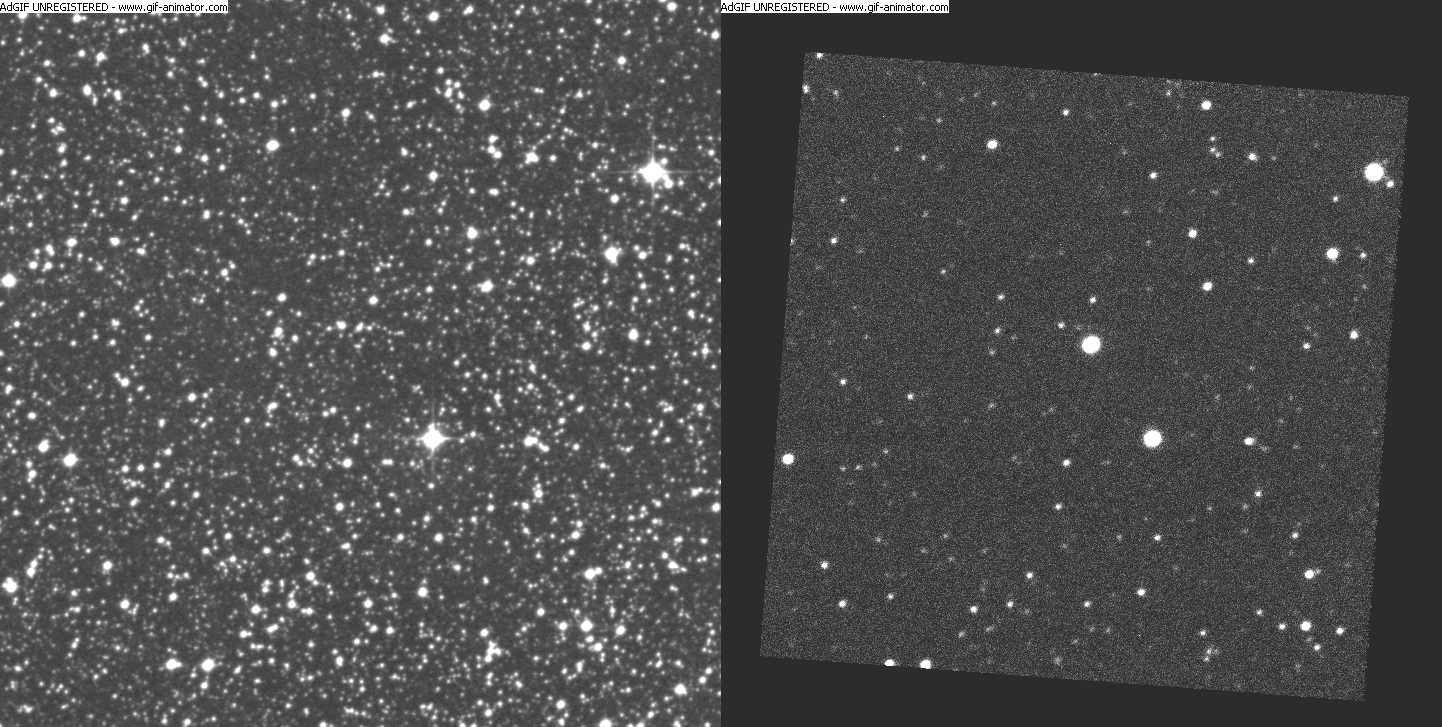
While below you can see an animation showing a comparison between our confirmation image and the archive POSS2/UKSTU plate (R Filter - 1997). Click on the thumbnail for a bigger version:


UPDATE - MARCH 29, 2012

According to Cbet 3072 issued on March 28, observers at Koyama Astronomical Observatory (KAO) and at Okayama University of Science (OUS) have obtained a spectra of this variable star. An H-alpha emission line can be seen in the spectrum. H_beta, Fe II, and O I 777.4-nm are also visible. These features suggest that the object is an "Fe II-type" classical nova. This nova, designated NOVA OPHIUCHI 2012, has been discovered by Hideo Nishimura (Miyawaki, Kakegawa, Shizuoka-ken) on three 13-s frames (limiting mag 13.5) taken on Mar. 25.789 UT with a Canon 200-mm f/3.2 lens and a Canon EOS 5D Digital Camera mounted on a Takahashi EM100 equatorial telescope at Gomyo, Kakegawa, Japan.

by Ernesto Guido, Giovanni Sostero & Nick Howes

Monday, March 26, 2012

New Comet: P/2012 F5 (GIBBS)

CBET 3069 and M.P.E.C. 2012-F87, issued on 2012, March 25, announced the discovery of a periodic comet by A. R. Gibbs on Mar. 22.8, through the Mount Lemmon 1.5-m reflector. On his images, Gibbs, found a stellar coma and a long, narrow tail about 7'.4 long in p.a. 292.5 deg. The new object has been designated P/2012 F5 (GIBBS) by the Minor Planet Center.

We tried its follow up at first on 2012, March 23.8, when this object was still listed in the NEO-CP webpage as "TF85899". We operated from the Malina River Observatory (Povoletto, Italy) through a 0.3-m, f/4.7 reflector + CCD, under a hazy sky. On our stackings we found a faint and narrow, streak, about 2-arcmin long, oriented toward PA 295 deg.

This feature was very close to the expected position of "TF85899" however, due to its faintness (R about 19.2) and curious shape, we suspected it migth be a noise, rather than a real object, so we decided to go for a second night of follow-up, just to make sure. On 2012, Mar. 25.8, we repeated the observations of this object with the same set-up, and found again an odd aspect: kind of elongated and narrow tail, at least 30" long, toward PA300 (in these mages we suspected that the tail might be longer than this, however our observations were hampered by a bright, nearby field star). The central condensation was very difficult to locate, hampering its precise astrometric measurement.

Meanwhile other observers reported about its curious shape in a the [Comets-ml] forum, so we had an indipendent confirmation that what we observed on Mar. 23.8 was actually a real (albeit odd) cometary object, and not an artefact.

Our confirmation image of March 23 (click on it for a bigger version):


According to the preliminary orbital elements issued by the Minor Planet Center, P/2012 F5 has an orbital period of 5.32 years, an inclination on the ecliptic of 13.5 deg, semi-major axis of 3 AU and en eccentricity about 0.4. Its perihelion was reached in September 2010.

by Giovanni Sostero, Ernesto Guido and Nick Howes

Saturday, March 24, 2012

Possible Nova in Centaurus

Following the posting on the Central Bureau's Transient Object Confirmation Page about a possible Nova in Cen (TOCP Designation: PNV J13410800-5815470) we performed some follow-up of this object remotely through the 2.0-m  f/10.0 Ritchey-Chretien + CCD of "Faulkes Telescope South" (MPC Code - E10).

On our images taken on March 24.5, 2012 we can confirm  the presence of an optical counterpart with filtered  R-Bessel CCD magnitude 9.3 (USNO-B1.0 Catalogue reference stars) at coordinates:

R.A. = 13 41 09.36, Decl.= -58 15 16.9

(equinox 2000.0; USNO-B1.0 catalogue reference stars).


Our confirmation image (click on it for a bigger version):


While below you can see an animation showing a comparison between our confirmation image and the archive POSS2/UKSTU plate (R Filter - 1994). Click on the thumbnail for a bigger version:


UPDATE - MARCH 29, 2012

According to Cbet 3073 issued on March 29, F. M. Walter, Stony Brook University, obtained a low-resolution (0.31-nm) red (560-690 nm) spectrogram of PNV J13410800-5815470 on Mar. 27.3 UT using the SMARTS 1.5-m telescope (+ RC spectrograph) at Cerro Tololo. The variable is a classical "Fe II"-type nova. This nova, designated NOVA CENTAURI 2012, has been discovered by John Seach, Chatsworth Island, NSW, Australia,  on six images (limiting mag 11.0) taken on Mar. 23.386 UT with a digital SLR camera (+ 50-mm f/1.0 lens).

by Ernesto Guido, Alison Tripp, Nick Howes and Giovanni Sostero

Thursday, March 22, 2012

Recovery of comet P/2005 JY126 (Catalina)

Cbet Circular No. 3065, issued on 2012, March 22, announces the recovery of comet P/2005 JY126P/2012 F4 (CATALINA) by our team; this comet was discovered on 2005, June 7.32 by Catalina Sky Survey and it was last observed on 2007, January 13.

On 2012, March 21.6 we started an observing session to recover the periodic comet P/2005 JY126. We found an object of magnitude ~19.6 located 8.5 arcsec west of the nominal position. Stacking of three R-filtered exposures, 120-sec each, obtained remotely, from the Siding Spring Faulkes Telescope South through a 2.0-m f/10.0 Ritchey-Chretien + CCD, under good seeing conditions,shows that this object appears slightly "soft" compared to the nearby field stars of similar brightness.

On 2012, March 22.4 we have been able to obtain a second night of observations by stacking of 29 R-filtered exposures, 120-sec each, obtained remotely, from the iTelescope network (near Mayhill, NM) through a 0.25-m f/3.4 reflector + CCD. 

Below you can find our recovery image of 2012, March 21.6. The red square shows the nominal position, while the circle shows where we actually found the comet.


The indicated correction to the prediction on MPC 69904 is Delta(T) = +0.01 day. The linked orbital elements by G. V. Williams, from 246 observations spanning 2005 Apr. 17-2012 Mar. 22 (mean residual 0".6), and an ephemeris appear on MPEC 2012-F54

by Giovanni Sostero, Ernesto Guido, Nick Howes and Alison Tripp

Monday, February 27, 2012

Trans-Neptunian Object 2012 DR30

M.P.E.C. 2012-D67, issued on 2012, February 26, announces the discovery of a new Trans-Neptunian Object (discovery magnitude 18.7) by R. H. McNaught with 0.5-m Uppsala Schmidt + CCD at Siding Spring on February 22, 2012. The new object has been designated 2012 DR30.

We performed some follow-up measurements of this object, while it was still on the neocp. Stacking of six R-filtered exposures, 60-sec each, obtained remotely, from the Siding Spring-Faulkes Telescope South on 2012, Feb. 23.5, through a 2.0-m f/10.0 Ritchey-Chretien + CCD, shows that the object has stellar aspect.

Our confirmation image (click on the image for a bigger version):


M.P.E.C. 2012-D67 assignes the following preliminary orbital elements to 2012 DR30:  H= 7.2; e= 0.91; a= 160.45; Peri.= 203.99; q= 14.43 AU; Incl.= 76.04

by Ernesto Guido, Giovanni Sostero & Nick Howes

Sunday, February 19, 2012

Unusual Minor Planet 2011 YU75

This unusual minor planet was discovered by the Spacewatch sky survey on 2011, Dec. 26. It moves along a very eccentric orbit (perihelion close to Mars, aphelion nearly 3 AU away from Saturn). Currently it's about 1 AU from Earth and 2 AU from the Sun, approaching its perihelion, scheduled for the end of April 2012 (q= 1.7 AU). Since it moves along a nice comet-like track (a= 7.5 AU, e= 0.77, Incl.= 16.7 deg), we decided to insert it in our wish-list of interesting targets, in order to check if it's going to develope any perceptible sign of cometary activity (coma and/or tail) while approaching the Sun.

On 2012, Feb 17.4 we aimed the "Faulkes Telescope South" 2.0-m f/10.0 Ritchey-Chretien + CCD at Siding Spring (Australia) to this target, and collected on it twelve R-filtered exposures, 30-seconds each. Stacking these images through "Astrometrica" along the expected proper motion of 2011 YU75, we get a nice starlike object (magnitude ~19) at its expected position. Its FWHM was the same of the nearby field stars (about 1.2-arcsec) and no traces of coma/tail was visible to us, in spite of several image processing routines we applied on it. So we can conclude that, at least through the analysis of the images we collected, at this time 2011 YU75 shows no detectable outgassing activity.  Below you can see our follow-up image. Click on it so see a larger version.


by Nick Howes, Giovanni Sostero and Ernesto Guido

Friday, February 17, 2012

New Comet: P/2012 C3 (PANSTARRS)

Cbet nr. 3021, issued on 2012, February 16, announces the discovery of a new comet (discovery magnitude 21.6) by Larry Denneau and Richard Wainscoat in four exposures taken with the 1.8-m Pan-STARRS 1 telescope at Haleakala on February 15.3. The new comet has been designated P/2012 C3 (PANSTARRS).

We performed some follow-up measurements of this object, while it was still on the neocp. Stacking of ten R-filtered exposures, 60-sec each, obtained remotely, from the Siding Spring-Faulkes Telescope South on 2012, Feb. 16.6, through a 2.0-m f/10.0 Ritchey-Chretien + CCD, shows that this object is a comet: faint fan-shaped tail, nearly 6-arcsec long in PA 284.


Our confirmation image (click on the image for a bigger version):


M.P.E.C. 2012-D03 assignes the following preliminary parabolic orbital elements to comet P/2012 C3: T 2011 Oct. 11.99; e= 0.61; Peri. = 346.39; q = 3.67 AU; Incl.= 9.38


by Nick Howes, Giovanni Sostero & Ernesto Guido