Showing posts with label nova centaurus. Show all posts

Tuesday, December 3, 2013

Possible Bright Nova in Centaurus

Following the posting on the Central Bureau's Transient Object Confirmation Page about a possible Nova in Cen (TOCP Designation: PNV J13544700-5909080) we performed some follow-up of this object remotely through the 0.50-m f/6.8 astrograph + CCD + focal reducer of iTelescope network (MPC Code  Q62 - Siding Spring, AU).

On our images taken on December 03.68, 2013 we can confirm the presence of an optical counterpart with unfiltered CCD magnitude  ~5.0 at coordinates:

R.A. = 13 54 45.22, Decl.= -59 09 04.5 (equinox 2000.0; UCAC-3 catalogue reference stars).

According to Vizier the nearest star (located at 1.538 arcsecond from the transient) to this position in the USNO-B1.0 catalogue is:

USNO-B1.0  0308-0442031   (J2000) 13 54 45.374 -59 09 03.52    mag. B2=15.52 R2 =15.12

Our confirmation image (click on it for a bigger version):


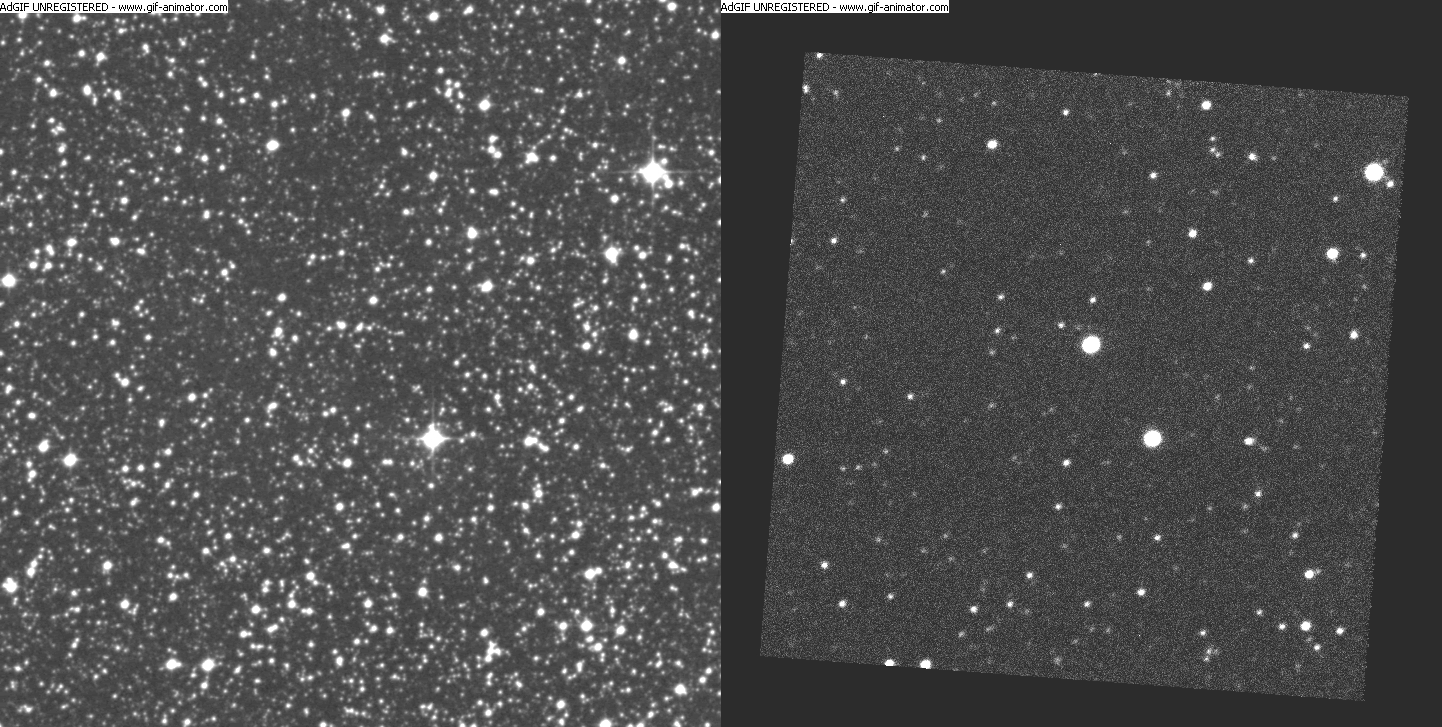
Below an animation showing a comparison between our confirmation image and the archive POSS2/UKSTU plate (R Filter - 1999). Click on the thumbnail below for a bigger version. 


UPDATE - December 04, 2013

According to CBET No. 3732, PNV J13544700-5909080 is now NOVA CENTAURI 2013. This nova has been discovered by John Seach (Chatsworth Island, NSW, Australia) in six CCD images obtained with a digital SLR camera (+ 50-mm-f.l. f/1.0 lens; limiting mag 11) taken on Dec. 2.692 UT. Low-resolution spectrograms reported independently by M. Locke and R. Kaufman show strong H_alpha and H_beta emission indicative of a nova.

by Ernesto Guido, Nick Howes & Martino Nicolini

Monday, April 9, 2012

Another Possible Nova in Cen

Following the posting on the Central Bureau's Transient Object Confirmation Page about a possible Nova in Cen (TOCP Designation: J14250600-5845360) we performed some follow-up of this object remotely through the 2.0-m  f/10.0 Ritchey-Chretien + CCD of "Faulkes Telescope South" (MPC Code - E10).

On our images taken on April 09.5, 2012 we can confirm the presence of an optical counterpart with Bessell-R CCD magnitude 8.7 at coordinates:

R.A. = 14 25 04.45, Decl.= -58 45 34.3

(equinox 2000.0; UCAC-2 catalogue reference stars).

According to VIZIER there is a 15.319 J-magnitude star at 2.6 arcseconds from the transient position (NOMAD1 0312-0489482). 


Our confirmation image (click on it for a bigger version):


An animation showing a comparison between our confirmation image and the archive POSS2/UKSTU plate (R Filter - 1997). Click on the thumbnail below for a bigger version:


UPDATE - January 30, 2018

Apparently, while this object has been confirmed as a nova on spectra taken by T. Bohlsen, no permanent designation by GCVS has been assigned to this transient. See also here & here


by Ernesto Guido, Nick Howes & Giovanni Sostero

Saturday, March 24, 2012

Possible Nova in Centaurus

Following the posting on the Central Bureau's Transient Object Confirmation Page about a possible Nova in Cen (TOCP Designation: PNV J13410800-5815470) we performed some follow-up of this object remotely through the 2.0-m  f/10.0 Ritchey-Chretien + CCD of "Faulkes Telescope South" (MPC Code - E10).

On our images taken on March 24.5, 2012 we can confirm  the presence of an optical counterpart with filtered  R-Bessel CCD magnitude 9.3 (USNO-B1.0 Catalogue reference stars) at coordinates:

R.A. = 13 41 09.36, Decl.= -58 15 16.9

(equinox 2000.0; USNO-B1.0 catalogue reference stars).


Our confirmation image (click on it for a bigger version):


While below you can see an animation showing a comparison between our confirmation image and the archive POSS2/UKSTU plate (R Filter - 1994). Click on the thumbnail for a bigger version:


UPDATE - MARCH 29, 2012

According to Cbet 3073 issued on March 29, F. M. Walter, Stony Brook University, obtained a low-resolution (0.31-nm) red (560-690 nm) spectrogram of PNV J13410800-5815470 on Mar. 27.3 UT using the SMARTS 1.5-m telescope (+ RC spectrograph) at Cerro Tololo. The variable is a classical "Fe II"-type nova. This nova, designated NOVA CENTAURI 2012, has been discovered by John Seach, Chatsworth Island, NSW, Australia,  on six images (limiting mag 11.0) taken on Mar. 23.386 UT with a digital SLR camera (+ 50-mm f/1.0 lens).

by Ernesto Guido, Alison Tripp, Nick Howes and Giovanni Sostero

Wednesday, May 13, 2009

Possible Nova in Centaurus 2009

Following an alert note posted today by Grzegorz Pojmanski in the vsnet-alert newsgroup about a possible nova in Cen, on 2009 May. 13.57 we performed some follow-up of this object remotely through a 0.25-m, f/6 Ritchey-Chretien + CCD, from the RAS Observatory (Moorook, Australia).

We can confirm the presence of an optical counterpart with unfiltered CCD magnitude about 8.6 (UCAC-2 Catalogue refernce stars) at coordinates:

R.A. = 13h31m15.77s, Decl. = -63o57'38".6 (equinox 2000.0; UCAC-2 catalogue reference stars).

Comparison with an Anglo-Australian Observatory Schmidt red plate (limiting magnitude about 20), obtained on 1997, Feb. 05, show that this position is nearly coincident with a field star, whose position end figures are 15s.68, 38".6, and magnitude about 15 (however, the extreme stellar crowding due to nearby field stars, makes this measurement rather difficult).

Our image of this transient is available at the following URL:

http://tinyurl.com/qlbesc

UPDATE

This nova has been designated V1213 Cen. For more info see also this paper on NATURE.


by Ernesto Guido and Giovanni Sostero