Showing posts with label impact Jupiter. Show all posts

Saturday, August 31, 2019

Comets & Asteroids - Summary for July & August 2019

During the 2-month period July through August 2019, 7 new comets were discovered and there were 4 comet recoveries. "Current comet magnitudes" & "Daily updated asteroid flybys" pages are available at the top of this blog (or just click on the underline text here). See below for the "Other news" section.

The dates below refer to the date of issuance of CBET (Central Bureau Electronic Telegram)  which reported the official news & designations.

- Comet Discoveries

Jul 01 Discovery of C/2019 L3 (ATLAS)                  (CBET 4644)
Jul 02 Discovery of C/2019 K7 (SMITH)                  (CBET 4645)
Jul 02 Discovery of C/2019 K8 (ATLAS)                  (CBET 4646)
Jul 03 Discovery of C/2019 LB_7 (KLEYNA)           (CBET 4647)*
Jul 15 Discovery of C/2019 N1 (ATLAS)                  (CBET 4650)
Jul 17 Discovery of P/2019 M2 (ATLAS)                  (CBET 4651)**
Jul 18 Discovery of C/2019 M3 (ATLAS)                  (CBET 4653)


*The available astrometry for this very faint object was published on MPEC 2019-N20, where it was inadvertently given the minor-planet designation 2019 LB_7 by the Minor Planet Center.

**Following a private remark by the D. Green that the orbital elements of comets D/1884 O1 (Barnard) and P/2019 M2 are similar, Nakano has attempted an investigation into the possibility that the two designations might refer to the same comet. Nakano remarks that he is unable to link the two orbits, suggesting that (while possibly related) the two comets seem to be different objects. Additional astrometry for P/2019 M2 is urgently needed to extend the arc of observations at this return, before the comet fades rapidly in the coming weeks.(CBET 4657)

- Comet Recoveries

Jul 06 Recovery of P/2006 S1 (CHRISTENSEN) as P/2019 M1     (CBET 4649)
Jul 17 Recovery of 39P/OTERMA                                                   (CBET 4652)*
Jul 28 Recovery of P/2014 U2 (KOWALSKI) as P/2019 O1          (CBET 4654)
Aug 09 Recovery of P/2010 U2 (HILL) as P/2019 P1                    (CBET 4658)

*Recovery of comet 39P/Oterma (magnitude 24) on CCD images taken on July 3 UT with the 8.1-m "Gemini South" telescope, with confirmatory follow-up images being obtained on July 5 using both the 8.1-m "Gemini South" and the 6.5-m Magellan-Clay telescopes.  A point-source object was located within 1" of an ephemeris generated by the orbit given on MPC 75716.An upper bound of the nucleus radius -- based on photometry of the July 3 and 5 individual 100-s r' images and assuming a 4-percent albedo -- is between 2.1 and 2.5 km.  This upper bound is lower than what would be derived from 2001 photometry reported on MPCs 43260 and 43446 (2.5-3.5 km), suggesting that there might have been a compact coma in those observations and/or that 39P has an elongated nucleus.The comet was last seen in 2001 (cf. IAUC 7689). Comet 39P is currently inbound with perihelion in 2023. The comet was missed at its 1983 return.

- Other news


Jul 08 Zwicky Transient Facility (ZTF) spotted an unusual asteroid with the shortest "year" known for any asteroid. The rocky body, dubbed 2019 LF6, is about a kilometer in size and circles the sun roughly every 151 days. In its orbit, the asteroid swings out beyond Venus and, at times, comes closer in than Mercury, which circles the sun every 88 days. 2019 LF6 is one of only 20 known "Atira" asteroids, whose orbits fall entirely within Earth's. In the images below you can see an animation showing the asteroid as captured by ZTF on June 10 and how the orbit of 2019 LF6 (white) falls entirely within the orbit of Earth (blue).


Credit: ZTF/Caltech Optical Observatories


Credit: NASA/JPL-Caltech

Jul 12 ATel #12931 Disintegration of Comet C/2019 J2 (Palomar) - Quanzhi Ye et al. report the apparent disintegration of comet C/2019 J2 (Palomar), first detected by Soulier and Sárneczky on images taken on UT 2019 July 6-7. After receiving the reports from Soulier and Sárneczky, Ye examined the images taken with the Zwicky Transient Facility (ZTF) operated on the 1.2-m Oschin Schmidt telescope at Palomar Observatory. The ZTF image on July 9 shows that the comet has lost its central condensation. Although the disintegration only becomes apparent at some time between the ZTF observation on July 2 and the Maisoncelles/Konkoly observation on July 6, ZTF photometry suggests that the process likely started much earlier, possibly in early May. The brightness of the comet increased by ~0.6 mag from Apr. 27 to May 9, then decreased by an equal amount from May 9 to Jul. 2, while a typical comet would have brightened by 1.0 mag from Apr. 27 to Jul. 2.

Jul 29 Austrian filmmaker Christian Stangl combined some of the more than 400,000 images taken by @ESA's Rosetta mission into a stunning short film: "the Comet". Together the images show details of Comet 67P, which Rosetta followed and researched for 2 years.


Aug 07 On July 24, asteroid 2019 OK (60-130 meters in size; discovered by SONEAR team @CrisJacques)  approached Earth at about 65,000 km above the surface, one fifth the distance to the Moon. Largest Asteroid To Pass This Close To Earth in a Century
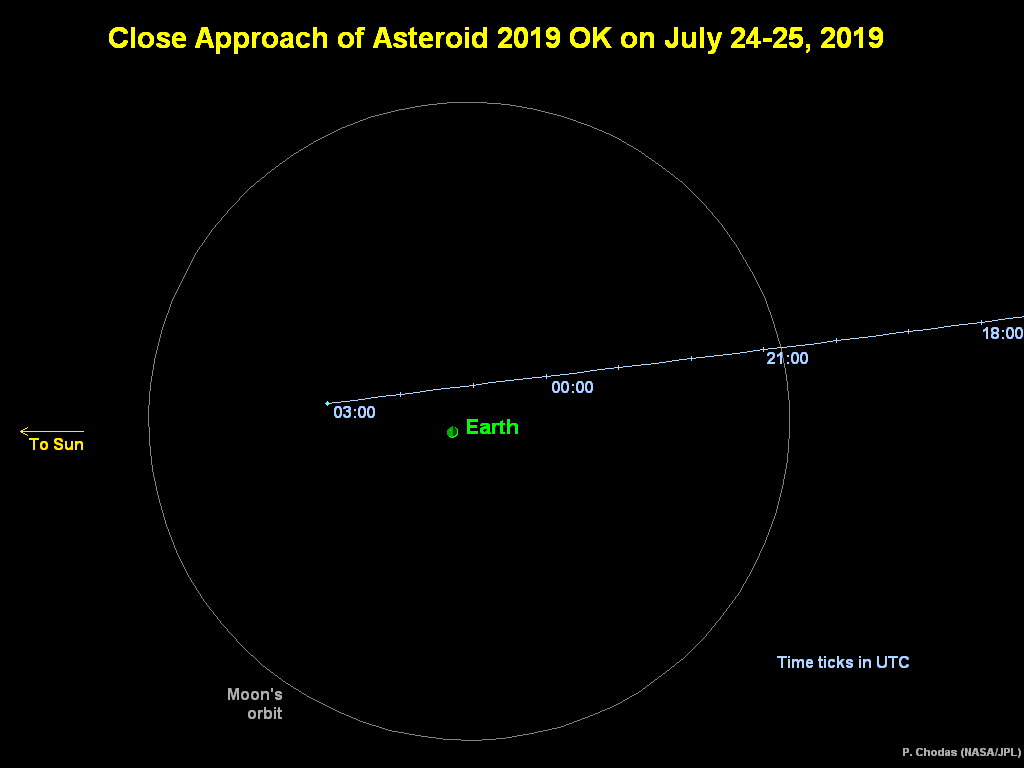
Credits: P. Chodas (NASA/JPL)

Aug 08 A possible impact on Jupiter recorded on 07 August 2019 at 04:07 UTC by E. Chappel. This is not the first time that we have seen something slam into Jupiter. It's actually the seventh event of its kind in recent years. More info about past recent events are available here

Credits: E. Chappel


Credits: E. Chappel

Aug 17 Fireball over Sardinia, Italy on the evening of August 16, 2019 via @ClaudioPorcu - More video available here  #meteor #meteora #astronomy #astronomia #Sardegna

Credits: C. Porcu

Below you can see a map showing the trajectory in the atmosphere projected to the ground of this bolide. The triangulation was done using 6 visual observations selected among the more than 80 arrived at the IMO.

(Credits: A. Carbognani)


by Ernesto Guido

Wednesday, May 31, 2017

New Impact Flash on Jupiter

On May 26, 2017 (between 19:24.6 and 19:26.2 Universal Time) a new possible impact flash on Jupiter was imaged by Sauveur Pedranghelu, a French amateur astronomer from Corsica. According to a preliminar analysis by Marc Delcroix (who runs a Jovian impact flashes detection project) this flash, detected in the North polar area of Jupiter, seems shorter than the others (~0.7s vs 1-2s) and displayed two brightness peaks. (click on the images below for a bigger version).


The image by Pedranghelu was then posted online as a call for observations of Jupiter obtained in the same time interval to exclude the possibility that the flare might have been caused by an artefact or flashing satellite. Few hours after the posting, two other observers from Germany (Andre Fleckstein & Thomas Riessler) confirmed independently from one another the finding with their own images. 


Below you can see an animation made by Thomas Riessler using his Jupiter observations showing the impact flash on Jupiter. (click on it for a bigger version). The impact area imaged in the hours after the reported flash showed NO remnants of the impact.


Credit: T. Riessler 

This is not the first time that we have seen something slam into Jupiter, beginning with a fireball recorded by Voyager 1 as it flew past in 1979 (see image below) and the famous impact of Comet Shoemaker-Levy 9 in 1994. 


March 5, 1979 - Fireball in Jupiter's Atmosphere by Voyager 1
Credit: Cook & Duxbury

In this blog we reported about all the recent cases starting from the event of July 19, 2009 (a scar left on Jupiter by an unseen impact observed by Anthony Wesley), of June 03, 2010 (impact flash observed by Anthony Wesley and Christopher Go), of August 20, 2010 (impact flash observed by Masayuki Tachikawa & Aoki Kazuo), of September 10, 2012 (impact flash observed  by Dan Petersen and George Hall), of March 17, 2016 (impact flash observed by Gerrit Kernbauer and John McKeon).

The role of planet Jupiter as a shield protecting Earth from getting hit by such objects is still controversial and it has been discussed in depth in a series of articles by Jonathan Horner and Barrie Jones (Jupiter - friend or foe?).

by Ernesto Guido

Thursday, March 31, 2016

Comets & Asteroids - Summary for March 2016

During the month of March 2016,  3 new comets were discovered. On March 17, 2016 a new impact flash on Jupiter has been captured by amateur astronomers. Moreover, delay-doppler images of asteroid 2016 DV1 (on March 03, 2016) and of comet P/2016 BA14 (on March 22, 2016) have been obtained by Goldstone Solar System Radar.(see below for more about these news). "Current comet magnitudes" & "Daily updated asteroid flybys" pages are available at the top of this blog (or just click on the underline text here).

The dates below refer to the date of issuance of CBET (Central Bureau Electronic Telegram)  which reported the official news & designations.

 - Comet Discoveries

Mar 11  Discovery of C/2016 E1 (PANSTARRS)
Mar 16  P/2015 B4 (LEMMON-PANSTARRS)
Mar 16  C/2016 E2 (KOWALSKI)


Scientists using the Goldstone Solar System Radar in California's Mojave Desert observed comet P/2016 BA14 during its historic flyby. Close approach of March 22, 2016 by P/2016 BA14 has been the third closest on record and the closest flyby of a comet in 246 years (for more info about P/2016 BA14 see our previous post). Radar images from the flyby indicate that the comet is about 1 kilometer in diameter. Moreover data collected by V. Reddy using the NASA Infrared Telescope Facility (IRTF) on Mauna Kea, Hawaii indicate that the comet reflects less than 3 percent of the sunlight that falls on its surface. 

Radar images of comet P/2016 BA14 - Credit: NASA/JPL-Caltech/GSSR


Comet P/2016 BA14 - Credit: NASA/JPL-Caltech/GSSR


- Asteroid & Meteors news

On March 17, 2016 (at 00:18:35UT) a possible impact flash on Jupiter was imaged independently by 2 amateur astronomers: Gerrit Kernbauer (Mödling, Austria) & John McKeon (Dublin, Ireland). Both videos are on Youtube: bit.ly/1RwXOZb & bit.ly/1RwXOZc. If confirmed, this becomes the fifth such event in the past decade. For more info about old impact flashes see our previous post here. Click on the gif below to see a comparison side by side of the 2 videos with an apparent impact flash on the Jupiter's East limb. 

Credit: Kernbauer & McKeon


Credit: John McKeon

On March 03, 2016, delay-doppler images of asteroid 2016 DV1 were obtained using DSS-13 to transmit and GBT to receive. The images span ~1 rotation. Rotation period is about 304 +/-8 seconds.

Goldstone Radar Observations of 2016 DV1


by Ernesto Guido

Friday, June 4, 2010

Impact Flash on Jupiter

Amateur astronomers Anthony Wesley (Australia) and Christopher Go (Philippines) have independently observed an impact flash on Jupiter. According to their images and videos, the impact flash happened at 20:31 UTC of June 3, 2010 and lasted only few seconds in Jupiter's faded south equatorial belt. The alert was first launched by Wesley and soon after confirmed by Go who happened to imaging the planet at the same time.


Credit: A. Wesley


Credit: Christopher Go

Wesley suggests that the impact "doesn't seem to have left any mark, so it probably burned up in the upper atmosphere before it reached the cloud deck. There were no visible remains at the impact point for the next half hour or so, until sunrise put an end to the imaging."

According to S&T website: "The flare occurred at longitude 248.8° in Jupiter's System I, 342.7° in System II, and 159.4° in System III. The latitude is 16° south. This region should be visible from about 4:00 to 6:30 June 4th UT, favoring observers in Europe and Africa when Jupiter is up before dawn. The impact site will return to good view about every 9 hours 56 minutes thereafter."

Major telescopes will be pointed on the area as soon as possible. So it's likely that we'll have more info available in the next few hours.


Link to Wesley webpage about this event (where you can download his 45MB video):

Link to download the video of this event by C. Go

Anthony Wesley was also the discoverer of the impact scar on Jupiter on July 2009.

For more info about the 2009 impact:

http://bit.ly/d6KuEM (Hubble Images of the scar)
http://bit.ly/cGOI1P (Published results on the Jupiter impact appeared in ApJ Letters)


UPDATE JUNE 16, 2010


Unlike previous impacts, Hubble imaging of the June 3rd impact site revealed no debris scar. The impact flash came from a giant meteor burning up high above Jupiter's cloud tops. The space visitor did not plunge deep enough into the atmosphere to explode and leave behind any telltale cloud of debris, as seen in previous Jupiter collisions.


Image Credit: NASA, ESA, M.H. Wong (University of California, Berkeley), H.B. Hammel (Space Science Institute, Boulder, Colo.), A.A. Simon-Miller (Goddard Space Flight Center), and the Jupiter Impact Science Team.

"We suspected for this 2010 impact there might be no big explosion driving a giant plume, and hence no resulting debris field to be imaged. There was just the meteor, and Hubble confirmed this," adds Hammel, a veteran Jupiter observer of the 1994 string of impacts.

by E. Guido & G. Sostero

Monday, July 20, 2009

New Impact on Jupiter?

Starting from July 19, 2009 rumors appeared all over the astronomical internet community about a possible new impact on Jupiter.

A new dark spot was just discovered by Australian amateur astronomer Anthony Wesley on Jupiter surface. He noticed it on his images taken with his 14.5" newtonian aroud 1300UTC of 19th July. The same area was imaged by Wesley 2 days before and the dark spot wasn't there. This new dark spot shares a strikingly resemblance with the impact marks made on Jupiter by comet Shoemaker-Levy 9 when it crashed into the giant planet in 1994 (just in these days is recurring the 15th anniversary of the impacts of the comet Shoemaker-Levy 9 fragments on Jupiter, dated 16-22 July 1994).

Below the Wesley images of the new dark spot (click on the image for a bigger version)


For comparison below you can see a SL9 impact image dated back to 1994 (click on the image for a bigger version)


After the announcement on Wesley website, other amateur astronomers have been able to confirm the dark spot. Anyway the shape alone of this dark spot, was not enough for the impact nature to be confirmed. In favour of the impact hypothesis: the location of this new dark spot, near the Jupiter South Pole where usually storm activity is minor and the fact that the location was featureless in the images of 2 days earlier.

But a more resolutive proof is the Near-IR or methane-band imaging. Material from an impact should be stratospheric and hence should appear bright at these wavelengths.

A confirmation that arrived few hours ago. Leigh Fletcher, planetary scientist at Pasadena, was twittering live about this event and the work he and his colleagues were doing with IRTF.  Below are some of his tweets:

"We're now almost certain it's an impact event, extremely exciting!"

"Working with Glenn Orton, we're acquiring spectra of the impact site
with IRTF/SpeX. Very bright in refl. sunlight, high altitude
particles"

"The impact site on Jupiter is rotating into view on the IRTF, we're
imaging with Spex, have acquired spectra. VERY bright feature!!"

"New instrument for looking at Jupiter impact site: IRTF/MIRSI,
probing thermal characteristics of the impact location."

"This has all the hallmarks of SL-9 in 1994 (15 years to the day!). High altitude particulates, looks nothing like weather phenom"


While this is a note appeared on mpml mailing list by Franck Marchis (Astronomer at University of California at Berkeley):

"We observed Jupiter with the Keck telescope and its NIR camera and we confirm that the feature is unusual because of its brightness in the CH4 band. It is most likely a impact explosion in the upper atmosphere of Jupiter. We are processing the data right now and will beginning the analysis"

While waiting for an official release by professional astronomers confirming the impact event definitively, it's interesting to report this comment by astronomer Alan Fitzsimmons:
"it is no surprise that if an asteroid or inert comet had hit Jupiter recently we might not know about it. A 1-km diameter asteroid or inactive comet at that distance is roughly magnitude V=25 to 26 (100 thousand million times fainter than Jupiter itself), much too faint to pick up. SL-9 was only found because it had activated through tidal disruption - we now know that it had probably been in orbit around Jupiter since the 1930’s, but no-one picked it up because of its faintness"

Congratulations to Anthony Wesley for his finding!!!


by Ernesto Guido