Sunday, December 12, 2010

Comet-like appearance of (596) Scheila

CBET nr.2583, issued on 2010, Dec. 12, announced the discovery of a spiral like structure around main belt asteroid (596) Scheila by Steve Larson in the course of Catalina Sky Survey (CSS) through the Catalina 0.68-m Schmidt telescope, on images obtained on 2010, Dec. 11.4. The cometary appearance has been confirmed by other observers.

In the Catalina images, the "coma" is bright (Vtotal~13.5), and extends some 2 arcmin north and 5 arcmin west from the central condensation.

We have been able to confirm this object remotely, using a 0.43-m f/6.8 reflector + CCD located in Nerpio (Spain): on December 12.01, co-adding of 7 unfiltered exposures, 60-seconds each, shows a wide spiral like tail. The longest part of this spiral tail is 1' in PA 280 while the small part is 30" in PA 22. You can see our image below:


According to the "Dictionary of Minor Planet Names" by Lutz D. Schmadel, (596) Scheila was discovered on 1906 Feb. 21 by A. Kopff at Heidelberg. Named in honor of an acquaintance of the discoverer, an English woman student in Heidelberg. (596) Scheila is a main-belt asteroid inclined roughly 14 degree on the ecliptic and it is now 3.1AU from the Sun and 0.8AU out of the ecliptic. With an absolute magnitude H8.9 the estimated diameter is 113Km.


Orbit Diagram of (596) Scheila:

http://ssd.jpl.nasa.gov/sbdb.cgi?sstr=596&orb=1

So this object is a potential new member of the recently recognized class of main-belt comets introduced by Jewitt & Hsieh in 2006 . These objects are remarkable for having both the orbital characteristics of asteroids and the physical characteristics of comets: they look like comets because they show comae and tails but they have orbits interior to Jupiter's and Tisserand parameters substantially larger than 3, like asteroids.

The Tisserand parameter of (596) is T_jup = 3.209


UPDATE - December 12, 11:30 UT

We have imaged again (596) Scheila at 08:20UT of December 12, 2010, this time remotely from the GRAS Observatory (near Mayhill, NM) through a 0.25-m, f/3.4 reflector + CCD. Below you can see the new image - stack of 8x120sec exposures:
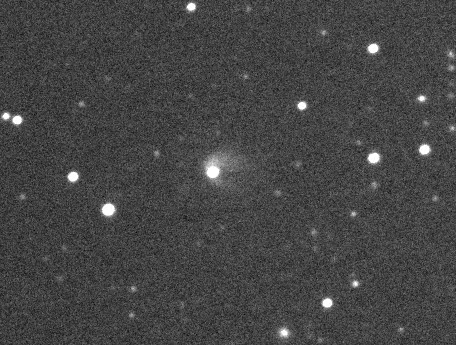


by Ernesto Guido & Giovanni Sostero

Saturday, November 20, 2010

Bright Sungrazing Comet on November 17-19, 2010

Only few days after the bright sungrazing comet of November 13/14, another new bright comet diving into the Sun has been discovered on Nov. 17 by Michal Kusiak using the images taken by SOHO spacecraft. This object too belong to the famous Kreutz-group, a family of sungrazing comets that are named after German astronomer Heinrich Kreutz who first studied them in the details. These comet fragments passes extremely close to the Sun at perihelion and usually they completely evaporated during such a close approach.


LASCO C2 Image - November 19, 2010


(Credit: SOHO)


C2 Movie (click on the thumbnail for a bigger version)


(Credit: SOHO)

We've had many bright Kreutz comets this year... A sign of a big one on its way?

Recently, different studies (Sekanina & Chodas 2007; Knight & Hearn 2008) have shown that the flow of Kreutz comets (correct of all systematic errors) increased. In the years since 1997 to 2002 for the Kreutz comet brighter that eighth magnitude has been calculated an average of about 83 new discoveries each year, while in the period 2003 - 2007 the average annual discovery rate risen to 125. This increase also applies to the findings of comets brighter than sixth magnitude where there was a increase in the flux of comets around 80%.

Sekanina and Chodas (2007) noted the increase in raw discoveries and suggested it may be “an early warning of another cluster of bright sungrazers approaching the Sun in coming decades.”


On November 18, 2010 the leading expert on Kreutz comets (reduced the observations of almost all of SOHO's ~1950 comets), Brian Marsden passed away after a prolonged illness. He will be remembered as contributing much to celestial mechanics and the dynamics and orbits of minor bodies of the solar system and as having an encyclopedic knowledge of the history of astronomy. Obituary on Sky & Telescope website and on mpec 2010-W10

by Ernesto Guido

Tuesday, November 16, 2010

Bright Sungrazing Comet on 13/14 November 2010

A new bright comet diving into the Sun has been discovered on Nov. 13th by Masanori Uchina using the images taken by SOHO spacecraft. This object belong to the famous Kreutz-group, a family of sungrazing comets that are named after German astronomer Heinrich Kreutz who first studied them in the details. These comet fragments passes extremely close to the Sun at perihelion and usually they completely evaporated during such a close approach.

Several sungrazing comets are discovered each year in SOHO images, many of them are very small and faint while sometimes some bigger and bright fragments arrive in the proximity of the Sun.

As expected, this sungrazing comet has not survived the close encounter with the sun.

C2 Image - November 14 ,2010

(Credit : SOHO)

C2 Movie (click to see a bigger version)


(Credit : SOHO & Spaceweather)

You can read more details about other recently 2010 bright SOHO comets here:


by Ernesto Guido

Monday, November 8, 2010

Evolution of the morphology of comet C/2010 V1

The recently discovered comet C/2010 V1 (Ikeya-Murakami) has been probably discovered thanks to an outburst. In fact IAUC 9183 reports that Kaoru Ikeya swept the comet's position also on Nov. 1, but did not see the comet down to mag 9-10, despite better conditions than on the 2nd. Moreover the evolution of its coma morphology is rapidly changing from night to night.

Here you can see our last image of this comet (stack of 10X30seconds exposures) obtained on 2010 Nov. 08.5, remotely from the GRAS Observatory (near Mayhill, NM) through a 0.25-m, f/3.4 reflector + CCD.


Below an animation showing the evolution of the morphology of comet C/2010 V1 (Ikeya-Murakami) starting from our first image dated Nov. 04 to the last image dated Nov. 08, 2010 (in the animation the image of Nov. 7 is not present due to cloudy sky):


by Ernesto Guido & Giovanni Sostero

Comet 103P/Hartley by EPOXI

As most of you already know, NASA's Deep Impact spacecraft (renamed EPOXI) successfully flew 700 kilometers away from comet 103P/Hartley on Thursday November 04, 2010. This comet is the fifth comet nucleus visited by a spacecraft (the other four are: Halley, Tempel 1, Borrelly and Wild 2).

"Early observations of the comet show that, for the first time, we may be able to connect activity to individual features on the nucleus," said EPOXI Principal Investigator Michael A'Hearn of the University of Maryland, College Park.

Below you can find the flyby images released until now.

Montage showing the comet approached by the spacecraft. The sun is to the right.


(Credit: NASA/JPL-Caltech/UMD )


Close-up view of comet 103P/Hartley taken by NASA's EPOXI


(Credit: NASA/JPL-Caltech/UMD )


Image showing jets and where they originate from the surface of comet


(Credit: NASA/JPL-Caltech/UMD )


Below an image montage showing all the five comet nucleus visited by a spacecraft. Comet 103P/Hartley is by far the smallest and has the most activity in relation to its surface area.


(Credit: NASA/JPL-Caltech/UMD )

The analysis of the data acquired is underway and more revelations about comet 103P/Hartley are expected.

Congrats to the all the EPOXI team for this spectacular flyby!!


by Ernesto Guido

Friday, November 5, 2010

Comet C/2010 V1 (Ikeya-Murakami)

The new bright morning comet announced yesterday has been officially designated C/2010 V1 (Ikeya-Murakami). The mpec 2010-V46 with the first and preliminary orbit has been issued and it shows the perihelion already on Oct. 18, 2010, at about 1.7 AU.

Today we performed again some follow-up of this bright object to obtain more astrometric measures that are important to compute a reliable orbit. Below you can see the image (stack of 10X20seconds exposures) obtained on 2010 Nov. 05.5, remotely from the GRAS Observatory (near Mayhill, NM) through a 0.25-m, f/3.4 reflector + CCD. It's still evident the strong central condensation and the elongation toward PA 295.


According to COCD webpage this is the 7th visual comet discovery for Ikeya (co-discoverer also of the famous 1965's sungrazer Comet Ikeya-Seki) and the 2nd for Murakami.

by Ernesto Guido & Giovanni Sostero

Thursday, November 4, 2010

New Bright Comet: "2010 V1"

IAUC nr.9175, issued on 2010, Nov. 03, announces the visual discovery of a new bright comet by two Japanese amateur astronomers, Kaoru Ikeya and Shigeki Murakami. The new comet has been designated "2010 V1". The orbit is still not available, it will be ready when more astrometric observations will be available.

This is the second visual comet discovery of 2010, after the discovery in March of comet C/2010 F4 by Don Machholz.

We performed some follow-up measurements of this object few hours ago, on 2010 Nov. 04.5, remotely from the GRAS Observatory (near Mayhill, NM) through a 0.25-m, f/3.4 reflector + CCD. Our stackings shows a coma diameter of nearly 2 arcminutes, elongated toward PA 295 and a strong central condensation.


This comet is currently at a solar elongation of only 32 degree with a ccd magnitude around 12 and a visual magnitude around 8.

Congratulations to Ikeya and Murakami for this discovery!!

by Ernesto Guido & Giovanni Sostero