Showing posts with label Sungrazing Comet. Show all posts

Wednesday, May 11, 2011

Bright Sungrazing Comet on May 10-11, 2011

A new bright comet diving into the Sun has been discovered on May. 09 by amateur astronomer Sergey Shurpakov using the images taken by SOHO spacecraft. This object belong to the famous Kreutz-group, a family of sungrazing comets that are named after German astronomer Heinrich Kreutz who first studied them in the details. These comet fragments passes extremely close to the Sun at perihelion and usually they completely evaporated during such a close approach.


C3 Image - May 10, 2011 (click to see a bigger version)


(Credit : SOHO)


Yesterday's now-evaporated bright Kreutz comet didn't die alone! This small companion was visible by its side on this C2 image:


(Credit: SOHO; @SungrazerComets):


C2 Movie - May 11, 2011 (click to see a bigger version)


(Credit : SOHO)

This Kreutz probably peaked near mag 2. (It was just starting to saturate in the LASCO cameras)

You can read more details about 2010 bright SOHO comets here:

http://remanzacco.blogspot.com/2010/11/bright-sungrazing-comet-on-november-17.html
http://remanzacco.blogspot.com/2010/11/bright-sungrazing-comet-on-1314.html
http://remanzacco.blogspot.com/2010/10/new-bright-sungrazing-comet.html
http://remanzacco.blogspot.com/2010/04/new-bright-sungrazing-comet.html
http://remanzacco.blogspot.com/2010/01/bright-sungrazing-comet.html
http://remanzacco.blogspot.com/2010/01/new-sungrazing-comet.html
http://remanzacco.blogspot.com/2010/03/new-sungrazing-comet.html


by Ernesto Guido

Thursday, October 21, 2010

New Bright Sungrazing Comet

A new bright comet (designated SOHO-1932) diving into the Sun has been discovered on Oct. 19th by Bo Zhou using the images taken by SOHO spacecraft. This object belong to the famous Kreutz-group comet, a family of sungrazing comets that are named after German astronomer Heinrich Kreutz who first studied them in the details. These comet fragments passes extremely close to the Sun at perihelion and usually they completely evaporated during such a close approach.

Several sungrazing comets are discovered each year in SOHO images, many of them are very small and faint while sometimes some bigger and bright fragments arrive in the proximity of the Sun.


SOHO-1932


(Credit : SOHO)


SOHO-1932 in C2 (long, thin tail is well over a million-km long in this image)


(Credit : SOHO)


Animation of SOHO-1932 (click on the thumbnail for a bigger version)


(Credit : SOHO & Spaceweather)


You can read more details about other recently 2010 bright SOHO comets here:


by Ernesto Guido

Saturday, April 10, 2010

New Bright Sungrazing Comet

Another bright sungrazing comet appeared on the coronagraph image of April 09, 2010 from the Solar and Heliospheric Observatory (SOHO).

This is 4th bright sungrazing comet of 2010.

You can read more details about these other comets on our old posts:

http://remanzacco.blogspot.com/2010/01/bright-sungrazing-comet.html
http://remanzacco.blogspot.com/2010/01/new-sungrazing-comet.html
http://remanzacco.blogspot.com/2010/03/new-sungrazing-comet.html


C2 Movie (click to see a bigger version)


(Credit: SOHO)


Like its predecessors, this comet probably will not survive this close encounter with the Sun.


by Ernesto Guido

Friday, March 12, 2010

New Bright Sungrazing Comet

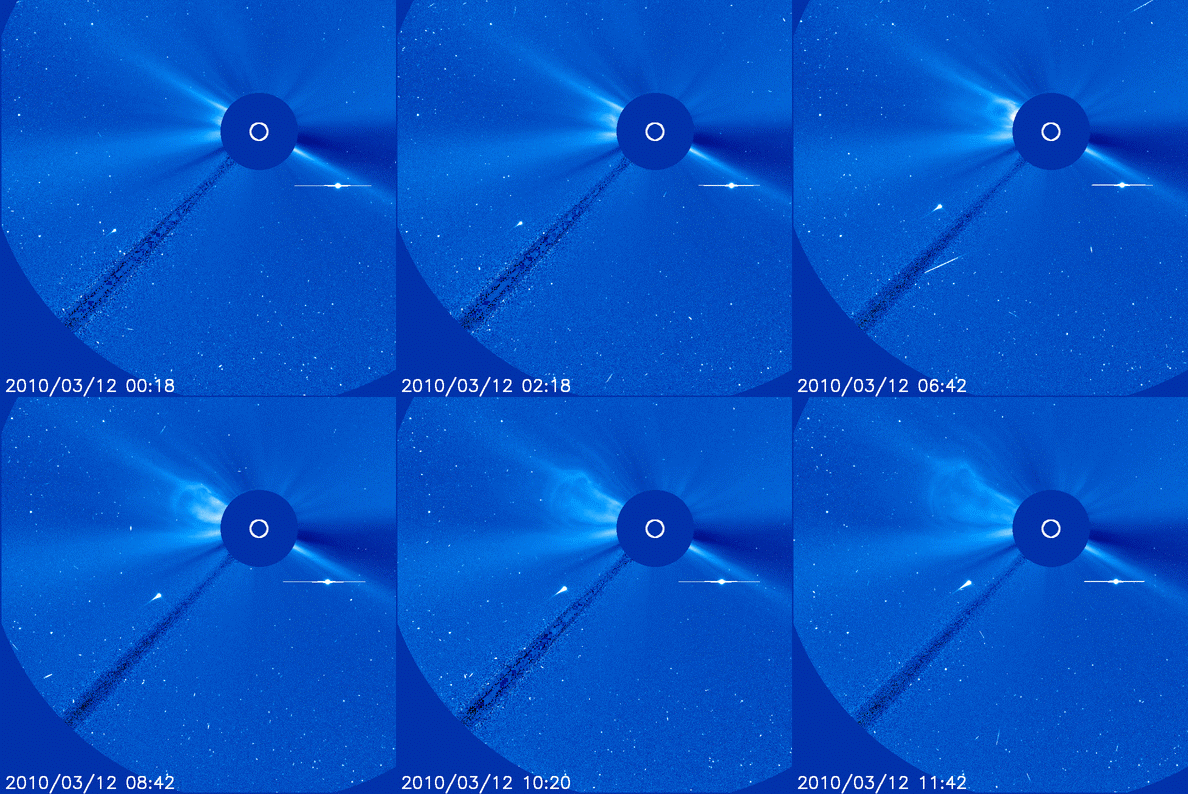
A new bright sungrazing comet has been discovered in the images of SOHO spacecraft. The comet is probably a member of the Kreutz sungrazer family and probably will not survive this close encounter with the Sun.

This is the 3rd bright sungrazer found in the last few months. Other 2 bright sungrazers were found in January 2010:


The comet is now visible in the images taken by LASCO C3 & C2 cameras of SOHO spacecraft. In the same animation, spanning roughly 12-hours, there is the comet, the planet Mercury and a coronal mass ejection (CME) :

C3 Movie


Image with labels (Credit: Spaceweather) :


C2 Movie (click to see a bigger version)


UPDATE MARCH 14

Upon closer inspection of the SOHO images it was found that this comet was part of a series of at least four comet fragments following the same trajectory. All the comets are highlighted in this video:


Anyway as expected, these sungrazing comets have not survived the close encounter with the sun.

by Ernesto Guido

Thursday, January 21, 2010

New Sungrazing Comet

After the bright sungrazing comet discovered on January 02, 2010 on images taken by NASA's STEREO-A spacecraft, a new comet is plunging toward the sun. On first looking this comet is ~1-1.5 mag fainter than the previous one from early January.

Below the new comet imaged by another solar spacecraft, SOHO:


Below the same image with labels (by Spaceweather):


While by clicking the thumbnail below you can see a full C3 Animation (credit SOHO):


The comet is just entering the field of view of SOHO C2 camera:


UPDATE - January, 23

As expected, this sungrazing comet has not survived to its close encounter with the sun.

By Ernesto Guido

Saturday, January 2, 2010

Bright Sungrazing Comet

Australian amateur astronomer Alan Watson discovered on January 02, 2010 a bright sungrazing comet in the images taken on December 30 by STEREO-A spacecraft.

A sungrazing comet is a comet that passes extremely close to the Sun at perihelion. While small sungrazers can be completely evaporated during such a close approach to the Sun, larger sungrazers can survive many perihelion passages.

The comet is now visible in the images taken by LASCO C3 camera of SOHO spacecraft:

C3 Movie:


Spaceweather image with labels:


According to a message by Wentao Xu on comets-ml mailing list, the comet has reached magnitude 4 on January 02.36. Magnitude right now (January 02 at 22UT) is perhaps 0 (maybe -1).

Below an animation made by M. Jaeger using 35 Soho images from Jan 2 at 14.42UT to Jan 2 at 21.18UT . Click on the image below to see it:

Bright Sungrazer comet - January 02, 2010

UPDATE - JANUARY 04, 2010


On January 03 the comet was visible in the Lasco C2 camera too:

http://bit.ly/4Iq5Vq & http://bit.ly/7ZCEy9

While here you can see the frames used by A. Watson to discover the comet in Stereo images. Look for the faint streak rising from lower left.

According to the latest Soho images the comet has not survived to this extremely close passage near the Sun.

By Ernesto Guido