Monday, February 13, 2023

Small Asteroid 2023 CX1 (NEOCP Sar2667) impacted Earth on February 13

On 2023 February 12.8 (20:18:07 UTC), K. Sarneczky found a small asteroid with the 0.60-m Schmidt + CCD of the Piszkéstető Observatory in Hungary (K88 MPC code) that was soon after put on the NEOCP list with the provisional designation Sar2667 for the follow-up by other observers. The object was subsequently imaged by many observers around the world and various impact assessment systems found a 100% impact probability in the area of the English Channel on Feb. 13 between 02 and 04 UTC. This is the second discovery by Sarneczky of an impactor, following the 2022 EB5 event in March 2022.

M.P.E.C. 2023-C103 issued subsequently on 2023 February 13 at 04:13 UT assigned the official designation 2023 CX1 to Sar2667 with the following comment:

K. Sarneczky reported a new NEOCP candidate observed at GINOP-KHK (K88). Rapid follow-up from multiple sites indicated an impact with the Earth's  atmosphere on February 13 03:00 UTC near the coast of Normandy, France, as determined by imminent impact monitoring services such as JPL's Scout, ESA's Meerkat and MPC's internal warning system.

Map of the impact zone predicted to occur a few kilometers from French coast, North-East of Le Havre. Click on it for a bigger version.

Credit: IMO


2023 CX1 was a small Aten asteroid with an estimated size of ~1.0 m (based on the object's absolute magnitude H=32.6). 

Below you can see the discovery images of 2023 CX1 taken at Konkoly Observatory's Piszkéstető Station with the 0.60-m Schmidt telescope. Three 4x25 sec stacked images with the object at 19.5 magnitude.

Credit: K. Sarneczky 


We performed follow-up measurements of this object while it was still on the NEOCP webpage and about 4 hours before the impact. Images obtained at the ALMO Observatory, in Padulle, Italy (G18 MPC code). Click on the image below for a bigger version. 

Credit: A. Valvasori, E. Guido


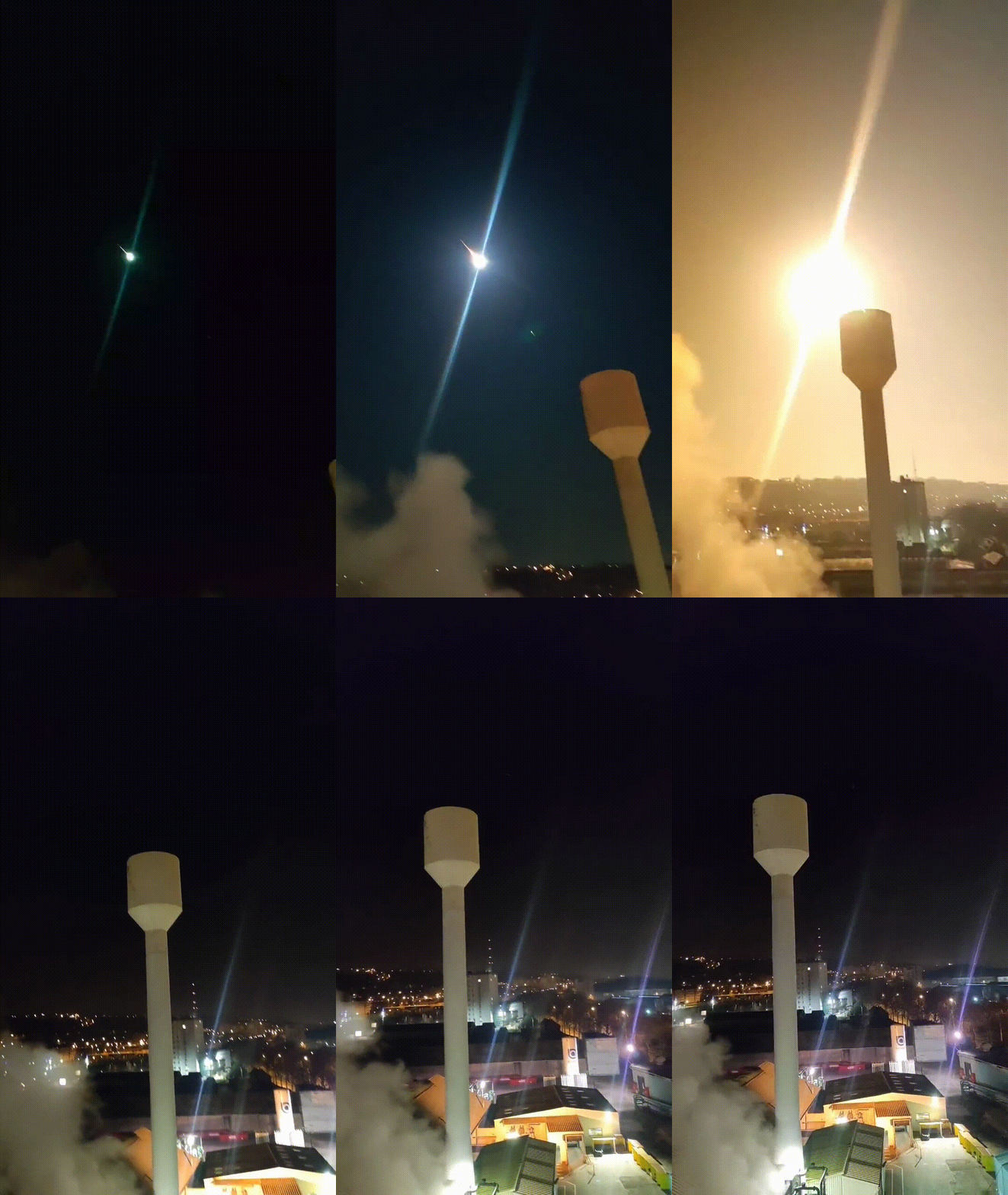
As expected, 02h 59min UT, 2023 CX1 entered the Earth atmosphere, producing a very bright fireball that was reported by dozens of witnesses and recorded on video by many thanks to favorable weather conditions over the involved densely populated area and the alert issued few hours in advance by astronomers. Below some of the best videos and photos posted on the web.


Credit: Gijs de Reijke


Credit: BNO News


Credit: Kevin


Credit: KrisztiUk


2023 CX1 became the 7th asteroid to be discovered before entering the Earth atmosphere. The first time it happened was with asteroid 2008 TC3, the second was with asteroid 2014 AA, the third was 2018 LA that impacted Earth on 02 June 2018, the fourth was with asteroid 2019 MO that impacted Earth on 22 June 2019 , the fifth was the asteroid 2022 EB5, the sixth was the asteroid 2022 WJ1 less than 3 months ago. Another space impacting object discovered prior to its to atmospheric entry was WT1190F but it is thought to have been a space debris, possibly  the translunar injection module of Lunar Prospector. For more info about 2008 TC3, 2014 AA, 2018 LA, 2019 MO, 2022 EB5 and 2022 WJ1 see also:

http://remanzacco.blogspot.it/2008/10/small-asteroid-2008-tc3-to-hit-earth.html

http://remanzacco.blogspot.com/2008/10/2008-tc3-animation.html

http://remanzacco.blogspot.com/2008/10/2008-tc3-update-impact-flash-imaged.html

http://remanzacco.blogspot.com/2008/11/2008-tc3-trail-imaged-over-northern.html

http://remanzacco.blogspot.it/2009/02/2008-tc3-fragments-recovered.html

http://remanzacco.blogspot.com/2014/01/small-asteroid-2014-aa-hit-earths_2.html

https://remanzacco.blogspot.com/2018/06/small-asteroid-2018-la-impacted-earth.html

https://remanzacco.blogspot.com/2019/06/small-asteroid-neocp-a10eom1-impacted.html

https://remanzacco.blogspot.com/2022/03/small-asteroid-2022-eb5-neocp-sar2593.html

https://remanzacco.blogspot.com/2023/02/small-asteroid-2022-wj1-neocp-c8ff042.html

http://remanzacco.blogspot.com/search/label/asteroid%20impact 


by Ernesto Guido

Friday, November 25, 2022

Small Asteroid 2022 WJ1 (NEOCP C8FF042) impacted Earth on November 19

On 2022 November 19.2,  D. Rankin found a small asteroid using the 1.5-m reflector + 10K CCD of Mt. Lemmon Catalina Sky Survey (G96 MPC code) that was soon after put on the NEOCP list with the provisional designation C8FF042 for the follow-up by other observers. The Minor Planet Center subsequently assigned the following official designation to this object, 2022 WJ1.

Richard A. Kowalski of CSS at 06:20UT of Nov. 19 alerted on mpml mailing list "...it appears that this object (C8FF042) will impact around the Great Lakes region of the United States a few hours from the time of this message". According to Bill Gray the impact point was at 19 Nov 2022 8:26:54.47 UTC, lat +43.12309, lon W80.26416, directly over Brantford, Ontario, Canada.

Discovery images of asteroid 2022 WJ1

Credit: Catalina Sky Survey


M.P.E.C. 2022-W69 issued subsequently on 2022 November 19 at 14:14 UT assigned the official designation 2022 WJ1 to C8FF042 with the following comment:

D. Rankin detected a fast moving object in images taken at Mt. Lemmon Survey (G96). The observations triggered a warning of an imminent impact.  Seven observatories were able to observe the sub-meter object before it  impacted the Earth's atmosphere on Nov. 19 at approximately 08:27 UTC over  Brantford, Ontario, Canada.

2022 WJ1 was a small Apollo asteroid with an estimated size of 0.5 m - 1.0 m (based on the object's absolute magnitude H=33.6). 

This is the sixth time in history that an impacting object is observed prior to atmospheric entry. The first time it happened was with asteroid 2008 TC3, the second was with asteroid 2014 AA, the third was 2018 LA that impacted Earth on 02 June 2018, the fourth was with asteroid 2019 MO that impacted Earth on 22 June 2019 and the fifth was the asteroid 2022 EB5. Another space impacting object discovered prior to its to atmospheric entry was WT1190F but it is thought to have been a space debris, possibly  the translunar injection module of Lunar Prospector. For more info about 2008 TC3, 2014 AA, 2018 LA, 2019 MO and 2022 EB5 see also:


http://remanzacco.blogspot.it/2008/10/small-asteroid-2008-tc3-to-hit-earth.html

http://remanzacco.blogspot.com/2008/10/2008-tc3-animation.html

http://remanzacco.blogspot.com/2008/10/2008-tc3-update-impact-flash-imaged.html

http://remanzacco.blogspot.com/2008/11/2008-tc3-trail-imaged-over-northern.html

http://remanzacco.blogspot.it/2009/02/2008-tc3-fragments-recovered.html

http://remanzacco.blogspot.com/2014/01/small-asteroid-2014-aa-hit-earths_2.html

https://remanzacco.blogspot.com/2018/06/small-asteroid-2018-la-impacted-earth.html

https://remanzacco.blogspot.com/2019/06/small-asteroid-neocp-a10eom1-impacted.html

https://remanzacco.blogspot.com/2022/03/small-asteroid-2022-eb5-neocp-sar2593.html

http://remanzacco.blogspot.com/search/label/asteroid%20impact 


by Ernesto Guido

Thursday, June 30, 2022

New Comets C/2022 J1 & C/2022 L1

CBET 5121 & MPEC 2022-J88 , issued on 2022, May 11, announce the discovery of a comet (magnitude ~18) by A. Maury and G. Attard on images obtained with a 0.28-m f/2.2 Schmidt reflector at San Pedro de Atacama, Chile, on May 5.  The new comet has been designated C/2022 J1 (Maury-Attard).

Stacking of 15 luminance-filtered exposures, 60 seconds each, obtained remotely (in poor conditions, high clouds) on 2022, May 6.4 from X02 (Telescope Live, Chile) through a 0.61-m f/6.5 astrograph + CCD, shows that this object is a comet with a diffuse coma of size about 12" and magnitude of 18.3-18.9 in an aperture radius of 5".5 (Observers E. Bryssinck, M. Rocchetto, E. Guido, M. Fulle, G. Milani, G. Savini, A. Valvasori).

Our confirmation image (click on the images for a bigger version)


CBET 5121 assigns the following parabolic orbital elements to comet C/2022 J1 (Maury-Attard): T 2022 Feb. 21.59; e= 1.0; Peri. =  307.65; q = 1.63 ;  Incl.= 106.45 (It is possible that the comet has a periodic orbit on the order of 120 years or so). 

                        -------------------------------------------------------------------------------------

CBET 5134 & MPEC 2022-L97, issued on 2022, June 13, announce that an apparently asteroidal object discovered on June 4 with the 0.68-m Schmidt reflector of the Catalina Sky Survey has been found to show cometary appearance by CCD astrometrists elsewhere after the Minor Planet Center posted it to the PCCP webpage on the basis of a comet-like orbit.  The new comet has been designated C/2022 L1 (Catalina).

Stacking of 25 luminance-filtered exposures, 60 seconds each, obtained remotely on 2022, June 9.3 from X02 (Telescope Live, Chile) through a 0.61-m f/6.5 astrograph + CCD, shows that this object is a comet with a condensed coma of size 11", with magnitude 19.5 as measured in a circular aperture of radius 5".5, with no clear tail visible (Observers E. Bryssinck, M. Rocchetto, E. Guido, M. Fulle, G. Milani, G. Savini, A. Valvasori).

Our confirmation image (click on the images for a bigger version)


CBET 5134 assigns the following parabolic orbital elements to comet C/2022 L1 (Catalina): T 2022 Sept. 28.10; e= 1.0; Peri. =  59.74; q = 1.59 ;  Incl.= 123.46

by Ernesto Guido
Tuesday, May 31, 2022

New Comet C/2022 F2 (NEOWISE)

CBET 5113 & MPEC 2022-G83, issued on 2022, April 06, announce the discovery of a comet (magnitude ~17) in infrared exposures obtained during Mar. 30-Apr. 1 UT with the Near-Earth Object Wide-field Infrared Survey Explorer (or NEOWISE; formerly the WISE earth-orbiting satellite). The new comet has been designated C/2022 F2 (NEOWISE).

Stacking of 60 unfiltered exposures, 30 seconds each, obtained remotely on 2022, April 3.3 from X02 (Telescope Live, Chile) through a 0.61-m f/6.5 astrograph + CCD, shows that this object is a comet with a central condensation inside a coma of diameter 19" and a hint of a broad tail 13" long in p.a. 283 degrees, with magnitude of 17.5-17.7 in an aperture of radius 5".5 (Observers E. Bryssinck, M. Rocchetto, E. Guido, M. Fulle, G. Milani, G. Savini, A. Valvasori).


Our confirmation image (click on the images for a bigger version)


CBET 5113 assigns the following parabolic orbital elements to comet C/2022 F2 (NEOWISE): T 2022 Mar. 24.47; e= 0.99; Peri. =  201.41; q = 1.59 ;  Incl.= 97.47

by Ernesto Guido

Saturday, April 30, 2022

New Comet C/2022 F1 (ATLAS)

CBET 5112 & MPEC 2022-G82, issued on 2022, April 06, announce the discovery of a comet (magnitude ~18.5) on CCD images taken on Mar. 30.3 UT with a 0.5-m f/2 Wright-Schmidt reflector at Rio Hurtado, Chile, in the course of the "Asteroid Terrestrial-Impact Last Alert System" (ATLAS) search program. The new comet has been designated C/2022 F1 (ATLAS).

Stacking of 20 unfiltered exposures, 90 seconds each, obtained remotely on 2022, April 2.4 from X02 (Telescope Live, Chile) through a 0.61-m f/6.5 astrograph + CCD, shows that this object is a comet with a compact coma about 9" arcsecond in diameter (Observers E. Bryssinck, M. Rocchetto, E. Guido, M. Fulle, G. Milani, G. Savini, A. Valvasori).

Our confirmation image (click on the images for a bigger version)


CBET 5112 assigns the following parabolic orbital elements to comet C/2022 F1 (ATLAS): T 2022 Sep. 4.00; e= 0.99; Peri. =  281.10; q = 5.94 ;  Incl.= 57.98; adding that: "these suggest that the comet will pass 1.46 AU from Saturn in 2025 August".

by Ernesto Guido

Tuesday, March 22, 2022

New Comet C/2022 E3 (ZTF) [may reach mag. +6 in Feb. 2023]

CBET 5111 & MPEC 2022-F13, issued on 2022, March 21, announce the discovery of an apparently asteroidal object (magnitude ~17) discovered on CCD images taken on Mar. 2 UT with a  1.2-m f/2.4 Schmidt telescope at Palomar in the course of the  "Zwicky Transient Facility" (ZTF) survey (MPC code I41). Subsequently, it has been found to show cometary appearance by CCD astrometrists elsewhere. The new comet has been designated C/2022 E3 (ZTF).

Stacking of 12 unfiltered exposures, 120 seconds each, obtained remotely on 2022, March 20.4 from X02 (Telescope Live, Chile) through a 0.61-m f/6.5 astrograph + CCD, shows that this object is a comet with a compact coma about 9" arcsecond in diameter (Observers E. Guido, M. Rocchetto, E. Bryssinck, G. Milani, G. Savini, A. Valvasori).


Our confirmation image (click on the images for a bigger version; made with TYCHO software by D. Parrott)


MPEC 2022-F13 assigns the following orbital elements to comet C/2022 E3 (ZTF): T 2023 Jan. 13.18; e= 0.99; Peri. =  145.77; q = 1.11 ;  Incl.= 109.09


Credit: MPC


According to CBET 5111: "These preliminary elements indicate that the comet will pass 0.28 AU from the earth in early Feb. 2023, when the comet may be near total visual magnitude 6; these also suggest that the comet passed about 1.18 AU from Saturn in 2020 May and about 3.07 AU from Jupiter in 2021 April." Below you can see a graph generated using the software Orbitas and showing the predicted magnitude (in red) versus its elongation from the Sun. As always with comets, the future magnitudes reported here are only indicative.


by Ernesto Guido


Wednesday, March 16, 2022

New Comet C/2022 E2 (ATLAS)

CBET 5109 & MPEC 2022-E227, issued on 2022, March 15, announce the discovery of an apparently asteroidal object (magnitude ~19) discovered on CCD images taken on Mar. 7 UT with a 0.5-m f/2 Schmidt reflector at Rio Hurtado, Chile, in the course of the "Asteroid Terrestrial-Impact Last Alert System" (ATLAS) search program. Subsequently, it has been found to show cometary appearance by CCD astrometrists elsewhere after it was posted on the Minor Planet Center's PCCP webpage. The new comet has been designated C/2022 E2 (ATLAS).

Stacking of 25 unfiltered exposures, 120 seconds each, obtained remotely on 2022, March 10.3 from X02 (Telescope Live, Chile) through a 0.61-m f/6.5 astrograph + CCD, shows that this object is a comet with a compact coma about 7" arcsecond in diameter (Observers E. Guido, M. Rocchetto, E. Bryssinck, G. Milani, G. Savini, A. Valvasori).


Our confirmation image (click on the images for a bigger version; made with TYCHO software by D. Parrott)


MPEC 2022-E227 assigns the following orbital elements to comet C/2022 E2 (ATLAS): T 2024 Sep. 16.95; e= 0.99; Peri. =  41.84; q = 3.67 ;  Incl.= 137.13


Credit: MPC


This comet could reach total magnitude ~13 in late 2024.  Below you can see a graph generated using the software Orbitas and showing the predicted magnitude (in red) versus its elongation from the Sun. As always with comets, the future magnitudes reported here are only indicative.


by Ernesto Guido

Saturday, March 12, 2022

Small Asteroid 2022 EB5 (NEOCP Sar2593) impacted Earth on March 11

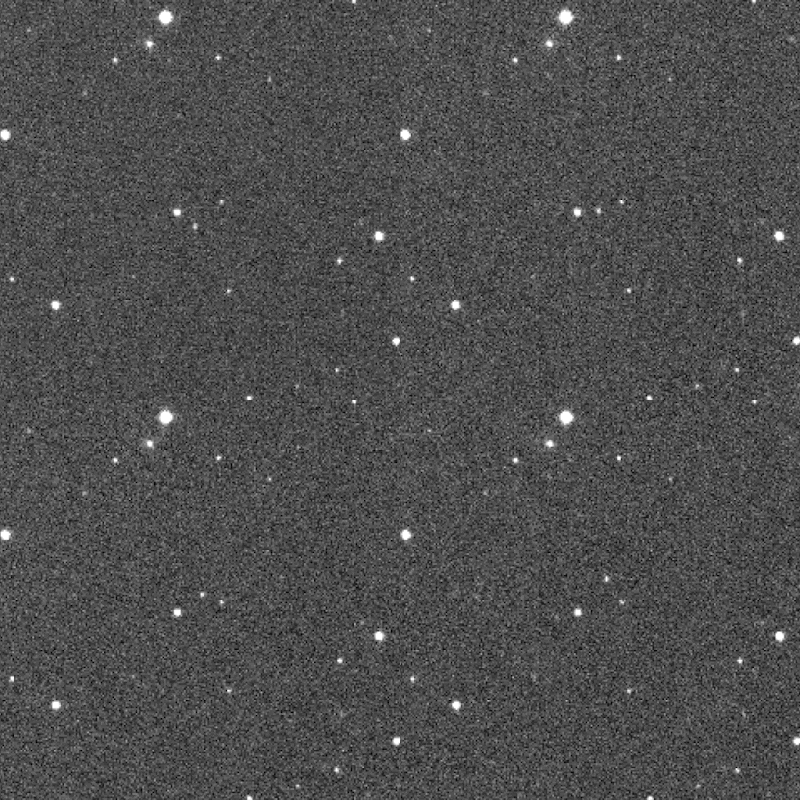
On 2022 March 11.80, K. Sarneczky found a small asteroid using the 0.60-m Schmidt + CCD of GINOP-KHK, Piszkesteto (K88 MPC code) that was soon after put on the NEOCP list with the provisional designation Sar2593 for the follow-up by other observers. The Minor Planet Center subsequently assigned the following official designation to this object 2022 EB5.


Discovery images (19:25UT) of asteroid 2022 EB5

Credit: K. Sarneczky 


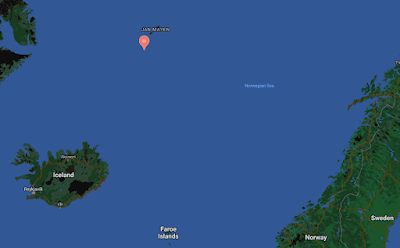
At 20:46UT of March 11, Bill Gray sent an alert in the MPML mailing list about the impact of Sar2593 with the Earth's atmosphere and: "to urge European observers to take a look for this object, currently on NEOCP.  It should come in at 21:23 UTC at latitude +70.47, longitude W 10.40,  plus or minus a few dozen km.  That's about forty minutes from "right now",  a bit north of Iceland". Below you can see a map of the impact location as calculated by Gray, southwest of Jan Mayen island.


Credit: B. Gray


Below an animation showing the impact trajectory 

Credit: T. Dunn


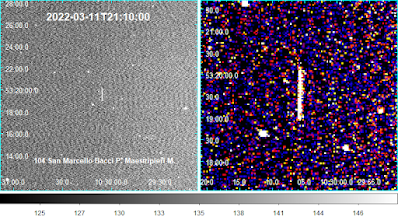
Below a follow-up image obtained by P. Bacci & M. Maestripieri at the San Marcello Pistoiese Observatory (104 MPC code) just about 15 minutes before its impact. 

Credit: Gamp/UAI

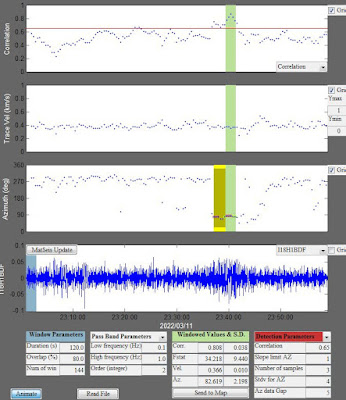
2022 EB5 is a small Apollo asteroid with an estimated size of 1.0 m - 2.3 m (based on the object's absolute magnitude H=32.1). 2022 EB5 impact infrasound  detection in Greenland had been published by P. Brown: "From this data yield is approximately 2-3 kT TNT. At 15 km/s, this is roughly 3-4 m diameter".

Credit: P. Brown


This is the fifth time in history that an impacting object is observed prior to atmospheric entry. The first time it happened was with asteroid 2008 TC3, the second was with asteroid 2014 AA, the third was 2018 LA that impacted Earth on 02 June 2018, the fourth was with asteroid 2019 MO that impacted Earth on 22 June 2019. Another space impacting object discovered prior to its to atmospheric entry was WT1190F but it is thought to have been a space debris, possibly  the translunar injection module of Lunar Prospector. For more info about 2008 TC3, 2014 AA, 2018 LA and 2019 MO see also:


http://remanzacco.blogspot.it/2008/10/small-asteroid-2008-tc3-to-hit-earth.html

http://remanzacco.blogspot.com/2008/10/2008-tc3-animation.html

http://remanzacco.blogspot.com/2008/10/2008-tc3-update-impact-flash-imaged.html

http://remanzacco.blogspot.com/2008/11/2008-tc3-trail-imaged-over-northern.html

http://remanzacco.blogspot.it/2009/02/2008-tc3-fragments-recovered.html

http://remanzacco.blogspot.com/2014/01/small-asteroid-2014-aa-hit-earths_2.html

https://remanzacco.blogspot.com/2018/06/small-asteroid-2018-la-impacted-earth.html

https://remanzacco.blogspot.com/2019/06/small-asteroid-neocp-a10eom1-impacted.html

http://remanzacco.blogspot.com/search/label/asteroid%20impact


By Ernesto Guido


Thursday, January 13, 2022

James Webb Space Telescope - Images & Animation

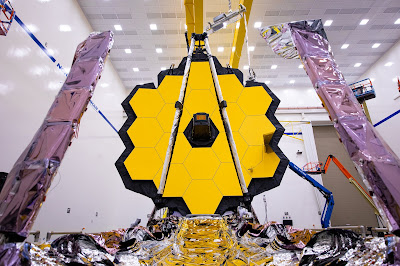
Named after James E. Webb, who was the administrator of NASA from 1961 to 1968, the James Webb Space Telescope (JWST) is a space telescope intended to succeed the Hubble Space Telescope (HST). The JWST with its primary mirror of 6.5 meters (made of 18 hexagonal gold-plated beryllium segments) and a sunshield the size of a tennis court, promises to usher in a new era of astronomy with its capability to observe some of the oldest, most distant objects in the Universe, viewing up to 100 times fainter than HST. After three decades from conception through design, JWST was launched December 25, 2021 and will orbit the Sun near the second Lagrange point (L2) of the Sun-Earth system.


 Credit: Northrop Grumman, NASA/Chris Gunn

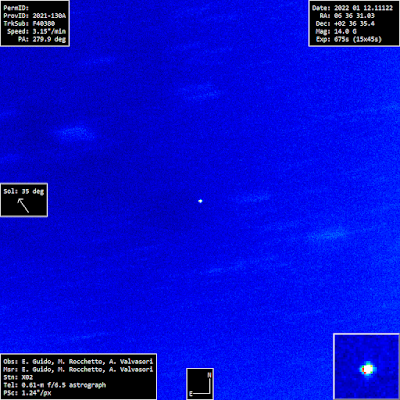
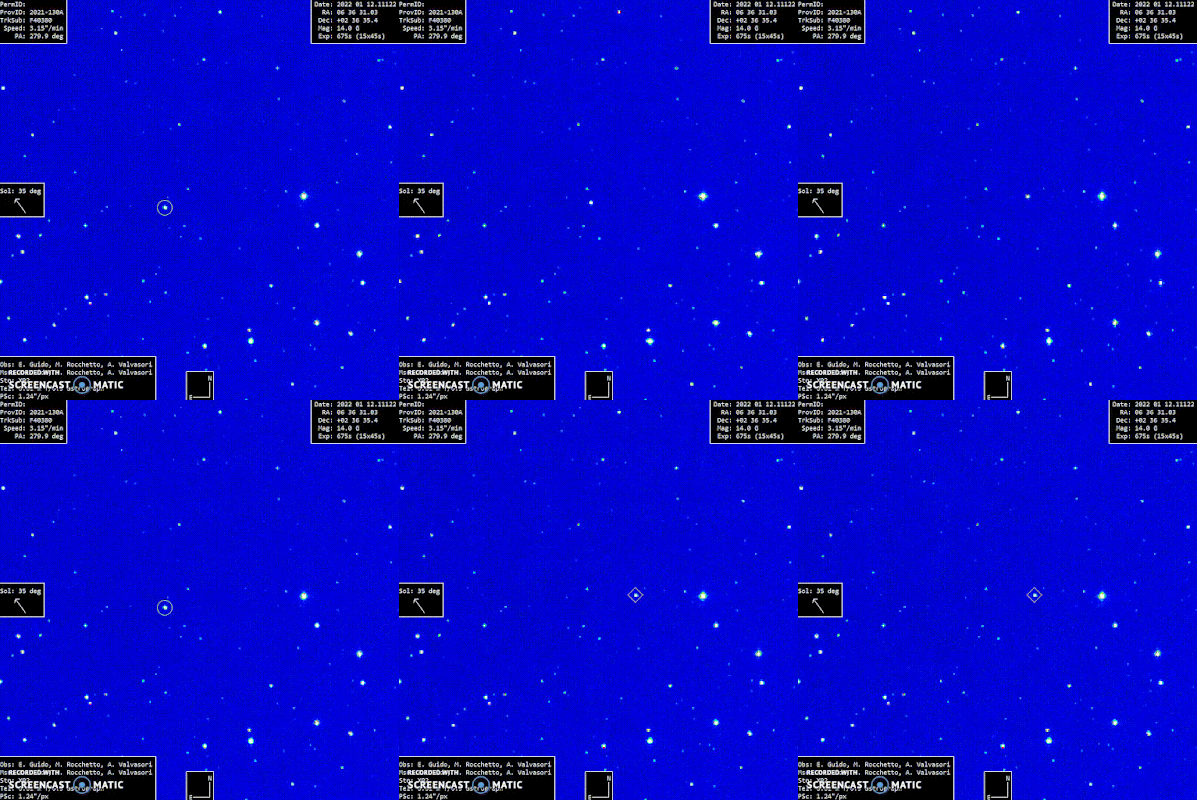
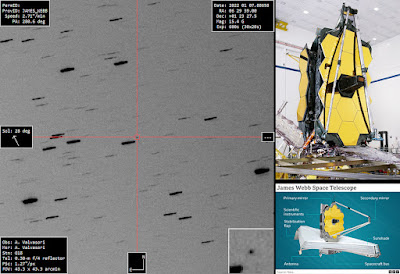
JWST can be easily seen from Earth as its magnitude is now around 14. The image and the animation below show the James Webb Space Telescope travelling towards its final destination. The images were taken on Jan 12, 2022 at 02:30 UTC by Ernesto Guido, Marco Rocchetto and Adriano Valvasori via Telescope Live using the Planewave CDK24 60-cm telescope installed at El Sauce Observatory, Chile (CHI-1). Click on each image for a bigger version. 


At the imaging time, JWST was around 741,900 miles away from Earth, almost 82 percent of the way to its destination. You can see where is Webb at any time on this webpage.


Below another image of JWST imaged by A. Valvasori & E. Guido via ALMO observatoy (MPC code G18 - Italy)  on January 07, 2022


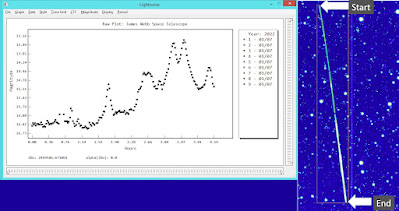
Below a lightcurve of JWST spanning about 4 hours. 179 exposures, each 60sec in duration obtained by Daniel Parrott using his software TYCHO


By Ernesto Guido


Friday, December 31, 2021

Comet Leonard's show and other comet photos

With just a few hours to go before the end of 2021, while the comet C/2021 A1 (Leonard) show is still going on, one last post of the year to thank all the readers of this blog. See you again in 2022, with the hope that there will be clear skies for everyone. According to M. Meyer, 2021 had 68 new comets (2020: 76, 2019: 64) of which 4 were amateur discoveries (2020: 5, 2019: 2). Top 3: PANSTARRS: 23; Mt. Lemmon/Catalina: 13/4; ATLAS: 8. Here's a short roundup of cometary photos starting with the most beautiful comet of 2021 and probably one of the best in recent years. (Click on each image below for a bigger version). 


COMET C/2021 A1 (Leonard) imaged on December 28, 2021 by Ernesto Guido, Marco Rocchetto & Adriano Valvasori via Telescope Live network (MPC code Q56, Australia).


Credit: E. Guido, M. Rocchetto, A. Valvasori


COMET C/2021 A1 (Leonard) imaged on December 31, 2021 by Ernesto Guido, Marco Rocchetto & Adriano Valvasori via Telescope Live network (MPC code Q56, Australia).

Credit: E. Guido, M. Rocchetto, A. Valvasori


COMET 108P/Ciffreo imaged on December 14, 2021 by Ernesto Guido, Marco Rocchetto & Adriano Valvasori through a 0.7 m f/8 Ritchey Chretien + CCD via Telescope Live network (MPC code Z08, Oria, Spain).

Credit: E. Guido, M. Rocchetto, A. Valvasori, E. Bryssinck


COMET C/2019 L3 (Atlas) imaged on December 13, 2021 by Adriano Valvasori & Ernesto Guido via ALMO observatory (MPC code G18, Italy).


COMET 67P (Churyumov–Gerasimenko) imaged on December 12, 2021 by Adriano Valvasori & Ernesto Guido via ALMO observatory (MPC code G18, Italy).


COMET C/2021 A1 (Leonard) imaged on November 30, 2021 by Adriano Valvasori & Ernesto Guido via ALMO observatory (MPC code G18, Italy).


COMET 29P (Schwassmann–Wachmann) imaged on October 11, 2021 by Adriano Valvasori & Ernesto Guido via ALMO observatory (MPC code G18, Italy).


COMET 4P (Faye) imaged on October 03, 2021 by Adriano Valvasori & Ernesto Guido via ALMO observatory (MPC code G18, Italy).


by Ernesto Guido

Tuesday, November 2, 2021

New Comet P/2021 U3 (Attard-Maury)

CBET 5064 & MPEC 2021-V21, issued on 2021, November 02, announce the discovery of a new comet (magnitude ~19)  by A. Maury and G. Attard on CCD images taken on October 24.3 UT  with the 0.28-m f/2.2 Rowe-Ackermann Schmidt astrograph at San Pedro de Atacama, Chile in the course of the  MAP (W94) survey.  The new comet has been designated P/2021 U3 (Attard-Maury). This is the 4th amateur comet discovery of 2021. It is also the second comet discovered using the synthetic tracking technique (using TYCHO software).

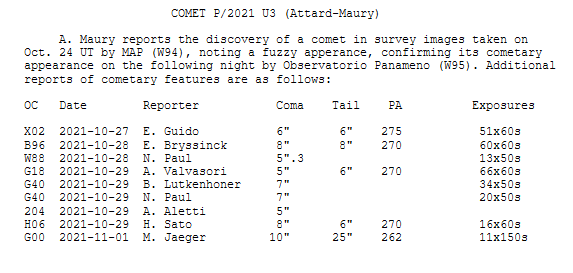
Stacking of 51 unfiltered exposures, 60 seconds each, obtained remotely on 2021, Oct. 27.3 from X02 (Telescope Live, Chile) through a 0.61-m f/6.5 astrograph + CCD, shows that this object is a comet with a compact coma about 6" arcsecond in diameter and a tail 6" long in PA 275 (Observers E. Guido, M. Rocchetto, E. Bryssinck, M. Fulle, G. Milani, C. Nassef, G. Savini, A. Valvasori).

Stacking of 66 unfiltered exposures, 60 seconds each, obtained remotely on 2021, Oct. 29.9 from G18  (ALMO Observatory, Italy) through a 0.30-m f/4 reflector + CCD, shows that this object is a comet with a compact coma about 5" arcsec in diameter and a tail 6" long in PA 270 (Observers A. Valvasori & E. Guido).

Our confirmation images (click on the images for a bigger version; made with TYCHO software by D. Parrott)


MPEC 2021-V21, assigns the following preliminary elliptical orbital elements to comet  P/2021 U3 (Attard-Maury): T 2021 Oct. 25.43; e= 0.55; Peri. =  335.48; q = 1.88 ;  Incl.= 70.05.

According to CBET 5064 "the comet passed 0.59 AU from Jupiter in 1983 October (though the orbital period is uncertain by well over a month). A search for earlier observations in archival astrometry produced nothing".


Credit: MPC

by Ernesto Guido

Friday, October 1, 2021

New Comet P/2021 Q5 (ATLAS)

CBET 5029 & MPEC 2021-R98 , issued on 2021, September 06, announce the discovery of a new comet (magnitude ~17) on CCD images taken on August 29.6 UT with a 0.5-m f/2 Schmidt reflector at Haleakala, Hawaii, in the course of the "Asteroid Terrestrial-Impact Last Alert System" (ATLAS) search program. The new comet has been designated P/2021 Q5 (ATLAS)

Stacking of 58 unfiltered exposures, 30 seconds each, obtained remotely on 2021, September 03.1 from G18  (ALMO Observatory, Italy) through a 0.30-m f/4 reflector + CCD, shows that this object is a comet with a compact coma about 8" arcsec in diameter and a tail 10" long in PA 270 (Observers A. Valvasori & E. Guido).

Our confirmation image (click on the images for a bigger version; made with TYCHO software by D. Parrott)


MPEC 2021-R98, assigns the following preliminary orbital elements to comet  P/2021 Q5 (ATLAS): T 2021 August 30.34; e= 0.61; Peri. =  180.81; q = 1.23 ;  Incl.= 10.72. 


Credit: MPC


by Ernesto Guido

Thursday, September 30, 2021

New Comet C/2021 Q4 (Fuls)

CBET 5028 & MPEC 2021-Q102, issued on 2021, August 31 & September 02, announce the discovery of a new comet (magnitude ~20) on CCD images taken on August 26.2 UT with the Mt. Lemmon Survey (G96) 1.5-m reflector. The new comet has been designated C/2021 Q4 (Fuls)

Stacking of 30 unfiltered exposures, 120 seconds each, obtained remotely on 2021, August 29.9 from Z08 (Telescope Live, Oria) through a 0.7 m f/8 Ritchey Chretien + CCD, shows that this object is a comet with a compact coma about 8" arcsec in diameter elongated toward PA 275 (Observers E. Guido, M. Rocchetto, E. Bryssinck, M. Fulle, G. Milani, C. Nassef, G. Savini, A. Valvasori).

Our confirmation image (click on the images for a bigger version; made with TYCHO software by D. Parrott)


MPEC 2021-Q102, assigns the following preliminary orbital elements to comet C/2021 Q4 (Fuls): T 2023 June 10.66; e= 1.0030276; Peri. =  147.01; q = 7.56 ;  Incl.= 71.47. The comet will pass 2.45 AU from Saturn on 2025 Apr. 30 UT.

Credit: MPC


by Ernesto Guido

Monday, August 2, 2021

New Comet C/2021 O3 (PANSTARRS)

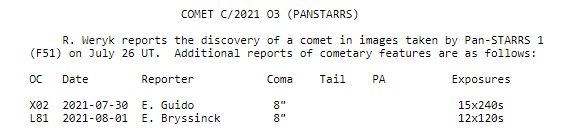
CBET 5009 & MPEC 2021-P05, issued on 2021, August 01, announce the discovery of a new comet (magnitude ~20) on CCD images taken on July 26.5 UT with the Pan-STARRS1 1.8-m Ritchey-Chretien reflector at Haleakala. The new comet has been designated C/2021 O3 (PANSTARRS)

Stacking of 15 unfiltered exposures, 240 seconds each, obtained remotely on 2021, July 30.3 from X02 (Telescope Live, Chile) through a 0.61-m f/6.5 astrograph + CCD, shows that this object is a comet with a compact coma about 8" arcsecond in diameter (Observers E. Guido, M. Rocchetto, E. Bryssinck, M. Fulle, G. Milani, C. Nassef, G. Savini, A. Valvasori).

Our confirmation image (click on the images for a bigger version; made with TYCHO software by D. Parrott)


MPEC 2021-P05, assigns the following preliminary orbital elements to comet C/2021 O3 (PANSTARRS): T 2022 Apr. 20.49; e= 1.0; Peri. =  299.88; q = 0.28 ;  Incl.= 56.72


Credit: MPC

This comet could become visible to the naked eye in 2022, reaching magnitude ~5. Below you can see a graph generated using the software Orbitas and showing the predicted magnitude (in red) versus its elongation from the Sun. Anyway, as always with comets, the future magnitudes reported here are only indicative. 


By Ernesto Guido

Saturday, July 24, 2021

New Comet C/2021 N3 (PANSTARRS)

CBET 5003 & MPEC 2021-O39, issued on 2021, July 22, announce the discovery of a new comet (magnitude ~20.5) on CCD images taken on July 13.5 UT with the Pan-STARRS1 1.8-m Ritchey-Chretien reflector at Haleakala (numerous pre-discovery observations going back an additional month were later identified). The new comet has been designated C/2021 N3 (PANSTARRS)

Stacking of 16 unfiltered exposures, 180 seconds each, obtained remotely on 2021, July 14.3 from X02 (Telescope Live, Chile) through a 0.61-m f/6.5 astrograph + CCD, shows that this object is a comet with a compact coma about 9" arcsecond in diameter elongated toward PA 230 (Observers E. Guido, M. Rocchetto, E. Bryssinck, M. Fulle, G. Milani, C. Nassef, G. Savini, A. Valvasori).

Our confirmation image (click on the images for a bigger version; made with TYCHO software by D. Parrott)


MPEC 2021-O39, assigns the following preliminary orbital elements to comet C/2021 N3 (PANSTARRS): T 2020 Aug. 13.96; e= 0.96; Peri. =  303.99; q = 5.69 ;  Incl.= 26.67


Credit: MPC


by Ernesto Guido