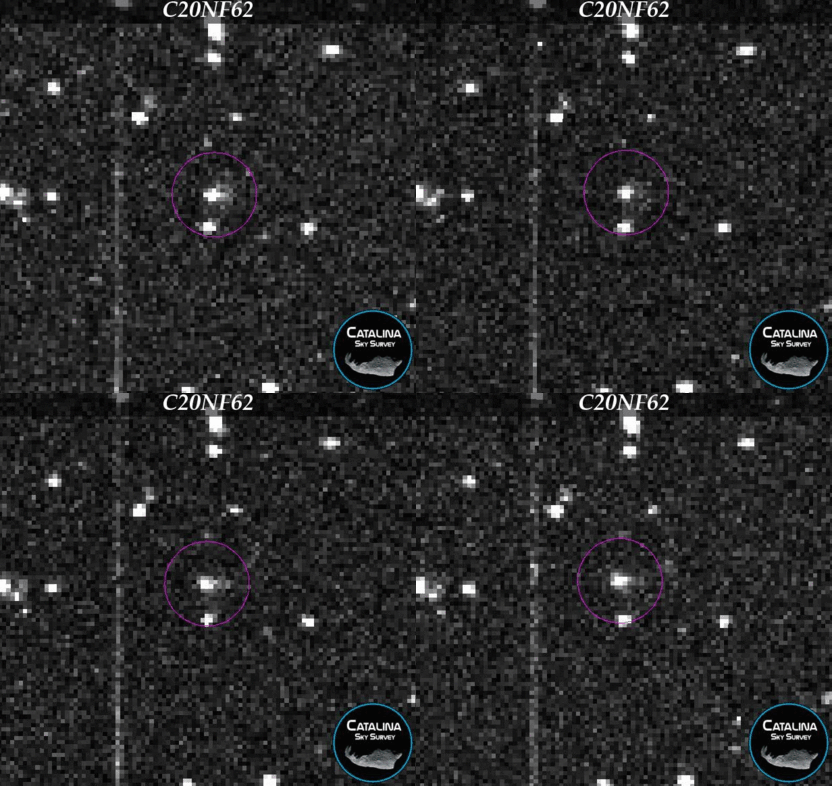
During the 2-month period January through February 2020, 9 new comets were discovered and cometary activity was detected for 1 previously discovered object (earlier designated with the prefix A/, see
MPEC 2018-H54). "
Current comet magnitudes" & "
Daily updated asteroid flybys" pages are available at the top of this blog (or just click on the underline text here). See below for the "Other news" section.
The dates below refer to the date of issuance of CBET (Central Bureau Electronic Telegram) which reported the official news & designations.
(This post has been written during the covid-19 lockdown in Italy. I hope everyone is staying safe out there)
- Comet Discoveries
Jan 06 Discovery of
C/2019 Y1 (ATLAS) (CBET 4708)
Jan 08 Discovery of P/2019 Y2 (FULS) (CBET 4709)
Jan 09 Discovery of P/2019 Y3 (CATALINA) (CBET 4711)
Jan 11 Discovery of C/2019 Y4 (ATLAS) (CBET 4712)
Jan 13 Discovery of P/2019 X2 (PANSTARRS) (CBET 4713)
Jan 15 Discovery of C/2020 A2 (IWAMOTO) (CBET 4715)
Jan 21 Discovery of C/2020 A3 (ATLAS) (CBET 4716)
Feb 06 Discovery of C/2020 B2 (LEMMON) (CBET 4723)
Feb 07 Discovery of
C/2020 B3 (RANKIN) (CBET 4724)
- Cometary activity detected
Feb 05 Cometary activity detected in A/2019 C1 = C/2019 C1 (ATLAS) (CBET 4721)*
*The object was given the designation "A/2019 C1" when announced on
MPEC 2019-D42, due evidently to its comet-like orbit.
 |
| Credit : PRISMA/FRIPON |
 |
| Credit : PRISMA |
Jan 09
NASA’s Lucy mission team is seeing double after discovering that Eurybates, the asteroid the spacecraft has targeted for flyby in 2027,
has a small satellite. This “bonus” science exploration opportunity for the project was discovered using images taken by the Hubble Space Telescope’s Wide Field Camera 3 in September 2018, December 2019, and January 2020.
 |
| Credit: Lucy/HST |
Jan 17 At 2130UTC of 2020-01-17, a #fireball was detected just north of Puerto Rico (5:31pm local time). Satellite image
available here #puertorico #meteor #fireball #meteoro #astronomy
Jan 23 CBET 4717 & CBET 4722 (Feb 05) report that the following minor planets are binaries systems: (9474) CASSADRURY & (2883) BARABASHOV.
Feb 07 CBET 4725 reports that Arecibo S-band (2380-MHz, 12.6-cm) range-Doppler radar images obtained on 2020 Feb. 4.8417-4.9215 and Feb. 5.8029-5.8611 UT reveal that the potentially hazardous, near-earth minor planet 2020 BX_12 (cf. MPEC 2020-B281) is a binary system. Preliminary measurements of visible range extents in radar images with 7.5 m/pixel resolution suggest a round primary at least 165 m in diameter and a secondary at least 70 m in diameter.
 |
| Credit: Arecibo/NASA/NSF |
Feb 12 #IAUnews What will be the impact of the planned mega-constellations of communication satellites on astronomical observations and on the pristine appearance of the night sky? Some
preliminary findings. See
also this paper by
J. C. McDowell (published online on March 16, 2020).
Feb 15
2020 CD3 is a tiny
near-Earth asteroid and temporary satellite of Earth. It was discovered at the Mount Lemmon Observatory by astronomers
Theodore Pruyne and
Kacper Wierzchoś on 15 February 2020, as part of the Mount Lemmon Survey or Catalina Sky Survey. The asteroid's discovery was announced by the Minor Planet Center on 25 February 2020, after subsequent observations have confirmed that it is orbiting around Earth. It is the second temporary satellite of Earth discovered in situ, after 2006 RH120, which was discovered in 2006. Based on its nominal trajectory, 2020 CD3 was captured by Earth between 2015–2016, and is expected to remain in a geocentric orbit around Earth until May 2020.
 |
| Credit: Tomislav Čar |
by Ernesto Guido