Showing posts with label Centaur. Show all posts

Tuesday, November 17, 2020

Follow-up of recent NEOCP objects from OASDG L07

Below you can find a selection of some objects for which we recently made follow-up observations at the "Osservatorio Salvatore di Giacomo, Agerola, ITALY" (MPC code L07; Observers E. Guido, A. Catapano, F. Coccia) while they still were on the NEOCP list. More details about the telescope, the  magnitude, number of images & exposition, asteroid speed & PA etc. are on the images. Click on each image for a bigger version. All the processing has been made with TYCHO software by D. Parrott.

2020 VX5 (neocp designation C3WZUQ2) is an Apollo-type asteroid discovered by G96 Mt. Lemmon Survey on November 15, 2020. This asteroid has an estimated size of 55 m - 120 m (H=23.4) and it had a close approach with Earth at about 29 LD (Lunar Distances = ~384,000 kilometers) or 0.074 AU (1 AU = ~150 million kilometers) at 1950 UT on 11 Nov. 2020.


2020 VN1 (neocp designation A10sCsG) is an Aten-type asteroid discovered by T05 ATLAS-HKO, Haleakala on November 10, 2020. This asteroid has an estimated size of 7.3 m - 16 m (H=27.8) and it had a close approach with Earth at about 1.19 LD (Lunar Distances = ~384,000 kilometers) or 0.00306 AU (1 AU = ~150 million kilometers) at 0757 UT on 07 Nov. 2020.


2020 VF1 (neocp designation X71128) is a Centaur-type object discovered by D29 Purple Mountain Observatory, XuYi Station on November 08, 2020. At the discovery time it was at about 9.7 AU from the Sun.


2020 VM1 (neocp designation P219ias) is an Apollo-type asteroid discovered by F52 Pan-STARRS 2, Haleakala November 08, 2020. This asteroid has an estimated size of 190 m - 420 m (H=20.8) and it had a close approach with Earth at about 73 LD (Lunar Distances = ~384,000 kilometers) or 0.18 AU (1 AU = ~150 million kilometers) at 2033 UT on 01 Nov. 2020.


by Ernesto Guido


Friday, December 8, 2017

New Outburst of 174P/Echeclus

On December 08, 2017 B. Skiff reported on mpml mailing list, that the centaur 174P/Echeclus  (also known as 60558 Echeclus) "seems to be at least 4 mag brighter than expected, and indeed as it appeared at the start of last night's images.  The Dec 7 series shows the outburst in progress on images taken near 2:00 and 2:48 UT; it is much brighter now (Dec 8 about 3:30 UT)". Last observations before this outburst had this object at around magnitude 18.

Prompted by this alert, I perfomed some follow-up of 174P/Echeclus and I can confirm that this object is experiencing a bright phase. Unfiltered exposures, 30-seconds each, obtained  remotely from Q62 (iTelescope network) on 2017, December 08.57 (through a 0.50-m f/6.8 astrograph + CCD + f/4.5 focal reducer) reveal 174P as a bright featureless star-like object of magnitude ~14.1 N (click on the image below for a bigger version).


This very interesting object was discovered by Spacewatch in 2000 and initially classified as a minor planet with provisional designation 2000 EC98 (its final minor planet designation is 60558 Echeclus). The presence of coma around it was first detected by Choi and Weissman (2006) on 2005 December 30.50 UT with the Palomar 5m telescope. Soon after, the object was given the periodic comet designation 174P/Echeclus. During the years, it experienced many outbursts. You can find info and images on all these past bright phases on this blog.


by Ernesto Guido

Wednesday, August 15, 2012

Distant Minor Planets 248835 & 2009 MS9

The Lowell Observatory LARI program hopes to engage the ever-growing and technically sophisticated amateur astronomy community in some exciting research projects with Lowell astronomers. Currently, Lowell astronomers are conducting several projects that would benefit from the participation of amateur astronomers. These projects span a broad range of technical skills and knowledge from taking very deep images of galaxies to monitoring small stars for transient events to data mining.

Centaurs and KBOs identified as part of this project have relatively short orbital arcs. As a result, their orbital elements are inaccurate, resulting in inaccurate sky-plane position. Faulkes Telescope's pro-am programme manager Nick Howes is working as a research associate with the Lowell observatory on a project to refine these orbits, imaging with the two Faulkes scopes, in collaboration with the team at Remanzacco Observatory and students using the Faulkes scopes. These Centaurs identified in this project are rarely brighter than 18th mag and the KBOs rarely brighter than 20th mag. The KBO targets have a slow motion across the sky so images taken over several hours or even days are needed on targets to detect movement. 

There are a number of names astronomers use to refer to these distant members of our solar system: Kuiper Belt Objects (KBO), Edgeworth-Kuiper Belt Objects (EKBO), Trans-Neptunian Objects (TNO), Scattered Disk Objects (SDO), Centaurs.

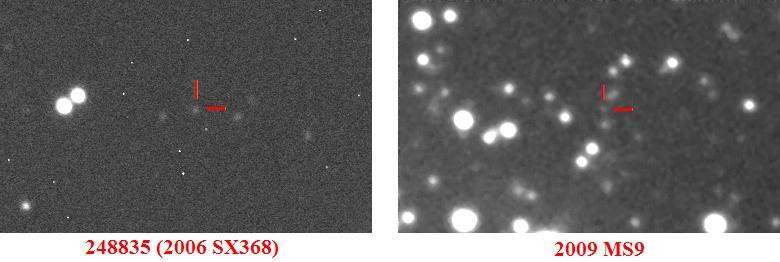
Below you can see the images of centaur 248835 & TransNeptunian Object 2009 MS9 (both objects are magnitude ~20) that we imaged on August 15.5, 2012 with the 2.0-m f/10.0 Ritchey-Chretien + CCD of Haleakala-Faulkes Telescope North. At the moment of the shoot 248835 was at ~12 AU from the Sun while 2009 MS9 was at ~11 AU. Each image is a stack of 4x120seconds fits. Click on the thumbnail for a bigger version.


Below you can see an animation (spanning ~45 minutes) showing the movement of centaur 248835 (2006 SX368). Click on the thumbnail for a bigger version.


Below you can see an animation (spanning ~45 minutes) showing the movement of TNO 2009 MS9. Click on the thumbnail for a bigger version.


Here you can find an useful webpage, maintained by astronomer Marc W. Buie, to help with prioritizing and keeping track of any followup work of various subsets of the known TNO's:

"It is not enough to find these interesting objects. To ensure that continued studies can proceed, these newly discovered objects need to be measured with some regularity. Unfortunately, telescope time on facilities capable of getting followup observations is in very short supply. Therefore, we are forced to be extremely efficient in our use of this time. In my opinion, there is nothing worse than seeing two sites be used to observe the same TNO within a few nights of each other. They could have done two objects instead".

by Nick Howes, Ernesto Guido & Giovanni Sostero