Showing posts with label comet 67P. Show all posts

Tuesday, May 31, 2016

Comets & Asteroids - Summary for May 2016

During the month of May 2016,  3 new comets were discovered and cometary activity was detected for 1 previously discovered object (earlier designated as an asteroid). 

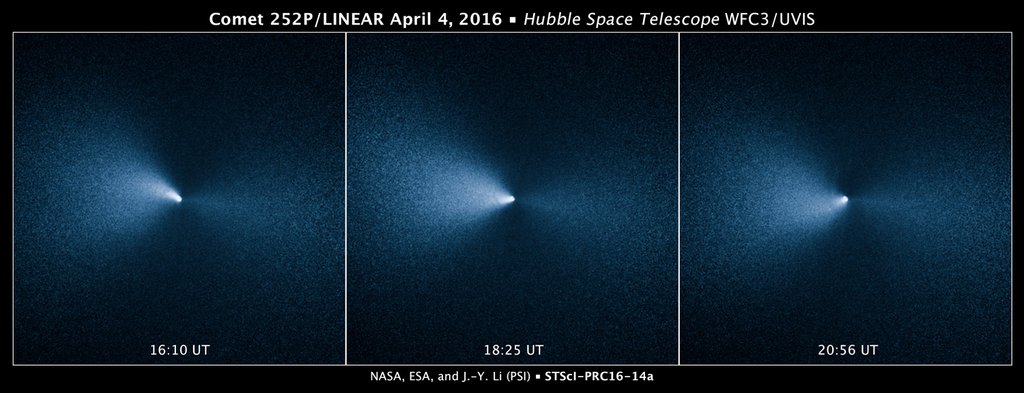
NASA's Hubble Space Telescope imaged comet 252P/LINEAR just after it swept by Earth on March 21, 2016 while the Subaru Telescope serendipitously captured high-resolution images of comet 67P/Churyumov-Gerasimenko. Moreover a non-gravitational acceleration has been detected influencing the motion of minor planet (85990) (see below for more about these news). "Current comet magnitudes" & "Daily updated asteroid flybys" pages are available at the top of this blog (or just click on the underline text here).

The dates below refer to the date of issuance of CBET (Central Bureau Electronic Telegram)  which reported the official news & designations.


- Comet Discoveries

May 09  Discovery of P/2016 J1 (PANSTARRS)*
May 09  Discovery of C/2016 J2 (DENNEAU)
May 31  Discovery of P/2016 J3 (STEREO)

* According to the discovery CBET,  follow-up images obtained at the 3.6-m Canada-France-Hawaii Telescope atop Mauna Kea on May 6.43 showed a second comet in the field. "The two components are moving at nearly identical rates in nearly identical directions (both about 0".6/minute in p.a. about 314 deg). The brighter component (designated component A) displays a clear and quite thin tail about 10" long in p.a. 250 deg in the May 6.43 images.  The fainter object (designated component B) also displays a clear but broader tail of similar length, oriented toward p.a. about 210 deg". The available astrometry for both components and ephemerides appear on MPEC 2016-J90

- Cometary activity detected

May 29  Cometary activity detected in 2016 KA = C/2016 KA (CATALINA)

Credit: P. Birtwhistle 

- Other news

May 12  Astronomers using NASA's Hubble Space Telescope captured images of comet 252P/LINEAR just after it swept by Earth on March 21.

Credit: NASA, ESA, and J.-Y. Li (Planetary Science Institute)

May 12 Hyper Suprime-Cam on the Subaru Telescope serendipitously captured high-resolution images of comet 67P/Churyumov-Gerasimenko during the inaugural queue-mode observations last March. The camera was scheduled to observe a distant compact galaxy when the chance came up to capture a view of the comet, and the images reveal fine details in the comet's coma and tails.

Credit: Subaru Telescope, NAOJ


May 25 Animation of the yearly discovery rate of #NEOs by size (H). Data from @MinorPlanetCtr via @JLGalache


May 27 CBET 4279 reports that a non-gravitational acceleration has been detected influencing the motion of minor planet (85990)

And finally a cartoon by the illustrator and cartoonist Tom Gauld + a Chelyabinsk event mention in "Zero K", the new novel by Don DeLillo (h/t to Paolo Simonetti

Credit: Tom Gauld


Credit: Don DeLillo
Credit: Don DeLillo


by Ernesto Guido

Thursday, November 13, 2014

PHILAE HAS LANDED!

On 12 November 2014, Philae landed of comet 67P/Churyumov-Gerasimenko. Actually looks like Philae landed 3 times on the comet's surface. In fact, magnetic field data from Philae’s ROMAP instrument revealed it touched the surface on  15:33UT, 17:26 and 17:33 UTC. In the weak gravity of the comet the first bounce took about 2 hours and now the lander is thought to be about 1 km away from the original landing site.

Below you can find a selection of the most important images (click on each image for a bigger version) & info arriving from Philae and Rosetta in these exciting hours. For all our previous updates about Rosetta mission please click here.

Description for the image below by ESA: "Rosetta’s lander Philae took this parting shot of its mothership shortly after separation. The image was taken with the lander’s CIVA-P imaging system and captures  one of Rosetta's 14 metre-long solar arrays. It was stored onboard the lander until the radio link was established with Rosetta around two hours after separation, and then relayed to Earth. The lander separated from the orbiter at 09:03 GMT/10:03 CET"

Credit: ESA/Rosetta/Philae/CIVA


Rosetta’s OSIRIS narrow-angle camera captured this parting shot of the Philae lander after separation.

Credit: ESA/Rosetta/MPS for OSIRIS Team MPS/UPD/LAM/IAA/SSO/INTA/UPM/DASP/IDA


Description for the image below by ESA: "The image shows comet 67P/CG acquired by the ROLIS instrument on the Philae lander during descent on Nov 12, 2014 14:38:41 UT from a distance of approximately 3 km from the surface. The landing site is imaged with a resolution of about 3m per pixel.The ROLIS instrument is a down-looking imager that acquires images during the descent and doubles as a multispectral close-up camera after the landing. The aim of the ROLIS experiment is to study the texture and microstructure of the comet's surface. ROLIS (ROsetta Lander Imaging System) is a descent and close-up camera on the Philae Lander."

Credit: ESA/Rosetta/Philae/ROLIS/DLR


Amazing image of Comet 67P surface imaged by Philae just before landing

Credit: ESA/Rosetta/Philae/CIVA

The video below is showing the ESA ROSETTA control room when Philae landed. Great joy with some Italian slang :D


The image below is the FIRST EVER IMAGE FROM THE SURFACE OF A COMET!!

Description for the image below by ESA: "Rosetta’s lander Philae is safely on the surface of Comet 67P/Churyumov-Gerasimenko, as these first two CIVA images confirm. One of the lander’s three feet can be seen in the foreground. The image is a two-image mosaic."

Credit: ESA/Rosetta/Philae/CIVA

UPDATE - November 13, 2014 @14:30UT

New images and info have been shown at ESA press conference. Because of the failure of a thruster & harpoons the lander bounced about 1 km away from the previously chosen landing site (that before the bounce was hit with great precision) and it is now almost vertical with one foot probably in the open air. Due to its new location on the comet and angle position, unfortunately Philae’s solar panels are generating much less power than had been planned, and when its batteries drain in a couple of days, it may not be able to recharge. Anyway the lander is still in contact with the Rosetta orbiter, performed its initial set of scientific observations and it's sending back data & images.

Rosetta’s OSIRIS narrow-angle camera witnessed Philae’s descent to the surface of Comet 67P/Churyumov-Gerasimenko yesterday. The animated gif below comprises images captured between 10:24 and 14:24 GMT (onboard spacecraft time). 

Credit: ESA/Rosetta/MPS for OSIRIS Team MPS/UPD/LAM/IAA/SSO/INTA/UPM/DASP/IDA

Credit: ESA/Rosetta/Philae/CIVA

Blue triangle indicates where Philae migh be. Red square was targeted site

Credit: ESA/Rosetta/Philae

First CIVA panorama
Credit: ESA/Rosetta/Philae/CIVA

UPDATE - November 20, 2014

From ESA blog. "With its batteries depleted and not enough sunlight available to recharge, Philae has fallen into 'idle mode' for a potentially long silence. In this mode, all instruments and most systems on board are shut down. Prior to falling silent, the lander was able to transmit all science data gathered during the First Science Sequence. From now on, no contact would be possible unless sufficient sunlight falls on the solar panels to generate enough power to wake it up. The possibility that this may happen was boosted this evening when mission controllers sent commands to rotate the lander's main body, to which the solar panels are fixed. This may have exposed more panel area to sunlight."

The image below is showing the moment when Philae's battery voltage was approaching the limit.

Credit: ESA

Description for the image below by ESA: "These incredible images show the breathtaking journey of Rosetta’s Philae lander as it approached and then rebounded from its first touchdown on Comet 67P/Churyumov–Gerasimenko on 12 November 2014. The mosaic comprises a series of images captured by Rosetta’s OSIRIS camera over a 30 minute period spanning the first touchdown. The time of each of image is marked on the corresponding insets and is in GMT. A comparison of the touchdown area shortly before and after first contact with the surface is also provided. (Touchdown occurred at 15:34 GMT spacecraft time (with the signal received on Earth at 16:03 GMT); the image marked 'touchdown point' was taken afterwards, at 15:43 GMT, but clearly shows the evidence of the touchdown event when comparing with an image taken previously.) The images were taken with Rosetta’s OSIRIS narrow-angle camera when the spacecraft was 17.5 km from the comet centre, or roughly 15.5 km from the surface. They have a resolution of 28 cm/pixel and the enlarged insets are 17 x 17 m. From left to right, the images show Philae descending towards and across the comet before touchdown. The image taken after touchdown, at 15:43 GMT, confirms that the lander was moving east, as first suggested by the data returned by the CONSERT experiment, and at a speed of about 0.5 m/s. The final location of Philae is still not known, but after touching down and bouncing again at 17:25 GMT, it reached there at 17:32 GMT. The imaging team is confident that combining the CONSERT ranging data with OSIRIS and navcam images from the orbiter and images from near the surface and on it from Philae’s ROLIS and CIVA cameras will soon reveal the lander’s whereabouts.

Credit: ESA/Rosetta/MPS for OSIRIS Team MPS/UPD/LAM/IAA/SSO/INTA/UPM/DASP/IDA

In the meantime Rosetta spacecraft will continue its exploration of Comet 67P/Churymov–Gerasimenko during the coming year as this comet come closer to our Sun. The image below shows Rosetta’s orbit, focusing on the manoeuvres after 12 November 2014.

Credit: ESA

In fact below you can see a new image taken by NAVCAM (Rosetta's navigation camera) on November 17, 2014 at a distance of 42 km from comet 67P and showing traces of activity stemming from the comet's neck.

Credit: ESA/Rosetta/NAVCAM

by Ernesto Guido

Wednesday, August 6, 2014

Rosetta has arrived at comet 67P!

After an epic 10-year journey, the European Space Agency’s Rosetta spacecraft arrived today August 06, 2014 at comet 67P/Churyumov–Gerasimenko becoming the first spacecraft to rendezvous with a comet.  Launched in March 2004, Rosetta had to make three gravity-assist flybys of Earth and one of Mars to help it on course to its rendezvous with the comet. This complex course also allowed Rosetta to pass by asteroids Å teins and Lutetia, obtaining unprecedented views and scientific data on these two objects. 

Rosetta woke up from deep space hibernation on 20 January 2014, nine million kilometres from comet 67P/Churyumov–Gerasimenko. Following wake-up, the orbiter’s 11 science instruments and 10 lander instruments were reactivated for science observations. Ten orbital correction manoeuvres were carried out between 7 May and 6 August, reducing the spacecraft’s velocity with respect to the comet from 775 m/s to 1 m/s, equivalent to walking pace. All this in preparation for the first landing on a comet expected on November.

Below you can see a high resolution (5.3 meters per pixel) image of comet Churyumov-Gerasimenko taken by OSIRIS/ROSETTA on August 3, 2014 (so 3 days before entering orbit) from a distance of 285 kilometers. Click on the image for a bigger version.


Copyright: ESA/Rosetta/MPS for OSIRIS Team MPS/UPD/LAM/IAA/SSO/INTA/UPM/DASP/IDA

Below here's another image , showing the "other" side of the comet 67P. The two images are separated by about 4 hours (120 degree comet rotation). Click on the image for a bigger version.


Copyright ESA/Rosetta/MPS for OSIRIS Team MPS/UPD/LAM/IAA/SSO/INTA/UPM/DASP/IDA

Comet 67P/Churyumov-Gerasimenko activity on 2 August 2014. The image below was taken by Rosetta’s OSIRIS wide-angle camera from a distance of 550 km. The exposure time of the image was 330 seconds and the comet nucleus is saturated to bring out the detail of the comet activity. Note there is a ghost image to the right. The image resolution is 55 metres per pixel. Click on the image for a bigger version.

Copyright ESA/Rosetta/MPS for OSIRIS Team MPS/UPD/LAM/IAA/SSO/INTA/UPM/DASP/IDA

The animation below comprises 101 images acquired by the Navigation Camera on board ESA's Rosetta spacecraft as it approached comet 67P/C-G in August 2014. The first image was taken on 1 August at 11:07 UTC (12:07 CEST), at a distance of 832 km. The last image was taken 6 August at 06:07 UTC (08:07 CEST) at a distance of 110 km. Click on the thumbnail before for a bigger version.


According to the official ESA press release
Comet 67P/Churyumov–Gerasimenko and Rosetta now lie 405 million kilometres from Earth, about half way between the orbits of Jupiter and Mars, rushing towards the inner Solar System at nearly 55 000 kilometres per hour.  Today, Rosetta is just 100 km from the comet’s surface, but it will edge closer still. Over the next six weeks, it will describe two triangular-shaped trajectories in front of the comet, first at a distance of 100 km and then at 50 km. At the same time, more of the suite of instruments will provide a detailed scientific study of the comet, scrutinising the surface for a target site for the Philae lander. Eventually, Rosetta will attempt a close, near-circular orbit at 30 km and, depending on the activity of the comet, perhaps come even closer. As many as five possible landing sites will be identified by late August, before the primary site is identified in mid-September. The final timeline for the sequence of events for deploying Philae – currently expected for 11 November – will be confirmed by the middle of October. After landing, Rosetta will continue to accompany the comet until its closest approach to the Sun in August 2015 and beyond, watching its behaviour from close quarters to give us a unique insight and realtime experience of how a comet works as it hurtles around the Sun


In November 2014, a small lander (named Philae) will leave the spacecraft and will harpoon itself to the surface of the comet 67P.


Below you can find an image of comet 67P taken by our team (Nick Howes, Giovanni Sostero, Alison Tripp and Ernesto Guido) on 25 April 2012, when comet was at roughly 5.683 AU from the Sun (so close to its aphelion) and of magnitude ~22. For more info on that imaging session and also for our image of this comet dated back to 2010 click here & here.


This blog will be updated as soon as new images and news will arrive so stay tuned!


UPDATE - August 06, 2014 @13:00UT

Stunning close up detail focusing on a smooth region on the ‘base’ of the ‘body’ section of comet 67P/Churyumov-Gerasimenko. The image was taken by Rosetta’s OSIRIS narrow-angle camera and downloaded today, 6 August. The image clearly shows a range of features, including boulders, craters and steep cliffs. The image was taken from a distance of 130 km and the image resolution is 2.4 metres per pixel. Click on the image for a bigger version.


Copyright ESA/Rosetta/MPS for OSIRIS Team MPS/UPD/LAM/IAA/SSO/INTA/UPM/DASP/IDA

While below there is a close-up detail of comet 67P/Churyumov-Gerasimenko. The image was taken by Rosetta’s OSIRIS narrow-angle camera and downloaded today, 6 August. The image shows the comet’s ‘head’ at the left of the frame, which is casting shadow onto the ‘neck’ and ‘body’ to the right. The image was taken from a distance of 120 km and the image resolution is 2.2 metres per pixel. Click on the image for a bigger version.


Copyright ESA/Rosetta/MPS for OSIRIS Team MPS/UPD/LAM/IAA/SSO/INTA/UPM/DASP/IDA

UPDATE - August 06, 2014 @18:00UT

The View From Rosetta - Animation of comet 67P recorded by Rosetta's navigational camera. (Credit: European Space Agency/BBC News). Click on the thumbnail below for a bigger version.


UPDATE - August 08, 2014 @16:00UT

Full-frame NAVCAM image taken on 5 August 2014 from a distance of about 145 km from comet 67P/Churyumov-Gerasimenko. Click on the image for a bigger version.

Credits: ESA/Rosetta/NAVCAM

Full-frame NAVCAM image taken on 7 August 2014 from a distance of about 83 km from comet 67P/Churyumov-Gerasimenko. Click on the image for a bigger version.

Credits: ESA/Rosetta/NAVCAM

An extract from the last post on Rosetta blog:

"Now that comet 67P/Churyumov-Gerasimernko is within our reach, Rosetta’s mass spectrometer COSIMA, managed by the Max Planck Institute for Solar System Research in Germany, is beginning to reach for cometary dust. Literally. On Sunday 10 August 2014, COSIMA will expose its first of 24 targetholders aiming to collect single dust particles. This might take a while. After all, from dust particle modeling, 67P/C-G’s coma is still comparable to a high-quality cleanroom. But, as 67P/C-G travels closer to the Sun along its orbit, the comet’s activity will increase and more dust will be within reach. For now, we are planning to keep the target exposed for one month, but checking on a weekly basis if the model predictions are not too low and if we are lucky."

UPDATE - August 23, 2014

The image below shows Comet 67P/Churyumov-Gerasimenko imaged by Rosetta's OSIRIS narrow angle camera on 7 August from a distance of 104 km. "While the comet’s head (in the top half of the image) is covered with parallel linear features, the neck displays scattered boulders on a smooth underground. In comparison, the comet’s body (lower half of the image) seems to have much more jagged features.". Click on the image for a bigger version.

Credit: ESA/Rosetta/MPS for OSIRIS Team MPS/UPD/LAM/IAA/SSO/INTA/UPM/DASP/IDA

A 2 day meeting started today at @CNES_France where scientists and engineers (the Landing Site Selection Group (LSSG)) will select 5 possible landing sites for Philae that will be announced on Monday. Final decision will be confirmed by the middle of October. To see how many factors influence the decision for the landing site see this blog post on Rosetta website.

According to Rosetta blog: "The Global Mapping phase runs 10 September to 7 October, and will see Rosetta going down to just 29 km distance, a point when we expect the spacecraft to become actively captured by the comet’s gravity, and its orbit to become circular. The aim is to get down to 19km height, keeping Rosetta on the Sunlit side or orbiting on the terminator line."

Below you can see the most recent image released by Rosetta taken by its navigation camera (NAVCAM) on 22 August 2014 at a distance of about 64 km from comet 67P. Click on the image for a bigger version.

Credits: ESA/Rosetta/NAVCAM


Below a Rosetta-67P related cartoon by Stephen Collins for the The Guardian . Click on the image for a bigger version.

Credits: Stephen Collins


UPDATE - September 30, 2014

Below you can find a summary of latest news about Rosetta mission. (Click on each image for a bigger version.)

- Site J marks the spot where @Philae2014 will land on comet 67P. Full story on Rosetta blog here.


- Amazing comet 67P image taken by @ESA_Rosetta NAVCAM on 19 Sep 2014 from 28.6 km with jets emanating from the neck region 


- New comet #67P four-image mosaic by @ESA_Rosetta NAVCAM taken on 24 Sept 2014 from 28.5 km + + zoom on large boulders (several metres across) lying in the smooth ‘neck’ region


-  The date is set! @Philae2014 will land on comet 67P on 12 November 2014

UPDATE - November 13, 2014

For more updates please follow the new blog post here


by Ernesto Guido

Thursday, October 11, 2012

Deep South

While talking with people at star parties, or giving talks to schools, we are frequently asked: "How far can you see through your telescope?”. For people not really involved in astronomy, the usual answer will be in light years perhaps, highlighting objects like a bright quasar such as 3C273, or possibly by explaining the concept of magnitude, and relating it to telescopes like the Hubble. The explanation of aperture rather than magnification is one that can initially be complex for beginners.

However, even professional research scientists need to know how far you can push the limit of the equipment for the work they do. This is an interesting question which we have recently tackled, as a result of a project Nick was invited to take part in with the Lowell Observatory in imaging and refining the orbits of Kuiper Belt objects, and one which the rest of us here at Remanzacco including Nick are now working on.

This concept of measuring the telescope´s capability in terms of how deep an image we could take, in what time, under what conditions, would give us confidence in some projects involving long period cometary bodies, TNO´s and assisting the research work of professional observatories, many of which have much larger telescopes even that the one we were testing. Recently, courtesy of our involvement in the Lowell project and also some very deep images taken of comet 67P in support of the European Space Agency Rosetta mission, the Faulkes telescope team gave us the opportunity to test the capabilities of their professional-class research grade instrument, namely the  2-m Faulkes Telescopes South at Siding Spring.

The idea was to check if, through this instrument with its sensitive cooled CCD, the C/1995 O1 (Hale-Bopp) was still visible. Comet Hale-Bopp was notable as one of the brightest and interesting comets observed in the modern era, and it's still a subject of interest for astronomers. (Nick had also recently met Thomas Bopp at the Tucson Space Fest).

According to a couple of recent works by G. Szabò et Al. (http://arxiv.org/abs/1104.4351 & http://arxiv.org/abs/1210.2785) comet Hale-Bopp was observed in 2010 on Dec. 4 through the 2.2- reflector at the La Silla Observatory at around 30.7 AU solar distance (and receding), and afterwards, on 2011, Oct. 23 at 32 AU. In their papers, the authors discussed a variety of interesting scientific aims with their detection of this comet at magnitude R=23.3 on 2010, Dec. 4, and R=23.7 on 2011, Oct. 23, that have some significant consequences on our understanding of Hale-Bopp, and comets in general.

Our interest on C/1995 O1 was also raised by a report posted in the Yahoo Group - Comets-ml which alluded to the possible detection of this comet at magnitude 21.8 on 2012, Aug. 07 using a more modest telescope. Languishing now at over 33.4 AU, we knew this was going to be an exceptionally tough target. However, we decided to attempt its observation through a professional class instrument, suitably placed in the southern hemisphere (currently Hale-Bopp is located near the south celestial pole, in the constellation Octans, at 87 deg declination south). We planned a systematic follow-up campaign over the course of several nights, in order to test not only if we could image the comet, but also the instrument capabilities through different observing condition (moonlight, seeing, sky transparency, etc.).

On each night we performed a series of 180 second Bessel R-filtered exposures that were subsequently stacked through dedicated software (Astrometrica by Herbert Raab and Maxim DL by Cyanogen). With Astrometrica we stacked along the expected proper motion of the comet (since Hale-Bopp was moving at a rate of 0.07"/min, this exposure time length would not trail the comet)

We estimated that if we were to catch this extremely faint object *(The research paper cited showed a possible light curve indicating in excess of magnitude 24) we knew we would need rather long total integration times, so we asked the collaboration of several colleagues working with the Faulkes scopes, including a work experience student, along with slots which had not been taken up on FTS. Faulkes telescope team members, including a work experience student, Cerys Roche, also assisted with the imaging test.

We accumulated a total of five nights of follow-up from 2012, Sept.25 till Oct.9. With observing runs typically from 30 minutes up to 90 minutes in duration, depending on the scope´s availability and the local weather conditions. We carefully analyzed the resulting stacks in search of comet Hale-Bopp, whilst also measuring sky conditions, limiting magnitude and looking for other moving objects in the field.

This is the log of our observations (the reported negative detection refers to an area wide about 2-arcmin, that's several times the expected error box on Hale-Bopp ephemerides):

2012, Sept.25.5, stacking of 20 exposures, 180 seconds each, comet not seen to limiting magnitude R= 22.5.

2012, Sept.26.5, stacking of 15 exposures, 180 seconds each, comet not seen to limiting magnitude R= 21.5

2012, Oct. 4.6, stacking of 25 exposures, 180 seconds each, comet not seen to limiting magnitude R= 22.5

2012, Oct. 8.6, stacking of 20 exposures, 180 seconds each, comet not seen to limiting magnitude R= 23.0

2012, Oct. 9.6, stacking of 20 exposures, 180 seconds each, comet not seen to limiting magnitude R= 23.5


(Note. On a night, stacking some set of images, we had the impression of an possible positive detection at the very threshold limit of our exposures, however we cannot conclusively state is the comet, due to its extremely low S/N. Whilst it may indeed be Hale-Bopp, without a secure second night of detection, there is a possibility it could just be an anomaly or noise)

In this following figure we report some representative results of our image stacks , where the red square overlay indicates the expected position of comet Hale-Bopp on each of the observing sessions. Click on the image for a bigger version.


It is our conclusion that, whilst on a few instances we may possibly have detected something, we have to state that cannot claim to have a positive and verifiable detection of C/1995 O1 even under our best observing conditions, down to limiting magnitude R about 23.5 with sub arcsecond seeing. In spite of the negative detection of the comet (which has some meaningful scientific consequences based upon the La Silla observations anyway), this was a vital experiment for us, since we have been able to ascertained how far we can go with the Faulkes scopes,  with respect to seeing and other associated conditions. We now know that we can detect moving targets on good nights down to in excess of magnitude 23.

We also understand far more how we can process our data right at the noise level limit. All this will be very helpful in our projects like that with the Lowell Observatory, aiming at the follow-up of faint Trans Neptunian Objects (TNOs) in need of follow-up to refine the knowledge of their orbital parameters, and also with the ESA SSA project, where detected objects can rapidly fade to limiting magnitudes which are beyond the 1m class instrument their team have.

We are grateful to those who kindly assisted us in this exciting hunt, and in particular to: P. Roche, C. Roche, A. Tripp, S. Roberts and K. Rochowicz.

by Nick Howes, Giovanni Sostero and Ernesto Guido

Thursday, May 10, 2012

First images of Comet 67P close to its aphelion

It's not often that amateurs can provide an important support to professional astronomers involved in an international space mission. At a recent comet conference for the forthcoming Rosetta mission, which will orbit comet 67P/Churyumov–Gerasimenko in 2014, and place a lander on the surface, Faulkes Telescope Pro-Am Programme Manager Nick Howes had put forward a detailed plan for long term observations of the comet 67P, using the twin Faulkes 2m telescopes based in Hawaii and Siding Spring. The proposal challenge was picked up by Faulkes Telescope user Richard Miles, who managed to image the comet on April 19th using Faulkes South (E10 mpc code), and by our Team using Faulkes North (F65 mpc code).

Stacking of 18 R-filtered exposures, 120-sec each, obtained remotely, from the Haleakala-Faulkes Telescope North on 2012, Apr.25.5, through a 2.0-m f/10.0 Ritchey-Chretien + CCD, under good seeing conditions, shows that comet 67P has a stellar appearance, with R magnitude about 22 (limiting magnitude in our field of R about 22.5). At the moment of our image the comet was at roughly 5.683 AU from the Sun. 

Our image of comet 67P/Churyumov-Gerasimenko at the aphelion (click for a bigger version)


Before these observations using the Faulkes Telescopes, the comet 67P was last observed on July 2010. While our previous last observation of this comet dates back to 2010, March 08 when it was at 3.60 AU from the Sun.

To date, our observation of 2012, Apr. 25.5 is the farthest known observation of comet 67P taken by a ground-based observatory. According to "Periodic Comet Extreme Observations" by Jim Scotti, the previous farthest observation of comet 67P was by B. Mueller (mpc code 695 Kitt Peak) that imaged it on 1991 May 16.23 when the comet was at 4.98 AU from the Sun (click on the image below for a bigger version).  


Below you can see the residuals for the Faulkes (E10 + F65) obs calculated by the "Institute de Mécanique Céleste de Calcul des Ephémérides" using all the observations of comet 67P available in the archive (click on the image below for a bigger version).


These follow-up observations are important in several ways: they are helpful to refine comet's 67P orbital parameters, in the perspective of its future encounter with the "Rosetta" spaceprobe. Moreover, the data recently collected through the Faulkes telescopes, might also shed some light on the current activity of the comet's nucleus, that is approaching its aphelion (farthest distance from the Sun, well beyond the orbit of Jupiter).

by Nick Howes, Giovanni Sostero, Alison Tripp and Ernesto Guido

Tuesday, March 9, 2010

Our last glance at comet 67P for a while

Periodic comet 67P/Churyumov-Gerasimenko, has greatly attracted the attention of the astronomical community, after the re-scheduling of the European Space Agency "Rosetta" mission toward it (http://www.esa.int/esaMI/Rosetta ).

After its perihelion passage, on February 28th, 2009, comet 67P has decreased its brightness, and moved toward solar conjunction. Currently it's observable again in Virgo. The main difficulty is due to its faintness (according to the ephemerids it's about m1= 19). On 2010 March 8th, we tried to perform some follow-up about this comet through the Grove Creek Observatory-Skylive network (near Trunkey, Australia). The sky conditions were good (stellar FWHM about 1.5 arcsec), with a stellar limiting magnitude on the final stacking close to 21.

At the expected coordinates, we found a faint (unfiltered CCD magnitude about 20.5) target that was and moving in good agreement with the ephemerids proper motion. In our stacking, it has a stellar aspect (details on image below. Click on the image for a bigger version):


According to the IAU-Minor Planet Center, "Dates Of Last Observation Of Comets", it was last observed on 2009 June 26, by the Observatorio Nazaret, of G. Muler (MPC#J47, Lanzarote, Spain).

Goodbye 67P, looking forward to you in May 2014, time of arrival of the Rosetta probe in yours vicinity.

by Giovanni Sostero & Ernesto Guido