Showing posts with label recurrent novae. Show all posts

Friday, April 15, 2011

T PYXIDIS OUTBURST

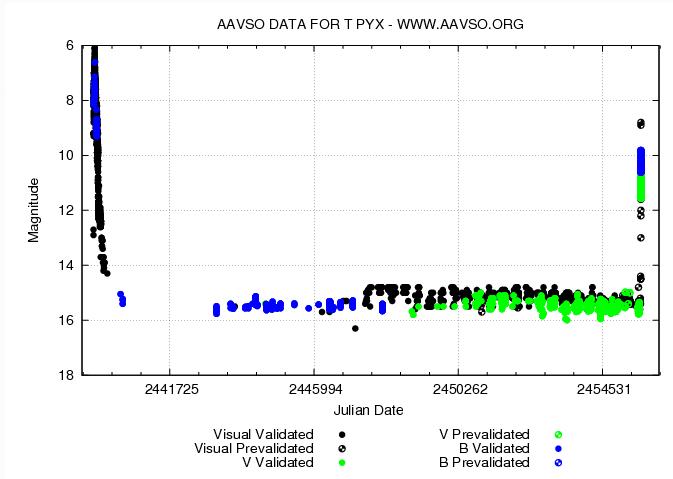
CBET No. 2700 issued on April 15, 2011 reports that the recurrent nova T Pyxidis has been discovered in outburst. It was detected by by Mike Linnolt at visual magnitude 13.0 on 2011 April 14.2931 and the outburst has been visually confirmed by several observers.

This is the first outburst of T Pyx since December 7, 1966 (discovered then by Albert Jones), nearly 45 years ago, when it reached visual magnitude 6.5 from fainter than 15th magnitude; it was brighter than magnitude 8 for two months. Previous outbursts occurred in 1890, 1902, 1920, and 1944. There are only ten known galactic recurrent novae.

Below you can see the five maxima of the recurrent nova T Pyx from 1890 to 1967.


(Credit: AAVSO)


AAVSO Light-Curve for the period 1966 to present.


(Credit: AAVSO)


T Pyxidis is 6,000 light-years away in the dim southern constellation Pyxis, the Mariner's Compass. In September 1997, astronomers released an image of T Pyxidis taken using the Hubble Space Telescope. The Hubble's image shows that the shells of gas around the star that were blown off during several eruptions, are actually more than 2,000 gaseous blobs packed into an area that is 1 light-year across.


(Credits: Mike Shara, Bob Williams, and David Zurek (Space Telescope Science Institute); Roberto Gilmozzi (European Southern Observatory); Dina Prialnik (Tel Aviv University); and NASA)


T Pyx is located at the following coordinates:

RA 09h 04m 41.5s DEC -32 22' 47.4" (2000)


On April 15.41 we have been able to image T Pyx remotely through Gras network from Officer, Australia (MPC Code - E03) using a RCOS 12.5" - FL 1950 @ f/6.3. The object has reached the unfiltered magnitude ~8.5. Click on the image for a bigger version.


Below you can find an animation showing a comparison between our image and the archive DSS plate (R Filter - 1992) - Click on the thumbnail for a bigger version:


Below you can see a a spectrum of T Pyx in its rising phase reported by Arai-san at Koyama Astron. Obs. (Kyoto Sangyo U.) :


Follow-up observations are strongly encouraged!!

by Ernesto Guido & Giovanni Sostero

Friday, January 29, 2010

U Scorpii in Outburst

The recurrent nova U Sco has been discovered in outburst at magnitude V=8.05 on January 28.4385 UT by amateur astronomers B. Harris and shortly after by S. Dvorak (who estimated it at V~8.8). According to the AAVSO website prior to outburst, U Scorpii was measured at V=18.2 on Jan 27.4501 (Harris), and estimated at m(vis) less than 16.5 on January 27.6271 by M. Linnolt.

Novae are binary systems where the companion star feeds matter through an accretion disk to accumulate on a white dwarf. After the eruption, the white dwarf returns to a steady state while the accumulation begins anew so that all novae recur. Each white dwarf will undergo many such eruptions, with the typical timescale between eruptions perhaps as long as 100,000 yr, although a subset of the nova population (called recurrent novae [RNe]) has recurrence timescales from 10 to 100 yr.

U Sco is one of the most famous recurrent novae. In quiescence it usually hovers around magnitude 17.6, but in outburst it briefly shoots up by about 8 or 9 magnitudes. In fact, U Sco is the all-time fastest nova known. Its brightening from minimum to maximum takes only about 5 hours, and its decline to two magnitudes below maximum takes about 38 hours. U Sco's last three eruptions, in 1979, 1987, and 1999, were all discovered by amateur astronomers.

One year ago, Bradley Schaefer predicted that the recurrent nova U Scorpii was due to explode again in April 2009 ± 1.0 year. Schaefer searched the old photographic sky-patrol plates stored at the Harvard College Observatory to discover three more eruptions of U Sco. With these, the pattern of eruption since 1900 has been once every 10 ± 2 years. (Eruptions were likely missed around 1927 and 1957 because Scorpius is hidden in conjunction with the Sun every November and December). Moreover, for his prediction, Schaefer used the system's brightness in quiescence (slightly variable) as a measure of the rate at which matter is falling onto the white dwarf.

Using a remote scope located in Australia, we have been able to image U Sco in outburst on Jan. 28.73:


Below you can see a comparison image showing the field of U Sco imaged by us on April 2009 when it was below the magnitude 17 and the same field imaged few hours ago on January 28, 2010:


On Vsnet mailing list T. Kato reports that Imamura-san (Okayam U. of Sci.) and Fujii-san have obtained spectra of U Sco on January 28.8. Kato comments that P Cyg-type components having a velocity of 4300 km/s for Halpha (Fujii). The lines of He I and N II were strong (also associated with P Cyg-type components). The FWHM of Halpha was 6100 km/s (Imamura).


(Credit: Fujii)

Within an hour of the discovery, U Sco had already be observed by two X-ray satellites (the Rossi X-Ray Timing Observatory and the INTEGRAL satellite). In the following weeks the recurrent nova will be observed by many ground-based telescopes and spaceborne observatories.

These observations will help to answer some questions about the suspected link between RNe and Type Ia SNe. Although it seems that for systems like RS Oph and U Sco, the mass of the White Dwarf (WD) is near the Chandrasekhar limit and increasing, there remain some fundamental questions. For example, what is the type of the WD (if ONe, then no SN explosion will occur); can the Hydrogen in systems with red giant secondaries really be “hidden” at the time of any SN outburst; is the population of (appropriate sub-type) RNe sufficient to explain the observed SN Ia rate? A combination of detailed observations of individual Galactic RNe, coupled with surveys of extragalactic novae, will help to answer these very important points. (Bode, 2009).


By Ernesto Guido & Giovanni Sostero

Tuesday, August 18, 2009

NOVA OPHIUCHI 2009

Cbet No. 1910 issued on 2009, August 17th announces the discovery by Koichi Itagaki of a possible nova (mag 10.0) on his unfiltered CCD survey frames taken on Aug. 16.515 UT using a 0.21-m f/3 reflector.

The nova position:

R.A. = 17h38m19s.68, Decl. = -26d44'14".0 (equinox 2000.0)


An image of the nova (by T. Greiner):


Nova Ophiuchi 2009 has been confirmed spectroscopically by various observers with the BAO 1.01-m telescope on Aug. 17.6 UT, in the course of the BAO Summer School and Japan Space Forum.

U. Munari et al. reports on Cbet No. 1912 that medium-resolution CCD spectrogram (0.06 nm/pixel; range 540-670 nm) was obtained on Aug. 17.83 UT with the 1.22-m telescope of the Asiago Astrophysical Observatory showing a quite-red spectral energy distribution and the very wide profiles of the emission lines.

"The colors, the rapid decline, and the velocity of the ejecta suggest that N Oph 2009 is a highly reddened outburst occourring on a massive white dwarf, not dissimilar from the U-Sco type of recurrent novae. A search in plate archives for missed previous outbursts could pay dividends".

To this end see also this interesting article appeared this morning on Arxiv:


By Ernesto Guido

References:

(subscription required for Cbet)