Friday, July 20, 2012

Close Approach of PHA Asteroid 2012 OQ

M.P.E.C. 2012-O13, issued on 2012 July 19, reports the discovery of the PHA asteroid 2012 OQ (discovery magnitude 16.1) by J75 OAM Observatory, La Sagra on images taken on July 16.9 with a 0.45-m f/2.8 reflector + CCD.

2012 OQ has an approximate size of 120 m - 270 m meters (H=21.7) and it will have a close approach with Earth at about 7.7 LD (Lunar Distances) or 0.0197 AU at 1829 UT of July 24, 2012. At the moment of its close approach this asteroid will reach the magnitude 15.9 while moving at 51"/min.

We performed some follow-up measurements of this object, while it was still on the neocp, remotely from the H06 ITelescope network (near Mayhill, NM) on  2012, Jul. 18.3, through a 0.25-m f/3.4 reflector + CCD.

Our confirmation image, stack of 34x20-second exposures


Below you can see an animation showing the movement of 2012 OQ (each frame is a 20-second exposure). Click on the thumbnail for a bigger version:


by Ernesto Guido, Giovanni Sostero and Nick Howes

Monday, July 16, 2012

Unusual Minor Planet 2012 NJ

MPEC 2012-N19, issued on 2012 July 14, reports the discovery by J75 OAM Observatory, La Sagra with a 0.45-m f/2.8 reflector + CCD of the unusual minor planet 2012 NJ. According to the latest orbital solution available, this object moves along a comet-like orbit with an Inclination of 84.32 deg,  Eccentricity = 0.85, Perihelion distance = 1.29 AU and Period = 24.23 years.

We performed some follow-up measurements of this object, while it was still on the neocp, remotely from the H06 ITelescope network (near Mayhill, NM) on  2012, Jul. 14.3, through a 0.51-m f/6.9 reflector + CCD.  No cometary features are visible in our images, the object has the same aspect of the nearby field stars of similar brightness.

Our confirmation image, stack of 10x10-second exposures (click on it for a bigger version):


Below you can see an animation showing the movement of 2012 NJ (each frame is 10-second exposure). Click on the thumbnail for a bigger version:


On mpml mailing list you can find an interesting discussion about the orbit of this object: 


UPDATE - July 18, 2012

According to Cbet 3178, a 35" tail in p.a. 235 deg has been reported by Gerhard J. Hahn on stacked and single images taken by Stefano Mottola using the 1.23-m telescope on Calar Alto on July 16, 17, and 18 UT. 2012 NJ is now comet P/2012 NJ (LA SAGRA)

Credit: Department of Asteroid and Comet Research, DLR Institute of Planetary Research


by Ernesto Guido, Giovanni Sostero & Nick Howes

Monday, July 9, 2012

NOVA SAGITTARII 2012 No. 4

Cbet 3166, issued on 2012 July 07, reports the discovery by Koichi Nishiyama and Fujio Kabashima (Japan) of a possible nova (mag 7.8) on two 40-s unfiltered CCD frames (limiting magnitude 13.7) taken around July 7.4986 UT using a 105-mm f/4 camera lens (+ SBIG STL6303E camera). The variable was designated PNV J18202726-2744263 when it was posted at the Central Bureau's TOCP webpage.

The nova has been designated NOVA SAGITTARII 2012 No. 4.

We performed some follow-up of this object remotely through the 2.0-m  f/10.0 Ritchey-Chretien + CCD of "Faulkes Telescope South" (MPC Code - E10). On our images taken on July 09.4, 2012 we can confirm the presence of an optical counterpart with R-filtered CCD magnitude 8.7 at coordinates:

R.A. = 18 20 27.20, Decl.= -27 44 26.2

(equinox 2000.0; CMC-14 catalogue reference stars).

Our annotated confirmation image. Click on it for a bigger version:


An animation showing a comparison between our confirmation image and the archive POSS2/UKSTU plate (R Filter - 1996). Click on the thumbnail below:


Spectra obtained by different observers (M. Fujii; K. Imamura; C. Buil) indicate that the variable is a "Fe II"-class nova

Spectrum by K. Imamura (OUS)


by E. Guido, N. Howes, M. Jenkins, J. Hodge & G. Sostero

PHA Asteroid 1999 XL136

M.P.E.C. 2012-N11, issued on 2012 July  9, reports the recovery of the PHA asteroid 1999 XL136 by R. H. McNaught with the 0.5-m Uppsala Schmidt + CCD in the course of the E12 Siding Spring Survey.

1999 XL136 was discovered on December 12, 1999 by LINEAR survey and observed for roughly 1 month (last observation was of January 09, 2000). It was classified as a PHA ((Potentially Hazardous Asteroid). PHA are asteroids larger than approximately 100m that can come closer to Earth than 0.05 AU. None of the known PHAs is on a collision course with our planet, although astronomers are finding new ones all the time.

On July 08, 2012 E12 survey discovered a relatively bright (16.5 magnitude) object and reported it to NEOCP with the provisional designation TN42425. After the arrival of follow-up observations by different observers around the world, MPC has been able to link TN42425 to the Apollo-type asteroid 1999 XL136, so to identify them as the same object.

1999 XL136 has an approximate size of 472 meters (H=19.279) and according to the new calculated orbit it had a close approach with Earth at about 4.49 LD (Lunar Distances) or 0.011 AU at 1914 UT of 23 June 2012. At the moment of its close approach this asteroid reached the magnitude 12.7 and was moving at 134"/min.


We have been able to follow-up this object while it was still on the neocp, using remotely a 0.43-m f/6.8 reflector + CCD of ITelescope network located  in Nerpio (Spain - Mpc code I89).

Below you can see an animation showing the movement of the object in the sky. Click on the thumbnail for a bigger version:


Below there is  the magnitude and ephemeris table calculated by MPC website for 1999 XL136 from the day just before the close approach to its rediscovery on July 08:

Date            UT         Delta     r         El.     Ph.    V
2012 06 22 000000  0.023   0.996   30.0 149.4  19.7  
2012 06 23 000000  0.015   1.007   49.7 129.7  16.1
2012 06 24 000000  0.012   1.018   96.4  83.0   12.9
2012 06 25 000000  0.018   1.029  132.7  46.5  12.7  
2012 06 26 000000  0.027   1.039  146.5  32.6  13.2  
2012 06 27 000000  0.038   1.050  152.4  26.7  13.8
2012 06 28 000000  0.049   1.061  155.3  23.6  14.3   
2012 06 29 000000  0.060   1.072  156.9  21.8  14.7   
2012 06 30 000000  0.071   1.083  157.9  20.7  15.1 
2012 07 01 000000  0.082   1.094  158.4  20.0  15.4
2012 07 02 000000  0.094   1.104  158.7  19.5  15.7 
2012 07 03 000000  0.105   1.115  158.8  19.2  15.9 
2012 07 04 000000  0.117   1.126  158.8  19.1  16.2 
2012 07 05 000000  0.128   1.137  158.7  19.0  16.4 
2012 07 06 000000  0.140   1.148  158.5  19.0  16.6 
2012 07 07 000000  0.151   1.158  158.2  19.0  16.8 
2012 07 08 000000  0.163   1.169  157.8  19.2  17.0

Is it worth to note that despite its bright magnitude from June 23 to July 08, this asteroid has gone unnoticed through its close approach. Below you can see an animation showing the daily Sky Coverage by professional surveys (in red) and the position of the asteroid (yellow dot). Click on the thumbnail:


Please note that the full moon was on July 04 and that the surveys usually are not working 2-3 days before and after the full moon. Moreover this is the North America monsoon period and this affects some surveys productivity.

by Ernesto Guido, Giovanni Sostero and Nick Howes

Wednesday, June 27, 2012

Possible Nova in Sgr - J17522579-2126215

Following the posting on the Central Bureau's Transient Object Confirmation Page about a possible Nova in Sgr (TOCP Designation: J17522579-2126215) we performed some follow-up of this object remotely through the 0.10-m f/5 reflector + CCD of ITelescope network (MPC Code - H06). 

On our images taken on June 27.3, 2012 we can confirm the presence of an optical counterpart with R-filtered CCD magnitude 8.9 at coordinates:

R.A. = 17 52 25.79, Decl.= -21 26 21.6

(equinox 2000.0; CMC-14 catalogue reference stars).


 Our annotated confirmation image. Click on it for a bigger version:


An animation showing a comparison between our confirmation image and the archive POSS2/UKSTU plate (R Filter - 1996). Click on the thumbnail below:


UPDATE - July 08, 2012

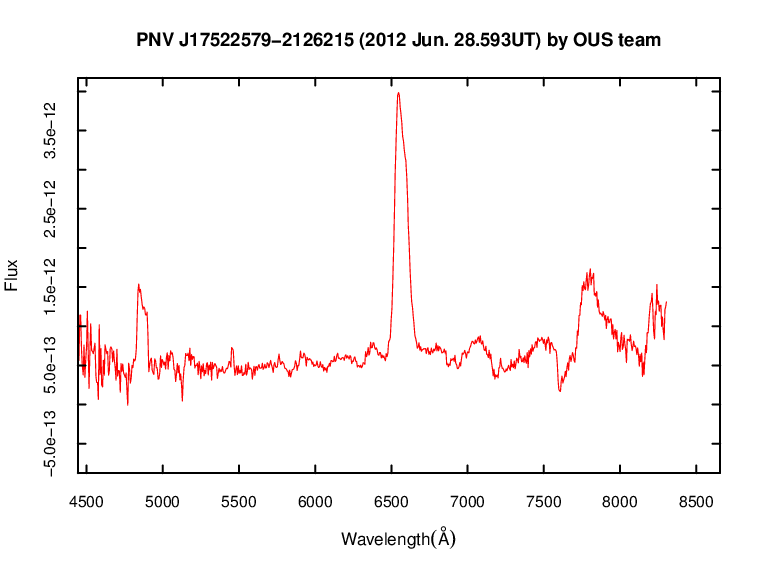
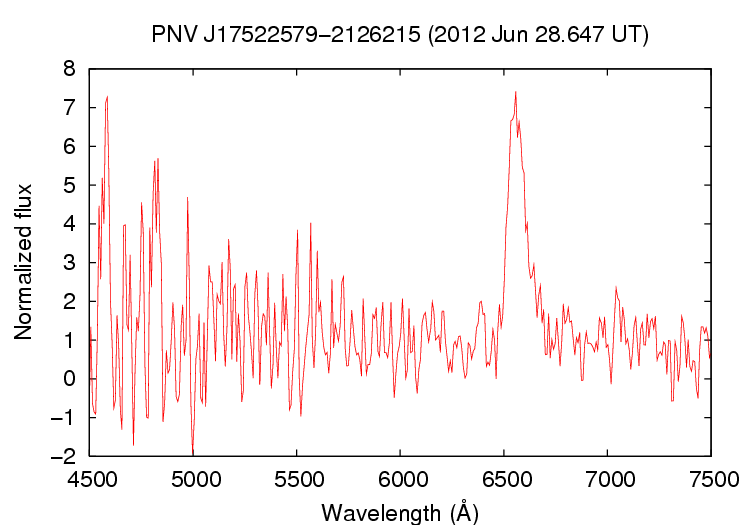
According to Cbet 3156, this variable has been designated NOVA SAGITTARII 2012 No. 3. This nova was discovered by K. Itagaki (Yamagata, Japan) on an unfiltered CCD image taken on June 26.5494 UT with a 0.21-m reflector (mag 10.3). Spectra obtained by different observers (K. Imamura; H. Maehara; C. Buil; U. Munari) suggests that this nova is of theHe/N type, with hydrogen Balmer and He I in strong emission.

Spectrum by K. Imamura (OUS)


by Ernesto Guido, Giovanni Sostero & Nick Howes

Wednesday, June 13, 2012

Bright Near-Earth Asteroid 2012 LZ1

M.P.E.C. 2012-L30  issued on 2012, June 12 announces the discovery of a new Near-Earth object (discovery magnitude 15.1) by R. H. McNaught in the course of the Siding Spring Survey on CCD images taken with the 0.5-m Uppsala Schmidt. This new asteroid has been designated 2012 LZ1.

2012 LZ1 is a large Near-Earth Object (NEO) approximately 300-700 metres in size (H=19.7) and it has been classified as a PHA (Potentially Hazardous Asteroid). PHA are asteroids larger than approximately 100m that can come closer to Earth than 0.05 AU. None of the known PHAs is on a collision course with our planet, although astronomers are finding new ones all the time. 

2012 LZ1 will be at its closest approach with Earth at ~14 lunar-distances (0.036 AU) on June 14, 23:10 UT.

We have been able to follow-up this object from the Haleakala-Faulkes Telescope North on 2012, June 13.5, through a 2.0-m f/10.0 Ritchey-Chretien + CCD.

At the moment of our images from FTN, "2012 LZ1" was moving at about ~33.64 "/min and its magnitude was ~14.2. At the moment of its close approach it will be bright as magnitude ~13.9 and moving at ~38.80 "/min. Anyway, for the following days, it will be bright enough to be imaged by most amateur telescopes. In fact it will drop below magnitude 17 on June 23.

Below you can see a 10-second exposure of  2012 LZ1 obtained with the FTN. The asteroid is slighlty trailed in the image due to its fast speed. Click on it for a bigger version.


Below you can see an animation showing the motion of 2012 LZ1. Each frame is a 10-second exposure through the FTN 2.0-m telescope. Click on the thumbnail to see a bigger version:


UPDATE - July 09, 2012

Using the planetary radar system at Arecibo Observatory, astronomers have determined that asteroid 2012 LZ1 is twice as large as originally estimated based on its brightness, and large enough to have serious global consequences if it were to hit the Earth. However, a new orbit solution also derived from the radar measurements shows that this object does not have any chance of hitting the Earth for at least the next 750 years. Scientists at Arecibo observed the asteroid on June 19, 2012, to measure its orbit more precisely and to determine its size, rotation rate, and shape, and found it to be about 1 kilometer (0.6 miles) in its largest dimension. The new size determination suggests that 2012 LZ1 must be quite dark, reflecting only 2-4% of the light that hits it.


by Nick Howes, Ernesto Guido & Giovanni Sostero

Friday, June 1, 2012

Recovery of comet P/1994 X1

Cbet Circular No. 3132, issued on 2012, May 31, announces the recovery of comet P/1994 X1 = 2012 K7 (McNaught-Russell) by our team; this comet was discovered on 1994, December 12 with the UK Schmidt Telescope at Siding Spring observatory and it was last observed on 1995, April 17.

On 2012, May 29 we started an observing session to recover the periodic comet P/1994 X1. We found an object of magnitude ~19.5 located ~35 arcsec south-west  of the nominal position, along the line of variations (LOV). Stacking of 7 R-filtered exposures, 60-sec each, obtained remotely, from the Haleakala-Faulkes Telescope North on 2012, May 29.6, through a 2.0-m f/10.0  Ritchey-Chretien + CCD, under good seeing conditions, shows that comet P/1994 X1 appears slightly diffuse, with a tiny coma about 3" in diameter, having a total m1 magnitude measured through a Bessel-R filter of about 19.5.

Second night follow-up observations, has been obtained on 2012, May 30.4, under the code H06. Stacking of 8 unfiltered exposures, 180-sec each, obtained on  2012, May 30.4 remotely from the ITelescope network near Mayhill, NM, through a 0.43-m f/6.8 astrograph + CCD + f/4.5 focal reducer, shows that this comet has a nearly stellar appearance.


Below you can find our recovery image of 2012, May 29.6 (click on the image for a bigger version)


Below you can find the recovery image of 2012, May 30.4 (click on the image for a bigger version)


While below you can see a small animation showing the movement of this faint comet on May 30.4 (click on the thumbnail to see the animation):


The indicated correction to the prediction on MPC 79019 is Delta(T) = +0.024 day. The linked orbital elements and an ephemeris by G. V. Williams appear on MPEC 2012-K75.


by Giovanni Sostero, Nick Howes, Erik Bryssinck & Ernesto Guido