Showing posts with label galactic novae. Show all posts

Sunday, June 13, 2021

Bright Nova in Her - NOVA HERCULIS 2021

Following the posting on the Central Bureau's Transient Object Confirmation Page about a possible Nova in Her (TOCP Designation: TCP J18573095+1653396) we performed some follow-up of this object through a TEL 0.32-m f/8.0 reflector + CCD located in Nerpio, Spain and operated by iTelescope network (MPC Code I89).

On images taken on June 13.15, 2021 we can confirm the presence of an optical counterpart with R-filtered CCD magnitude +6.2 at coordinates:

R.A. = 18 57 30.98, Decl.= +16 53 39.6

(equinox 2000.0; Gaia DR2 catalogue reference stars for the astrometry).

This nova has been discovered by  Seiji Ueda, Kushiro, Hokkaido, Japan, at mag 8.4 on three 6-s exposures (limiting mag 13.0) taken with a Canon EOS 6D digital camera (+ 200-mm f/3.2 lens) on June 12.537 UT.

According to ATel #14704, a spectrum obtained by Munari et al. "has an overall blue shape and shows very pronounced broad absorptions (FWHM about 3000 km/s) compatible with P-Cyg components for Halpha, Hbeta and Hgamma blue-shifted by about 3100 km/s [...] Overall, the spectrum could be compatible with a nova of unusual large velocity". 


Our confirmation image (made with TYCHO software by D. Parrott):


An animation showing a comparison between our image and the archive POSS1 plate (1990-08-17):


A wide-field view with the nova at the centre:


UPDATE - June 16, 2021

According to CBET 4977, E. Kazarovets reports that the permanent GCVS designation V1674 Her has been given to this nova


by Ernesto Guido & Adriano Valvasori

Wednesday, April 7, 2021

V6595 SAGITTARII = NOVA SAGITTARII 2021 No. 2

Following the posting on the Central Bureau's Transient Object Confirmation Page about a possible Nova in Sgr (TOCP Designation: PNV J17581670-2914490) we performed some follow-up of this object through a TEL 0.6-m f/6.5 astrograph + CCD located in the El Sauce Observatory in Chile and operated by Telescope Live network (MPC Code X02).

This transient has been discovered by Andrew Pearce at 8.4 mag (unfiltered) on 2021-04-04.825 UT using a Canon 1100D DSLR camera with a 100mm f/2.8 lens.  Total exposure time was 20 seconds (2 x 10s images stacked). Rob McNaught reported non-detection on 2021-04-02.776 UT (unfiltered limiting mag 11.0).

On images taken on April 06.40, 2021 we can confirm the presence of an optical counterpart with B-filtered CCD magnitude +8.955 (R-filtered & V-filtered images were saturated in 5-second exposures) at coordinates:

R.A. = 17 58 16.08, Decl.= -29 14 56.4

(equinox 2000.0; Gaia DR2 catalogue reference stars for the astrometry).


Our confirmation image (click on it for a bigger version):


An animation showing a comparison between my image and the archive POSS1 plate (1996-09-12). Made with TYCHO software by D. Parrott. Click on it for a bigger version.


According to ATel #14513,  K. Taguchi et al. obtained a spectrum of this transient on 2021-04-05.828 UT using the fiber-fed integral field spectrograph mounted on the 3.8-m Seimei telescope at Okayama Observatory of Kyoto University. Their spectrum shows Balmer lines, Fe II lines, and the Na I D line. According to their spectrum and the brightness, they conclude that this object is a classical nova (with a spectrum similar to those of the slow nova V1280 Sco in the early stage).

Below is part of the discovery image by A. Pearce showing the nova. The bright stars to the top right are gamma 1 and 2 Sgr.  South is to the top and east to the right. (Click on it for a bigger version)


Credit: A. Pearce


This nova has been designated N Sgr 2021 No. 2 (with permanent GCVS designation V6595 Sgr).


by Ernesto Guido, Adriano Valvasori, Marco Rocchetto

Friday, July 17, 2020

BRIGHT NOVA RETICULI 2020

Following the posting on the CBET 4811 & 4812 about the NOVA RETICULI 2020 we performed some follow-up of this object through a TEL 0.1-m f/3.6 astrograph + CCD located in the Heaven's Mirror Observatory, Australia (MPC code Q56) and operated by Telescope Live network.

On images taken on July 16.82, 2020 we can confirm the presence of an optical counterpart (with R-filtered magnitude about +4.5; B-filtered magn. +5.6; V-filtered magn. +5.6) at coordinates:

R.A. = 03 58 29.61, Decl.= -54 46 39.8

(equinox 2000.0; Gaia DR2 catalogue reference stars for the astrometry).

This transient was discovered by Robert H. McNaught (Coonabarabran, NSW, Australia) as an apparent 5th-magnitude nova on CCD images obtained on July 15.590 UT with a Canon 6D camera and an 8-mm-f.l. f/2.8 lens (at ISO 800). The position is very close to an object listed as "MGAB-V207" in the AAVSO's VSX online database (which gives position R.A. = 3h58m29s.55, Decl. = -54d46'41".2, equinox J2000.0, which calls it a novalike "VY Scl"-type variable with V magnitude range 15.8-18.0).

Spectroscopy by E. Aydi et al. (ATel #13867) using the High Resolution Spectrograph (HRS) mounted on the 11m Southern African Large Telescope as part of the SALT Large Science Program on Transients shows a spectrum that resembles that of a classical nova, likely after optical peak. Also, R. Kaufman (Bright, VIC, Australia) reports a low-resolution spectrum obtained by him on 2020 Jul. 16.62 UT (with a Canon 800D camera + 200-mm-f.l. f/3.5 lens) indicates the object to be a "Fe II-type" classical nova.

According to ATel #13868 "the positional coincidence of the optical/gamma-ray transient with the previously known VY Scl-type cataclysmic variable (d = 2.7 kpc from Gaia DR2; Bailer-Jones et al. 2018) suggests that the transient is a Galactic nova, which was confirmed with SALT spectroscopy (ATel #13867). It is only the third time that a classical nova eruption is observed in a previously known white dwarf hosting binary after V407 Cyg (ATel #2487) and V392 Per (ATel #11590), which were also detected by Fermi-LAT."

According to Cbet 4812 "the following pre-discovery V magnitudes from all-sky video images taken by M. A. Phillips at the Edward Pigot Seismic Observatory, Coonabarabran, using a ZWO ASI178MC-COOL color CMOS camera and a 1.4-mm-f.l. f/1.8 fish-eye lens: July 6.81, [6.0; 7.79, [5.5; 8.78, 5.4; 11.76, 3.7; 12.8, 3.8; 13.83, 4.0; 14.8, 4.4; 15.8, 4.7.  No variability was seen on single nights.  Further CCD magnitudes reported by McNaught from his images:  June 30.727, [9.8; July 1.763, [9.9; 2.826, [8.8; 15.747, 5.1; 15.785, 5.1; 15.804, 5.1. 

P. Schmeer, Bischmisheim, Germany, reports the following g magnitudes for the nova from the ASAS-SN Sky Patrol:  July 2.183, 16.6; 2.186, 16.3; 4.189, 15.5; 8.173, 6.8.  Schmeer adds that no previous outbursts or eruptions were recorded in ASAS-SN patrol images since 2014 June 18."


Below our confirmation image. Click on the image for a bigger version: 


An animation showing a comparison between my image and the archive POSS2/UKSTU Red plate (1993-12-17). 


by  Ernesto Guido, Marco Rocchetto & Adriano Valvasori

Thursday, October 31, 2019

V659 SCUTI = NOVA SCUTI 2019

Following the posting on the Central Bureau's Transient Object Confirmation Page about a possible Nova in Scutum (TOCP Designation: PNV J18395972-1025415) I performed some follow-up of this object through a TEL 0.6-m f/6.5 astrograph + CCD located in the El Sauce Observatory in Chile and operated by Telescope Live network.  

On images taken on October 31.01, 2019 I can confirm the presence of an optical counterpart with R-filtered CCD magnitude about +8.4 (saturated in a 10-second exposure) at coordinates:

R.A. = 18 39 59.71, Decl.= -10 25 41.9

(equinox 2000.0; Gaia DR2 catalogue reference stars for the astrometry).

This transient was discovered (discovered magnitude 11.5 g-Sloan Filter) by the All-Sky Automated Survey for Supernovae (ASAS-SN) on 2019 Oct. 29 at 01:12UT and reported to Transient Name Server (TNS) on Oct. 29 at 02:07:49 UTC as ASASSN-19aad = AT 2019tpb. According to CBET 4690, several independents discoveries have been reported to the Central Bureau of a nova in Scutum: Koichi Nishiyama (unfiltered magnitude 9.4 on Oct. 29.397), Hideo Nishimura (unfiltered magnitude 9.8 on Oct. 29.421), Shizuo Kaneko (unfiltered magnitude 9.8 on Oct. 29.462) (on AAVSO VSX is reported also Fujio Kabashima as independent discoverer). 

Spectroscopy by S. C. Williams et al. (see ATel #13241) & by  M. Pavana et al. (see ATel #13245) show that AT 2019tpb/ASASSN-19aad is a Galactic nova in the early stages of eruption.

N. Samus writes that the permanent GCVS designation V659 Sct has been assigned to this nova.

Below my confirmation image (sum of two unfiltered 30-sec exposure through a 0.6-m f/6.5 astrograph + CCD; El Sauce Observatory, Chile). Click on the image for a bigger version: 


An animation showing a comparison between my image and the archive POSS1 Blue plate (1951-07-30).


Below the same animation with a larger field of view. At the bottom left of V659 Sct you will notice a star occupying a different position in the new image with respect to the 1951 archive image. This star (Gaia designation DR2 4155146598548456064) is a high proper  motion star. Most stars are so distant that their apparent motion even over hundreds of years is all but negligible to naked eye observers. Some stars have very significant movements compared to the background stars (Click on it for a bigger version:


Below an image that is the difference between the new image and the archive image useful to highlight the "new" objects. There you can easily see the new galactic nova V659 Sct and the  high proper motion star.


by Ernesto Guido

Friday, March 23, 2018

Bright Transient in Carina

Following the posting on the ATel #11454 about the discovery by All Sky Automated Survey for SuperNovae survey (ASAS-SN) of a new transient source, possibly a classical nova, near the Galactic plane in Carina (ASAS-SN Designation: ASASSN-18fv) I performed some follow-up of this object through a 0.43-m f/6.8 astrograph + CCD from MPC Code Q62 (iTelescope Observatory, Siding Spring).

On images taken on March 23.4, 2018 I can confirm the presence of an optical counterpart with R-filtered CCD magnitude +5.7 at coordinates:

R.A. = 10 36 15.42, Decl.= -59 35 53.7

(equinox 2000.0; UCAC-4 catalogue reference stars).

Below you can see my confirmation image (single 20-sec exposure through a 0.43-m f/6.8 astrograph + CCD), click on it for a bigger version:


While below you can see a wide-field color image (90 second exposures) I obtained on March 23.4, 2018 through a Takahashi SKY90 Apochromatic Refractor f5/6 + Color CCD. In the image ASASSN-18fv is visible at the centre of the field together with part of the Carina Nebula (click on it for a bigger version):


This transient was discovered using data from the quadruple 14-cm "Cassius" telescope in CTIO, Chile of ASAS-SN survey on images obtained on UT 2018-03-20.32 at V<10 2018-03-16.32="" also="" asas-sn="" asassn-18fv="" at="" detected="" detection="" no="" on="" possibly="" saturated="" starting="" ut="" v="">17.0) of this object in subtracted images taken on UT 2018-03-15.34 and before by the same survey. No previous outbursts or variability are detected at the position of ASASSN-18fv since ASAS-SN started observing this location in February 2016. 

According to Atel #11467 pre-discovery images have been identified on images obtained by Evryscope-South, an array of 6-cm telescopes continuously monitoring 8000 square degrees of sky at 2-minute cadence from CTIO, Chile. The transient is not detected at UT 2018-03-16.0316 with an upper-limit of 11.9 +/- 0.1 mag (g'). Beginning at UT 2018-03-16.227, they detected a new source at 10.21 +/- 0.05 mag (g'). (click on the images below for a bigger version).

Credit: Evryscope
Credit: Evryscope


An animation showing a comparison between my confirmation image and the archive POSS2/UKSTU Red plate (1991-02-10). Click on it for a bigger version:


Spectroscopy by  P. Luckas (see ATel #11460) seems to indicate that ASASSN-18fv is a classical nova brightening and in the optically thick (Fe curtain) phase. 

But according to L. Izzo et al. (ATel #11468): "The lack of a strong blue continuum, that is however typical of classical nova outburst, and the low expansion velocities suggest a possible different nature for this object. The presence of many narrow absorptions also suggests a similarity with other peculiar explosions, like the luminous red variable V4332 Sgr (Martini et al. 1999), the possible luminous red novae V838 Mon and V1309 Sco (Tylenda et al. 2011, Mason et al. 2010) or the 'helium-flash' explosion observed in the Sakurai object (Duerbeck and Benetti 1996)". Doubts about the nova nature of this object were expressed also by J. Strader et al. (ATel #11456)

So further spectroscopic observations are important to clarify the nature of this very interesting transient.

by Ernesto Guido

Saturday, January 20, 2018

Possible Nova in Circinus

Following the posting on the Central Bureau's Transient Object Confirmation Page about a possible Nova in Circinus (TOCP Designation: PNV J13532700-6725110) I performed some follow-up of this object through a TEL 0.43-m f/6.8 reflector + CCD from MPC Code Q62 (iTelescope Observatory, Siding Spring). 

On images taken on January 20.6, 2018 I can confirm the presence of an optical counterpart with R-filtered CCD magnitude +8.09 & V-filtered CCD magnitude +8.33 at coordinates: 

R.A. = 13 53 27.57, Decl.= -67 25 01.0 

(equinox 2000.0; Gaia DR1 catalogue reference stars for the astrometry).

This transient has been reported to CBAT/TOCP by John Seach, Chatsworth Island, NSW, Australia. Discovery made with a DSLR with 50 mm f/1.2 lens.

Below my confirmation image (single unfiltered 60-sec exposure through a 0.43-m f/6.8 reflector + CCD; MPC Code Q62). Click on the image for a bigger version: 


An animation showing a comparison between the confirmation image and the archive POSS2/UKSTU Red plate (1997-03-31). Click on the animation for a bigger version: 


UPDATE - January 31, 2018

According to CBET 4482 issued on January 30, Spectroscopy by Strader et al., obtained with the 4.1-m Southern Astrophysical Research Telscope (+ Goodman spectrograph) at Cerro Pachon, Chile, on Jan. 21.28 UT shows clear P-Cyg profiles in the Balmer lines, with the absorption troughs located about 1300 km/s blueward of the rest wavelength (emission FWHM about 1500 km/s), and a number of Fe II lines (some of which also have P-Cyg profiles) -- suggestive of a "Fe II"-type nova. See also ATel #11209. While a low-resolution spectroscopic image by S. Kiyota that shows a strong hydrogen emission line is available here.

This nova has been designated NOVA CIRCINI 2018.

by Ernesto Guido

Monday, January 15, 2018

Possible Bright Nova in Musca

Following the posting on the Central Bureau's Transient Object Confirmation Page about a possible Nova in Musca (TOCP Designation: PNV J11261220-6531086) we performed some follow-up of this object through a TEL 0.50-m f/6.8 reflector + CCD + focal reducer from MPC Code Q62 (iTelescope Observatory, Siding Spring).

On images taken on January 15.57, 2018 we can confirm the presence of an optical counterpart with R-filtered CCD magnitude ~6.3 at coordinates:

R.A. = 11 26 14.95, Decl.= -65 31 24.1

(equinox 2000.0; Gaia DR1 catalogue reference stars).


This transient has been reported to CBAT/TOCP by Rob Kaufman, Bright, Victoria, Australia. Discovery image (taken with Canon 650D & 55mm lens) is available here. He also posted a low-resolution spectrum that "shows strong hydrogen emissions as well as FeII lines":

Credit: R. Kaufman

Below you can see our confirmation image (single 30-sec exposure through a 0.43-m f/6.8 reflector + CCD), click on it for a bigger version:


An animation showing a comparison between our confirmation image and the archive POSS2/UKSTU Red plate (1998-03-19). Click on it for a bigger version:


UPDATE - January 16, 2018

According to CBET 4472 this transient could be a classical "Fe II"-type nova and it has been designated NOVA MUSCAE 2018.

by Ernesto Guido & Alfonso Noschese

Tuesday, September 27, 2016

BRIGHT NOVA IN LUPUS - (PNV J15290182-4449409)

Following the posting on ATel #9538 & #9539 and on the Central Bureau's Transient  Object Confirmation Page about a possible bright Nova in Lupus (TOCP Designation:  PNV J15290182-4449409)  discovered in the course of the V-band All-Sky Automated Survey for Supernova (ASAS-SN) on images obtained on Sept. 24.010 UT using the robotic 14-cm telescopes, I performed some follow-up of this object remotely through a 0.32-m f/9 reflector + CCD + f7 focal reducer of iTelescope network (MPC Code  Q62 - Siding spring, Australia).

On my images taken on September 27.4, 2016 I can confirm the presence of an optical counterpart with unfiltered magnitude about 6.5 - 7.0 (rough estimate) at coordinates:

R.A. = 15 29 01.76, Decl.= -44 49 39.7 (equinox 2000.0; UCAC-4 catalogue reference stars).

Below my image of Nova Lupus. Details on the caption. Click on the image for a bigger version.


An animation showing a comparison between my confirmation image and the archive POSS2/UKSTU Red plate (1992-07-30). Click on the thumbnail below for a bigger version:


According to the Cbet 4322 issued on September 27, 2016: "T. Bohlsen (Armidale, NSW, Australia) obtained a noisy spectrogram on Sept. 24 (time unknown) that shows H_alpha emission and also an image that yielded magnitude V = 6.8; he surmised from this that the variable does appear to be a galactic nova."

by Ernesto Guido

Thursday, October 1, 2015

NOVA SAGITTARII 2015 No. 3

Following the posting on the Central Bureau's Transient Object Confirmation Page about a possible Nova in Sgr (TOCP Designation: PNV J18033275-2816054) we performed some follow-up of this object remotely through a 0.43-m f/6.8 astrograph + CCD) of  iTelescope network (MPC Code  Q62 - Siding Spring).

On our images taken on September 28.4, 2015 we can confirm the presence of an optical counterpart with R-CCD magnitude 9.5 at coordinates:

R.A. = 18 03 32.77, Decl.= -28 16 05.3

(equinox 2000.0; UCAC4 catalogue reference stars).

Our annotated confirmation image. Click on it for a bigger version:

An animation showing a comparison between my confirmation image and the archive POSS1 Blue plate (1958-04-18). Click on the thumbnail below for a bigger version:


According to CBET nr. 4145, issued on 2015, September 30, , PNV J18033275-2816054 is now NOVA SAGITTARII 2015 No. 3. This nova has been discovered K. Itagaki (Teppo-cho,Yamagata, Japan) on an unfiltered CCD frame taken on Sept. 27.429 UT using a 180-mm-focal-length camera lens.

A spectrogram (resolution about 500 at H-beta) taken of PNV J18033275-2816054 by M. Fujii (Kurashiki, Okayama, Japan) with a 0.4-m telescope on Sept. 27.487 UT shows Balmer emission lines, with the H-beta line having a P-Cyg profile that indicates an expansion velocity of about 1100 km/s.  Emission lines of Fe II (37), (42), and (49) also have P-Cyg profiles.  The Na D absorption is remarkable. (see image below).

Credit: M. Fujii

by Ernesto Guido

Friday, February 13, 2015

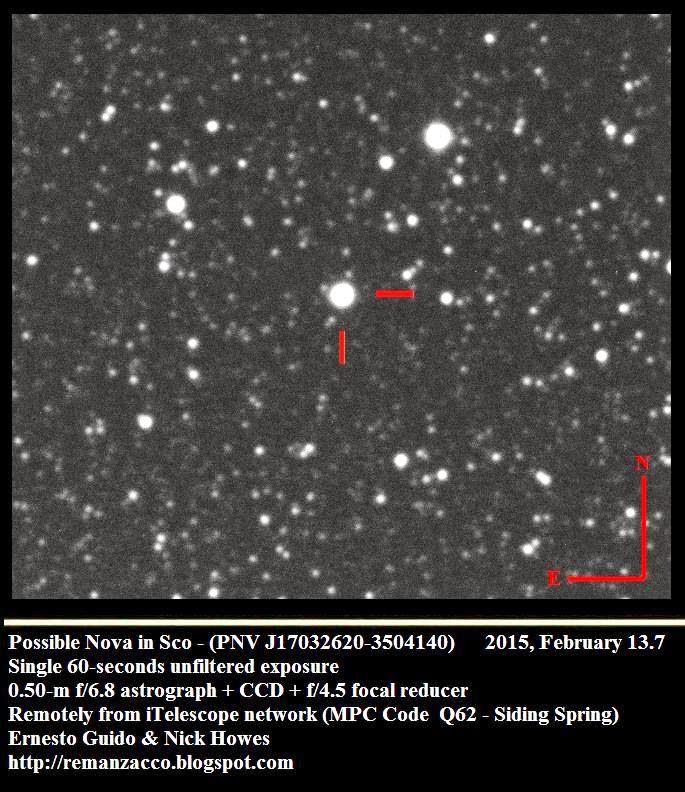
Possible Nova in Sco - (PNV J17032620-3504140)

Following the posting on the Central Bureau's Transient Object Confirmation Page about a possible Nova in Sco (TOCP Designation: PNV J17032620-3504140) we performed some follow-up of this object remotely through a 0.50-m f/6.8 astrograph + CCD + f/4.5 focal reducer) of iTelescope network (MPC Code  Q62 - Siding Spring).

On our images taken on February 13.7, 2015 we can confirm the presence of an optical counterpart with R-CCD magnitude 8.6 at coordinates:

R.A. = 17 03 26.19, Decl.= -35 04 18.1

(equinox 2000.0; UCAC3 catalogue reference stars).

Our annotated confirmation image. Click on it for a bigger version:


An animation showing a comparison between our confirmation image and the archive POSS2/UKSTU plate (R Filter - 1991). Click on the thumbnail below for a bigger version:


by Ernesto Guido & Nick Howes

Tuesday, December 3, 2013

Possible Bright Nova in Centaurus

Following the posting on the Central Bureau's Transient Object Confirmation Page about a possible Nova in Cen (TOCP Designation: PNV J13544700-5909080) we performed some follow-up of this object remotely through the 0.50-m f/6.8 astrograph + CCD + focal reducer of iTelescope network (MPC Code  Q62 - Siding Spring, AU).

On our images taken on December 03.68, 2013 we can confirm the presence of an optical counterpart with unfiltered CCD magnitude  ~5.0 at coordinates:

R.A. = 13 54 45.22, Decl.= -59 09 04.5 (equinox 2000.0; UCAC-3 catalogue reference stars).

According to Vizier the nearest star (located at 1.538 arcsecond from the transient) to this position in the USNO-B1.0 catalogue is:

USNO-B1.0  0308-0442031   (J2000) 13 54 45.374 -59 09 03.52    mag. B2=15.52 R2 =15.12

Our confirmation image (click on it for a bigger version):


Below an animation showing a comparison between our confirmation image and the archive POSS2/UKSTU plate (R Filter - 1999). Click on the thumbnail below for a bigger version. 


UPDATE - December 04, 2013

According to CBET No. 3732, PNV J13544700-5909080 is now NOVA CENTAURI 2013. This nova has been discovered by John Seach (Chatsworth Island, NSW, Australia) in six CCD images obtained with a digital SLR camera (+ 50-mm-f.l. f/1.0 lens; limiting mag 11) taken on Dec. 2.692 UT. Low-resolution spectrograms reported independently by M. Locke and R. Kaufman show strong H_alpha and H_beta emission indicative of a nova.

by Ernesto Guido, Nick Howes & Martino Nicolini

Thursday, August 15, 2013

Possible Bright Nova in Delphinus

Following the posting on the Central Bureau's Transient Object Confirmation Page about a possible Bright Nova in Del (TOCP Designation: PNV J20233073+2046041) we performed some follow-up of this object through a 0.43-m f/6.8 astrograph + CCD from MPC Code I89 (iTelescope network - Nerpio, Spain) and through a 0.25-m f/6.3 Schmidt-Cassegrain + CCD from MPC code C82 (Sorrento, Italy).

On our images taken on August 14.8, 2013 from MPC I89 we can confirm the presence of an optical counterpart with unfiltered CCD magnitude 6.8 at coordinates:

R.A. = 20 23 30.72, Decl.= +20 46 03.4

(equinox 2000.0; UCAC-3 catalogue reference stars).

On our images taken on August 14.8, 2013 from MPC C82 we can confirm the presence of an optical counterpart with unfiltered CCD magnitude 6.9 and R-Filtered magnitude 6.1 at coordinates:

R.A. = 20 23 30.68, Decl.= +20 46 03.7

(equinox 2000.0; CMC-14 catalogue reference stars).

Our confirmation image (click on it for a bigger version): 


An animation showing a comparison between our confirmation image and the archive POSS2/UKSTU plate (R Filter - 1990). Click on the thumbnail for a bigger version:


UPDATE - August 15, 2013
  
According to Cbet No. 3628, PNV J20233073+2046041 is now NOVA DELPHINI 2013. This nova has been discovered by Koichi Itagaki (Teppo-cho, Yamagata, Japan) on an unfiltered CCD frame taken on Aug. 14.584 UT using a 0.18-m reflector.

According to ATel #5279 an optical spectrum of NOVA DELPHINI 2013 was obtained (through patchy cloud) by the FRODOSpec instrument on the 2m robotic Liverpool Telescope on La Palma at 2013 August 14.909. The spectrum contains strong Balmer series emission exhibiting P Cygni profiles with velocities ~2000 km/s. A number of Fe II (also P Cygni profiles) and (weak) He I lines may be present. This object is likely to be a newly erupting classical nova (in the early fireball stage). A grating spectra, obtained by S. N. Shore et Al. on 2013 Aug. 14.87 with the coude spectrograph at the 2 meter Zeiss telescope of the Ondrejov Observatory, shows strong H-alpha emission with a P Cyg profile extending to a maximum radial velocities of -2300 km/s (absorption, EW approx 8.1A) and +2400 km/s (emission, EW \approx 52.9A) with no terminal edge at high negative velocity. The spectrum is typical of a classical nova -- possibly CO type -- in the early (optically thick) fireball stage but with indications of the onset of the recombination event.

UPDATE - August 17, 2013

According to the preliminary light-curve from AAVSO (see image below), NOVA DELPHINI 2013 reached a peak V magnitude ~ 4.3 on August 16.4.

Credit: AAVSO

Some interesting remarks about the nova are included in the ATel #5297 by Munari et Al.:
"Nova Del 2013 seems to have reached maximum brightness on August 16.45 UT at V=4.3 mag. It immediately entered the decline phase and it is declining pretty fast, of the order of 1 mag in a day, qualifying it as a very fast nova if the pace will be maintained on the coming days. Also the rise toward maximum has been real fast, 2 mag in about 1.5 days according to our photometry and AAVSO database. The total outburst amplitude is 12.6 mag in V, adopting V=16.9 mag for the progenitor as given by GSC 2.3.2."


Our image and animation showing the difference in brightness of NOVA DELPHINI 2013 between August 14.83 (V mag. ~6.3)  and August 15.93 (V mag. ~5.1). Images obtained with the same instrumentation and exposures. Click on the image for a bigger version.


Click on the thumbnail for a bigger version of the animation.


Below you can see a spectrum of NOVA DELPHINI 2013 obtained by M. Fulle on August 16 with a f=180mm f/2.8 with Star Analyser 100, 10x10-second exposure at 6400ISO (click on it for a bigger version).

Credit: M. Fulle


While below there is a normalized spectra obtained by Fujii-san on August 15, 2013 (click on it for a bigger version).


Credit: Fujii-san

UPDATE - August 18, 2013

According to Taichi Kato on [vsnet-alert 16230], NOVA DELPHINI 2013 reached a plateau, no fading.
The most recent AAVSO data indicate that the nova stopped fading (or even slightly brightened), and currently stays slightly above mag 5.0.  This behavior is consistent with Fujii-san's spectrum, which showed features of a premaximum nova. This nova is not a very fast nova as reported in ATEL 5297 (Munari et al.).

by Ernesto Guido, Nello Ruocco and Nick Howes

Monday, June 3, 2013

Possible Nova in Sco - PNV J17335943-3606216

Following the posting on the Central Bureau's Transient Object Confirmation Page about a possible Nova in Sco (TOCP Designation: PNV J17335943-3606216) we performed some follow-up of this object remotely through the 0.50-m f/6.8 astrograph + CCD + f/4.5 focal reducer of iTelescope network (MPC Code  Q62 - Siding Spring, AU).

On our images taken on June 03.7, 2013 we can confirm the presence of an optical counterpart with unfiltered CCD magnitude 11.5 at coordinates:

R.A. = 17 33 59.44, Decl.= -36 06 20.7

(equinox 2000.0; UCAC-3 catalogue reference stars).

Our annotated confirmation image (click on it for a bigger version). North is up, East is to the left:

 
An animation showing a comparison between our confirmation image and the archive POSS2/UKSTU plate (R Filter - 1996). Click on the thumbnail for a bigger version:


UPDATE - June 04, 2013

According to Cbet No. 3542, PNV J17335943-3606216 is now NOVA SCORPII 2013. This nova has been discovered by Koichi Nishiyama and Fujio Kabashima (Japan) on two 40-s unfiltered CCD frames (limiting magnitude 13.5) taken around June 3.6146 UT using a 105-mm f/4 camera lens (+ SBIG STL6303E camera). Spectra obtained by C. Buil (the spectrum shows a very reddened object, with an intense H-alpha emission line - equivalent width 2.9 nm; FWHM = 1200 km/s ), and independently by T. Bohlsen indicate a probable nova.

Credit: C. Buil, Castanet, France

by Ernesto Guido & Nick Howes

Saturday, February 2, 2013

Possible Nova in Cepheus

Following the posting on the Central Bureau's Transient Object Confirmation Page about a possible Nova in Cep (TOCP Designation: PNV J23080471+6046521) we performed some follow-up of this object remotely through the 0.43-m f/6.8 reflector + CCD of ITelescope network (MPC Code  I89 - Nerpio, Spain). 

On our images taken on February 02.8, 2013 we can confirm the presence of an optical counterpart with unfiltered CCD magnitude 9.8 at coordinates:

R.A. = 23 08 04.70, Decl.= +60 46 52.0

(equinox 2000.0; USNO-B1.0 catalogue reference stars).

Our annotated confirmation image (click on it for a bigger version):


An animation showing a comparison between our confirmation image and the archive POSS2/UKSTU plate (R Filter - 1991). Click on the thumbnail for a bigger version:


Kazuyoshi Imamura (Okayama Univ. of Sci. team, JAPAN) reports on vsnet-alert mailing list that they "succeeded in obtaining a low-resolution spectrum (R~400) of the PNV J23080471+6046521 (in Cep) on February 2.526 UT at the OUS (Okayama Univ. of Sci.) observatory......From our result, this object is thought to be a classical nova (Fe II class)"

Credit: K. Imamura (Okayama Univ. of Sci. team, JAPAN)

UPDATE - February 03, 2013

According to Cbet No. 3397, PNV J23080471+6046521 is now NOVA CEPHEI 2013. This nova has been discovered by Koichi Nishiyama and Fujio Kabashima (Japan) on two 40-s unfiltered CCD frames (limiting magnitude 13.5) taken around Feb. 2.4119 UT using a 105-mm f/4 camera lens (+ SBIG STL6303E camera). Spectra confirming the nature of the nova have been obtained by K. Imamura (see above) and M. Fujii (Bisei Astronomical Observatory).

Ernesto Guido & Nick Howes

Monday, April 9, 2012

Another Possible Nova in Cen

Following the posting on the Central Bureau's Transient Object Confirmation Page about a possible Nova in Cen (TOCP Designation: J14250600-5845360) we performed some follow-up of this object remotely through the 2.0-m  f/10.0 Ritchey-Chretien + CCD of "Faulkes Telescope South" (MPC Code - E10).

On our images taken on April 09.5, 2012 we can confirm the presence of an optical counterpart with Bessell-R CCD magnitude 8.7 at coordinates:

R.A. = 14 25 04.45, Decl.= -58 45 34.3

(equinox 2000.0; UCAC-2 catalogue reference stars).

According to VIZIER there is a 15.319 J-magnitude star at 2.6 arcseconds from the transient position (NOMAD1 0312-0489482). 


Our confirmation image (click on it for a bigger version):


An animation showing a comparison between our confirmation image and the archive POSS2/UKSTU plate (R Filter - 1997). Click on the thumbnail below for a bigger version:


UPDATE - January 30, 2018

Apparently, while this object has been confirmed as a nova on spectra taken by T. Bohlsen, no permanent designation by GCVS has been assigned to this transient. See also here & here


by Ernesto Guido, Nick Howes & Giovanni Sostero

Tuesday, March 27, 2012

Possible Nova in Ophiuchus

Following the posting on the Central Bureau's Transient Object Confirmation Page about a possible Nova in Oph (TOCP Designation: PNV J17260708-2551454) we performed some follow-up of this object remotely through the 0.10-m f/5 reflector + CCD from MPC code H06 (Mayhill station, NM) of iTelescope network.

On our images taken on 2012, March 27.5 we can confirm the presence of an optical counterpart with unfiltered CCD magnitude 10.9 at coordinates:

R.A. = 17 26 07.02, Decl.= -25 51 42.1

(equinox 2000.0; USNO-B1.0 catalogue reference stars).


Our confirmation image:


While below you can see an animation showing a comparison between our confirmation image and the archive POSS2/UKSTU plate (R Filter - 1997). Click on the thumbnail for a bigger version:


UPDATE - MARCH 29, 2012

According to Cbet 3072 issued on March 28, observers at Koyama Astronomical Observatory (KAO) and at Okayama University of Science (OUS) have obtained a spectra of this variable star. An H-alpha emission line can be seen in the spectrum. H_beta, Fe II, and O I 777.4-nm are also visible. These features suggest that the object is an "Fe II-type" classical nova. This nova, designated NOVA OPHIUCHI 2012, has been discovered by Hideo Nishimura (Miyawaki, Kakegawa, Shizuoka-ken) on three 13-s frames (limiting mag 13.5) taken on Mar. 25.789 UT with a Canon 200-mm f/3.2 lens and a Canon EOS 5D Digital Camera mounted on a Takahashi EM100 equatorial telescope at Gomyo, Kakegawa, Japan.

by Ernesto Guido, Giovanni Sostero & Nick Howes

Monday, April 26, 2010

Possible Nova in Scorpius

CBET circular No. 2262, issued on April 26, 2010, announces the discovery by K. Nishiyama & F. Kabashima (Japan) of another possible nova (mag 8.6) on two 40-s unfiltered CCD frames (limiting magnitude 13.1) taken around Apr. 25.788 UT using a 105-mm f/4 camera lens (+ SBIG STL6303E camera). The same CBET reports indipendent discovery by H. Nishimura & T. Kojima.

We performed some follow-up of this object remotely through a 0.25-m, f/3,4 reflector + CCD, from GRAS Observatory (near Mayhill, NM).

On our images taken on April 26.4, 2010 we can confirm the presence of an optical counterpart with unfiltered CCD magnitude about 8.2 (UCAC2 Catalogue reference stars) at coordinates:


R.A. = 16 55 13.17, Decl.= -38 03 47.8

(equinox 2000.0; UCAC2 catalogue reference stars).

Our confirmation image:


This is an animation showing a comparison between our image and the archive DSS plate (R Filter - 1995). Click on it for a bigger version.


UPDATE - MAY 06, 2010

According to IAUC circular No. 9142, a low-dispersion spectrum (range 420-850 nm, resolution about 500) of this object, taken by K. Kinugasa, H. Takahashi, and O. Hashimoto on Apr. 29.745 UT with the GAO 1.5-m telescope (+ GLOWS), shows broad (FWHM about 4000 km/s) Balmer and O I (777.4-, 822.7-, and 844.6-nm) emission lines. The features indicate that the object is a He/N nova in a declining phase.

The permanent GCVS designation V1311 Sco has been assigned to this nova.

V1311 SCORPII = NOVA SCORPII 2010 No. 2

by Ernesto Guido and Giovanni Sostero