Cbet nr. 3439, issued on 2013, March 14, announces the discovery of a new comet (discovery magnitude ~14) by Masayuki Iwamoto (Awa, Tokushima-ken, Japan) on three 60-s CCD frames taken on March 10.8 & 11.8 with a Pentax 100-mm f/4 lens and a Canon EOS 5D digital camera. The new comet has been designated C/2013 E2 (IWAMOTO).
We performed follow-up measurements of this object remotely, from the iTelescope network (Siding Spring - MPC code Q62) on 2013, March. 14.8, through a 0.50-m f/6.8 astrograph + CCD + f/4.5 focal reducer.
Below you can see our image, stack of 5x20-second exposures obtained at the twilight (few minutes before the sunrise) with the Sun only 10 degree below the horizon and the comet +27 degree above the horizon (click on the image for a bigger version).
Below you can see a short animation (composed of 5x20-seconds exposures and spanning 5 minutes) showing the movement of the comet. Click on it for a bigger version.
M.P.E.C. 2013-E67 assigns the following preliminary parabolic orbital elements to comet C/2013 E2: T 2013 Mar. 5.5; e= 1.0; Peri. = 92.93; q = 1.39; Incl.= 21.90.
UPDATE - March 15, 2013
Our new image of cometC/2013 E2 (IWAMOTO) obtained remotely from iTelescope Observatory in New Mexico (MPC code H06) on March 15.5. Click on the image below for a bigger version.
The discovery of comet C/2013 A1 (SIDING SPRING) was announced on Cbet nr. 3368 & M.P.E.C. 2013-A14, issued on 2013, January 05. The comet was discovered on CCD images obtained by notable Australian observer R. H. McNaught with the 0.5-m Uppsala Schmidt telescope a few days earlier on Jan. 03 (with a discovery magnitude 18.6). Precovery images of the comet *(images taken but not known/recorded of the comet) by the Catalina Sky Survey from 8 December 2012 and Pan-STARRS from 4 October 2012 were subsequently found and then used in an attempt to determine the orbit.
It has been noted that C/2013 A1 will have a very close approach with planet Mars on October 19, 2014. With an observation arc thus far of 148 days, JPL/NASA give a nominal closest approach of ~0.0003578 A.U. which is around 53,500 km on 2014 Oct. 19 at approximately 19:28UT +/- 1:03. The comet will pass Mars at a relative velocity of 56 km/s. Early estimates for the diameter of the nucleus have varied from 5 up to 50 km.
Due to the uncertainty within the orbital calculations, there is also a very small possibility that the comet may impact Mars (~ from 0.1% to 0.01% according to how you handle the observations thus far. See here for more info about this).
By comparison below you can find a table of the the closest known approaches to the Earth by comets published on Minor Planet Center website. This list is intended to be complete for comets discovered after 1700
that approached the earth to within 0.1020 AU. It also includes a number
of well-documented earlier approaches by periodic comets. C/1491 B1
allegedly came to within 0.0094 AU on 1491 Feb. 20.0 TT, but the orbit
of this comet is very uncertain.
The plots below made by Aldo Vitagliano with his software Solex through a MonteCarlo generation of clones, "shows a picture of the current prediction taken about half an hour before the possible impact. The generation of clones was made assuming equal weights on all observations (one discarded) and an esd of. 0.5 arcsecs. In total, 2000 clones are represented.......The blue dot represents the "old" nominal solution. The white dot is the new nominal solution and the magenta dot is an impactor. One grid square is 100,000 km and the XY axes are in the plane of the Mars' orbit." (click on the image below for a bigger version)
In the second plot the plane is rotated by 90°, so the axes are now X and Z (Z perpendicular to the Mars' orbital plane). The origin is not longer fixed on Mars, but is fixed on the nominal solution, and the plot shows how Mars moves with respect to the cloud. (click on the image below for a bigger version)
Below you can see an image of comet C/2013 A1 (single 80-second exposure. Click on the image for a bigger version). Our team will be closely monitoring this comet and feeding our observations to the minor planet centre to hopefully assist in resolving the orbit, and helping determine whether or not this comet will impact Mars.
A plot published on NASA/JPL website shows how comet C/2013 A1 will appear as seen from Mars. The "best observing" occurs when the comet's total brightness is at least magnitude 12 and its elongation from the Sun is 30° or larger. "During the close Mars approach, the comet will likely achieve a total visual magnitude of zero or brighter as seen from Mars-based assets. The attached illustration shows the comet's approximate, apparent visual magnitude and its solar elongation angle as a function of time as seen from Mars. Because the comet's apparent magnitude is so uncertain, the brightness curve was cut off at apparent visual magnitude zero. However, the comet may get brighter than magnitude zero as seen from Mars. From Earth, the comet will not likely reach naked eye brightness but it could brighten to visual magnitude 8 as seen from the southern hemisphere in mid-September 2014.""Our current estimate for the impact probability is less than one in six hundred and we expect that future observations will allow us to completely rule out a Mars impact." (click on the plot below for a bigger version).
Credit: Jon Giorgini / NASA / JPL
According to the S&T article (see link above in the post):
Three craft are circling the Red Planet right now (Mars Reconnaissance Orbiter, Mars Odyssey, and ESA's Mars Express), and both Curiosity and Opportunity are roving its surface. Potentially any of them might be commanded to take some comet pictures.
"For example, one of Curiosity's Mast Cameras has a 100-mm focal length and color capability. If the comet performs as expected, says Michael Ravine of Malin Space Science Systems, which built the cameras, some imaging will definitely be planned".
UPDATE - March 07, 2013
In the attempt to extende the observational arc of comet C/2013 A1, we perfomed some follow-up remotely from the Faulkes Telescope South (mpc code E10) on 2013, March 07.5 through a 2.0-m f/10.0 Ritchey-Chretien + CCD. Below you can see our image, stack of 11x80-seconds R-Filtered exposures. The galaxy just below the comet in the image is PGC177709. Click on it for a bigger version.
Below you can see an animation (spanning 25 minutes and composed of 11 exposures, 80 seconds each) showing the movement of comet C/2013 A1. Click on the thumbnail below for a bigger version.
Images of taken in collaboration with the Faulkes Project and Horbury Academy. Faulkes Telescope is operated by Las Cumbres Observatory Global Telescope Network.
UPDATE - March 10, 2013
The MPC recently issued a new batch of comet astrometry (included our Faulkes South observations, see previous update) , and JPL/NASA has just updated their forecast of the upcoming close approach. Now the nominal closest approach is of ~0.0007357 A.U. which is around 110,060 km on 2014 Oct. 19 at approximately 18:50UT +/- 00:57. Probability of impact is now of 1 in 2300.
UPDATE - March 26, 2013
After the latest observations, the probability of impact according to JPL is of 1 in 10000.Aldo Vitagliano, author of the software Solex, created a video showing how the comet should miss Mars. In the video Mars is the red disk at the center of the video. The line-of-sight is in the plane of Mars' orbit, and the vertical axis of the plot is perpendicular to the Mars' orbital plane. The movie shows 2000 MonteCarlo clones of the comet, created assuming a standard error of 0.5 arcsecs for the observations. The (retrograd) cloud comes from below the orbital plane and crosses it before Mars arrives. See the video below.
While assuming a standard error of 1 arcsecs for the observations, this results in a more "expanded" cloud of possible comets, and gives a small residual impact probability. See second video below.
UPDATE - October 24, 2014
Please click here for a selection of some of the most significant results and images obtained from the observation of this flyby on 2014, October 19.
M.P.E.C. 2013-E14, issued on 2013 March 04, reports the discovery of the asteroid 2013 ET (discovery magnitude 16.9) by Catalina Sky Survey (mpc code 703) on images taken on March 03.3 with a 0.68-m Schmidt + CCD.
2013 ET has an estimated size of 64 m - 140 m (based on the object's absolute magnitude H=23.1) and it will have a close approach with Earth at about 2.54 LD (Lunar Distances = ~384,000 kilometers) or 0.0065 AU (1 AU = ~150 million kilometers) at 1207 UT on March 09 2013. This asteroid will reach the peak magnitude ~15.0 on the first hours of March 09.
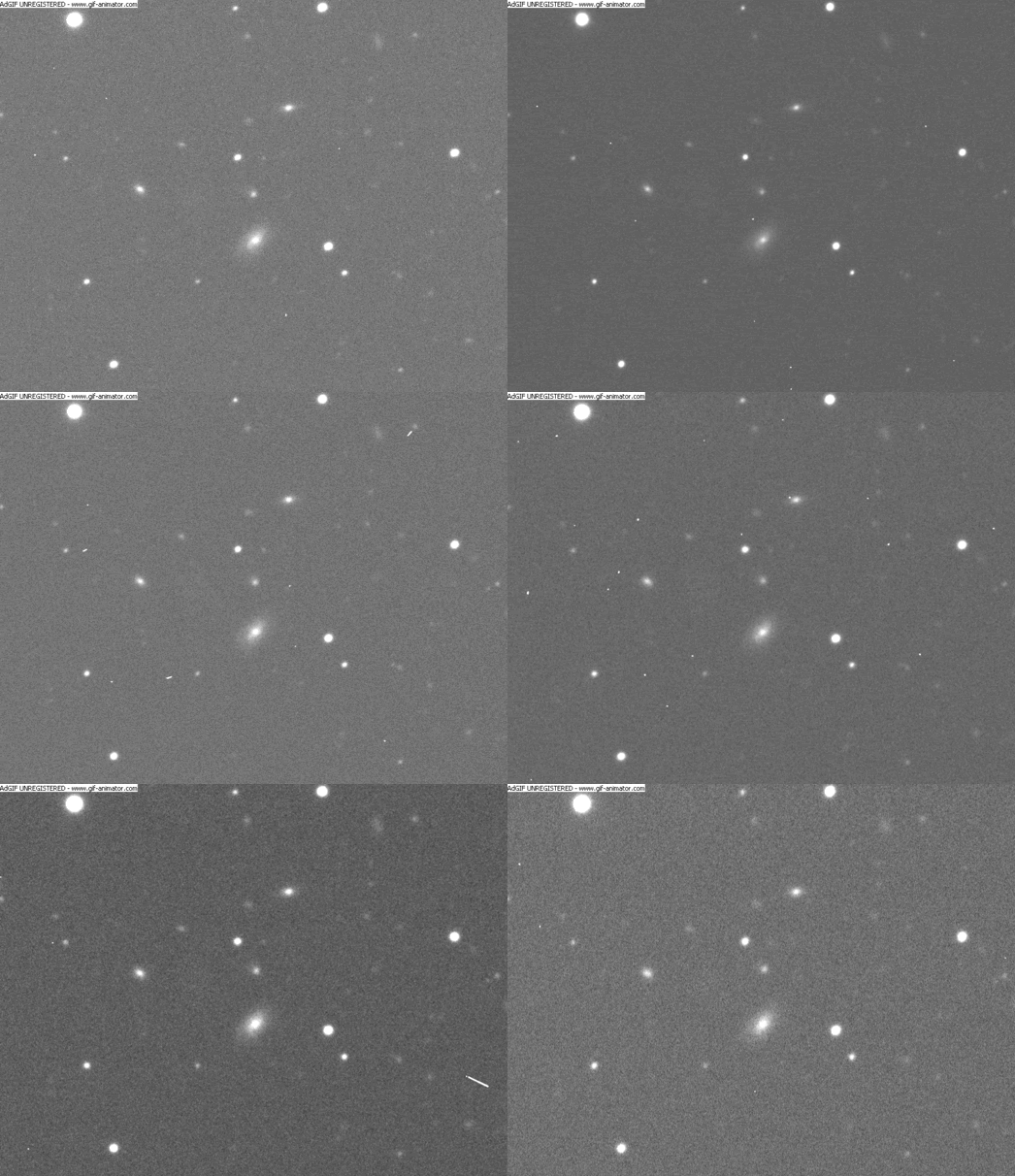
We performed some follow-up measurements of this object on 2013, March 04.4, while it was still on the neocp, remotely from the Haleakala-Faulkes Telescope North, through a 2.0-m f/10.0 Ritchey-Chretien + CCD (Faulkes Telescope is operated by Las Cumbres Observatory Global Telescope Network). Below you can see our image, stack of 5X10-second exposures, taken with the asteroid at magnitude ~16.9 and moving at ~6.15"/min. At the moment of the close approach 2013 ET will move at ~ 153"/min. Click on the image below to see a bigger version. North is up, East is to the left.
Below you can see a short animation showing the movement of 2013 ET (three consecutive stacks of 5X10-second exposures each). North is up, East is to the left. Click on the thumbnail for a bigger version:
UPDATE - March 10, 2013
Due to its close approach, 2013 ET was a strong radar target at Goldstone. On a message on mpml, JPL Radar Team confirmed they were able to detect radar echoes from 2013 ET at Goldstone on March 07.
"The radar signal-to-noise ratios were stronger than expected and we obtained images with a range resolution as fine as 7.5 meters/pixel, but even so, the images barely resolve the object into a few range rows because 2013 ET is so small. The Doppler broadening (aka the bandwidth) of the echoes varies as the asteroid spins, so clearly it's somewhat elongated, and there are hints of irregularity in the shape in the images. We're planning to release some images after the track on March 10 when we should see more detail if things go well."
UPDATE - March 19, 2013
As announced on the previous update of this post, asteroid 2013 ET was successfully targeted by the 70-meter Deep Space Network antenna at Goldstone, Calif. A sequence of radar images was obtained on March 10, 2013 by NASA scientists when the asteroid was about 1.1 million kilometers from Earth, which is 2.9 lunar distances.
"The radar imagery suggests the irregularly shaped object is at least 130 feet (40 meters) wide. The 18 radar images were taken over a span of 1.3 hours. During that interval, the asteroid completed only a fraction of one rotation, suggesting that it rotates once every few hours."
Asteroid 2012 DA14 had a close approach with Earth at 1925 UT on 2013 Feb. 15. at about 0.09 LD (Lunar Distances = ~384,000 kilometers) or 0.0002 AU (1 AU = ~150 million kilometers). For more info about this asteroid and its close approach see our previous post.
Below you can find a selection (in chronological order) of our images & animations taken before, during and after the close approach.
Image of 2012 DA14 taken remotely from Australia on February 15, 2013 at 17:40UT. Exposure time 5 seconds with a 0.50-m f/6.8 astrograph + CCD + f/4.5 focal reducer from Q62 (iTelescope Observatory, Siding Spring). The asteroid was then of magnitude ~9.5 and moving at ~1140 "/min and less than 2 hours before its close approach of 19:25UT. Click on the image for a bigger version.
Below you can see a short animation made by using 3x5-second exposures. Click on the thumbnail for a bigger version.
Image taken remotely from Australia on February 15, 2013 at 18:45UT, just 40 minutes before the close approach. Exposure time 60 seconds with a 0.1m f/5.0 Astrograph + CCD from Q62 (iTelescope Observatory, Siding Spring). The asteroid was then of magnitude ~7.6 and moving at ~2665 "/min.
Credit: E. Guido & N. Howes
Image taken from Remanzacco Observatory in Italy (mpc code 473) on February 15, 2013 at 20:54UT. Exposure time 20 seconds. The asteroid was then of magnitude ~8.2 and moving at ~1513 "/min. Observers L. Donato; D. Lasaponara; G. Pasqualin; V. Santini; M. Travagini.
Credit: L. Donato; D. Lasaponara; G. Pasqualin; V. Santini; M. Travagini
Image taken remotely from Spain on February 15, 2013 at 22:31UT, 3 hours after the close approach. Exposure time 60 seconds with a 0.15-m f/7.3 refractor + CCD from I89 (iTelescope Observatory, Nerpio, Spain). The asteroid was then of magnitude ~9.9 and moving at ~525 "/min. Click on the image for a bigger version.
Credit: E. Guido & N. Howes
Below you can see a short animation made by using 2x60-second exposures. Click on the thumbnail for a bigger version.
Image taken remotely from New Mexico on February 16, 2013 at 11:47UT, roughly 16 hours after the close approach. Exposure time 10 seconds with a 0.50-m f/6.8 astrograph + CCD + f/4.5 focal reducer from H06 (iTelescope Observatory, New Mexico). The asteroid was then of magnitude ~9.9 and moving at ~525 "/min. Click on the image for a bigger version.
Credit: E. Guido & N. Howes
Below you can see a short animation made by using 14x10-second exposures. Click on the thumbnail for a bigger version.
2012 DA14 has an estimated size of 40 m - 90 m (based on the object's absolute magnitude H=24.09) and it will have a close approach with Earth at about 0.09 LD (Lunar Distances = ~384,000 kilometers) or 0.0002 AU (1 AU = ~150 million kilometers) at 1925 UT on 2013 Feb. 15.
2012 DA14 will pass only ~ 27,700 km (17,200 mi) above the Earth's surface, that is only 0.09 lunar distances or 5.4 Earth radii from the center of the Earth. So close that it will pass inside the ring of geosynchronous weather and communications satellites (located about 35,800 kilometers (22,200 miles) above the equator, but still well above the vast majority of satellites, including the International Space Station). Due to the extremely close approach, this object will be a very strong radar target at Goldstone where observations are scheduled on 2013 Feb. 16, 18, 19, and 20. Radar images should provide constraints on the size, shape, and rotation state of the object.
Credit: NASA/JPL Near-Earth Object Program Office
This asteroid will reach the peak magnitude ~7 on February 15 around 1930 UT and it will be brighter than 9th magnitude for approximately 3 hours (18h00-21h30 UTC). At the moment of the close approach 2012 DA14 will move at ~ 2800"/min (slightly less that 1 degree per minute). This means it will need only 40 seconds to move the apparent diameter of the Moon. While it will be too faint to be seen with the naked eye, 2012 DA14 will be easily visible with a good set of binoculars or a small telescope. It will rise above the horizon in the constellation Virgo, after that it will move in the direction of the north celestial pole, reaching about 10th magnitude approximately two hours later in the Little Dipper. In the morning hours of February 16, it will have crossed half of the sky, moving slowly close to the Pole Star at a magnitude of 13.
Below you can see an animation (10-minute steps) showing the path of 2012 DA14 from 21:00 UT of Feb. 15 to 02:00 UT of Feb. 16 (calculated for Rome, Italy). Next to the asteroid designation, you can see the expected magnitude value. Click on the animation for a bigger version.
The animated gif below made by Geert Barentsen indicate (green areas) parts of the world where the asteroid will be above (and the Sun below) the horizon during the period of its maximum brigthness (18h00-21h30 UTC of Feb. 15). Observers in Australia, Asia and Europe will be best placed. Click on the animation for a bigger version.
While there is no cause for concern ( 2012 DA14 will NOT impact Earth), this is one of the closest approaches recorded and the record close approach for a known object of this size. The table below shows the top 20 closest approaches by NEOs (Near-Earth Objects) sorted by nominal distance (click on the image for a bigger version).
Credit: NASA/JPL
While the table below shows the top 20 closest approaches by NEOs (Near-Earth Objects) sorted by nominal distance + absolute magnitude H < =26. (click on the image for a bigger version).
Credit: NASA/JPL
According to JPL website"on average, we expect an object of this size to get this close to the Earth about once every 40 years. An actual Earth collision by an object of this size would be expected much less frequently, about once every 1200 years on average".
We plan to image 2012 DA14 during its close approach so stay tuned!
UPDATE - February 14, 2013
Below you can see a short animation showing the motion of asteroid 2012 DA14 on Feb. 14, 2013 at around 11:06UT. The asteroid was moving at ~1.15 "/min and its magnitude was ~17. The animation has been assembled using 3 images taken with Faulkes Telescope South 2.0-m f/10.0 Ritchey-Chretien + CCD operated by Las Cumbres Observatory Global Telescope Network by E. Gomez. Animation by Remanzacco Observatory.Click here or on the animation for a bigger version.
(Credit LCOGT/Faulkes)
UPDATE - February 15, 2013 - 11:00UT
Apparently, at about 09:30 local time, a very big meteor burned up over Chelyabinsk, a city in Russia just east of the Ural mountains, and about 1500 kilometers east of Moscow. A pretty big sonic boom from the fireball, which set off car alarms and shattered windows. There are reports of many people injured (by shattered glass blown out by the shock wave).
According to ESA expertsthere is NO link between Russia event & asteroid 2012 DA14 close approach.
Here you can see preliminary calculations showing how the 2 events are unrelated.
UPDATE - February 15, 2013 - 20:00UT
We have been able to image 2012 DA14 remotely from Australia on February 15, 2013 at 17:40UT. Exposure time 5 seconds with a 0.50-m f/6.8 astrograph + CCD + f/4.5 focal reducer from Q62 (iTelescope Observatory, Siding Spring). The asteroid was then of magnitude ~9.5 and moving at ~1140 "/min and less than 2 hours before its close approach of 19:25UT. Click on the image for a bigger version.
Credit: E. Guido & N. Howes
Below you can see a short animation made by using 3x5-second exposures. Click on the thumbnail for a bigger version.
UPDATE - February 15, 2013 - 22:00UT
New image we have obtained remotely from Australiaon February 15, 2013 at 18:45UT, just 40 minutes before the close approach. Exposure time 60 seconds with a 0.1m f/5.0 Astrograph + CCD from Q62 (iTelescope
Observatory, Siding Spring). The asteroid was then of magnitude ~7.6
and moving at ~2665 "/min.
Credit: E. Guido & N. Howes
UPDATE - February 16, 2013 - 13:00UT
You can find here a selection (in chronological order) of our images & animations taken before, during and after the close approach.
UPDATE - February 19, 2013 - 19:00UT
An initial sequence of radar images of asteroid 2012 DA14 was obtained on the night of Feb. 15/16, 2013, by NASA scientists using the 230-foot (70-meter) Deep Space Network antenna at Goldstone, Calif. Each of the 72 frames required 320 seconds of data collection by the Goldstone radar.
The observations were made as the asteroid was moving away from Earth.
The asteroid's distance from the radar dish increased from 74,000 miles
(120,000 kilometers) to 195,000 miles (314,000 kilometers). The
resolution is 13 feet (four meters) per pixel. The images span close to
eight hours and clearly show an elongated object undergoing roughly one
full rotation.
M.P.E.C. 2013-C24, issued on 2013 Feb. 6, reports the discovery of the asteroid 2013 CL22 (discovery magnitude 16.7) by J75 OAM Observatory, La Sagra on images taken on February 05.06 with a 0.45-m f/2.8 reflector + CCD.
2013 CL22 has an estimated size of 30 m - 68 m (based on the object's absolute magnitude H=24.7) and it had a close approach with Earth at about 1.2 LD (Lunar Distances = ~384,000 kilometers) or 0.0031 AU (1 AU = ~150 million kilometers) at 0743 UT on 2013 Feb. 02. This asteroid reached the peak magnitude ~13.1 on February 02 around 1600 UT.
We performed some follow-up measurements of this object, from the H06 ITelescope network (near Mayhill, NM) on 2013, Feb. 05.4, through a 0.51-m f/6.9 reflector + CCD. Below you can see our image, stack of 15x15-second exposure, taken with the asteroid at magnitude ~16.9 and moving at ~6.07 "/min. At the moment of the close approach 2013 CL22 was moving at ~ 259"/min. Click on the image below to see a bigger version.
Below you can see a short animation showing the movement of 2013 CL22 (three consecutive 15x15-second exposure). Click on the thumbnail for a bigger version:
This asteroid has gone unnoticed through its close approach. In the period from January 30 to February 05 (discovery date) the asteroid was brighter than magnitude 20 (mag. ~19.8 on Jan. 30, ~18.4 on Jan. 31, ~15.6 on Feb. 01, ~13.5 on Feb. 02, ~15.9 on Feb, 03). Below you can see an animation showing the daily Sky Coverage by professional surveys (in red) and the position of the asteroid (yellow dot). Click on the thumbnail below to see a bigger version:
Following the posting on the Central Bureau's Transient Object Confirmation Page about a possible Nova in Cep (TOCP Designation: PNV J23080471+6046521) we performed some follow-up of this object remotely through the 0.43-m f/6.8 reflector + CCD of ITelescope network (MPC Code I89 - Nerpio, Spain).
On our images taken on February 02.8, 2013 we can confirm the presence of an optical counterpart with unfiltered CCD magnitude 9.8 at coordinates:
Our annotated confirmation image (click on it for a bigger version):
An animation showing a comparison between our confirmation image and the archive POSS2/UKSTU plate (R Filter - 1991). Click on the thumbnail for a bigger version:
Kazuyoshi Imamura (Okayama Univ. of Sci. team, JAPAN) reports on vsnet-alert mailing list that they "succeeded in obtaining a low-resolution spectrum (R~400) of the PNV J23080471+6046521 (in Cep) on February 2.526 UT at the OUS (Okayama Univ. of Sci.) observatory......From our result, this object is thought to be a classical nova (Fe II class)"
Credit: K. Imamura (Okayama Univ. of Sci. team, JAPAN)
UPDATE - February 03, 2013
According to Cbet No. 3397, PNV J23080471+6046521 is now NOVA CEPHEI 2013. This nova has been discovered by Koichi Nishiyama and Fujio Kabashima (Japan) on two 40-s unfiltered CCD frames (limiting magnitude 13.5) taken around Feb. 2.4119 UT using a 105-mm f/4 camera lens (+ SBIG STL6303E camera). Spectra confirming the nature of the nova have been obtained by K. Imamura (see above) and M. Fujii (Bisei Astronomical Observatory).